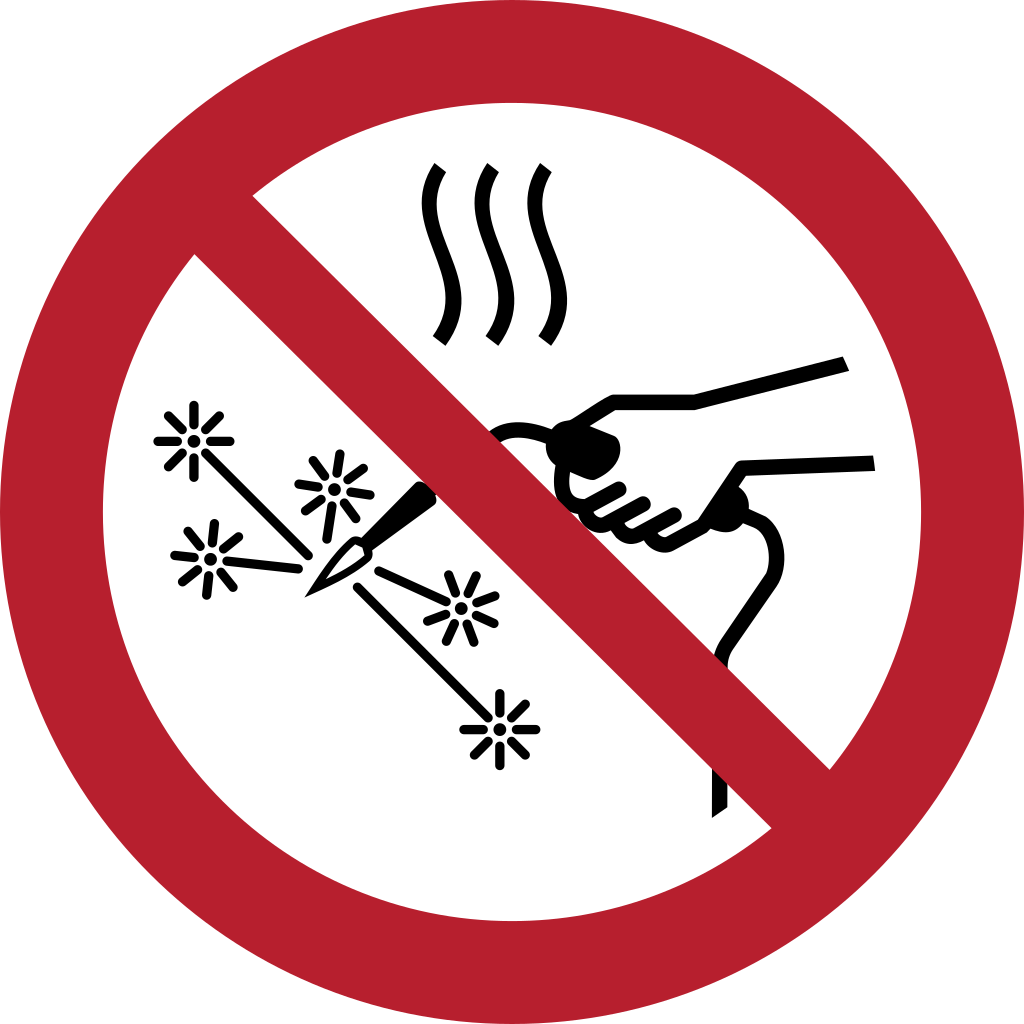
Hot works prohibited
Hot work is prohibited in the marked area.
Understanding this sign
Red circular signs with a diagonal bar identify an action that must not be taken in the marked area.
Check what object or action the symbol prohibits. A prohibition sign does not identify all the hazards in an area.
What ISO 7010 P039 Prohibits
P039 bans hot work: the class of activities that produce flames, sparks, or intense heat as part of the job itself. Welding, flame cutting, brazing, torch soldering, and abrasive grinding are the core cases, and site rules usually extend the term to heat-shrinking, thermal spraying, and hot-tar roofing. The ISO 7010 register gives the referent as Hot works prohibited, with the function of prohibiting hot works, rendered in the standard ISO 3864-1 format of a black pictogram behind a red ring and diagonal bar.
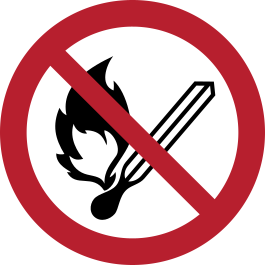
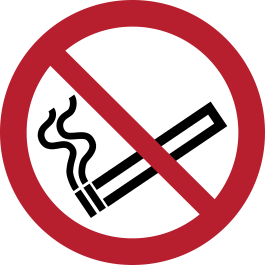
The key distinction is from P003, the sign prohibiting open flames, ignition sources, and smoking. P003 addresses incidental ignition sources anyone might carry into an area — a lighter, a cigarette, a spark-producing tool. P039 addresses a category of planned work, and in most safety management systems that category is not banned absolutely but controlled through a permit: the sign marks where hot work may not proceed without formal authorization, or may not proceed at all.
Hot Work Permits and the Rules Behind the Sign
Mature fire-safety programs treat hot work as a permitted activity. In North America the reference document is NFPA 51B, the standard for fire prevention during welding, cutting, and other hot work, and OSHA's welding rules impose parallel duties; insurers frequently require a documented permit program as a condition of coverage. A typical permit specifies the location and duration, requires combustibles to be cleared or shielded within a defined radius, mandates a fire watch during the work and for a period afterward, and names the person authorizing it.
P039 is the visible edge of that system. Posted at a workshop entrance or process unit boundary, it tells contractors and maintenance crews that grinders and torches stay in their cases until a permit says otherwise. Fire investigation literature consistently identifies unpermitted or poorly controlled hot work — especially by outside contractors unfamiliar with the site — as a leading cause of serious industrial and construction fires, which is why the sign is aimed as much at visiting trades as at employees.
Where Facilities Post P039
Permanent postings guard places where hot work is never acceptable without exceptional controls: flammable liquid and gas storage, battery rooms, paint and solvent areas, dust-handling plant such as grain elevators and woodworking shops, and zones classified for explosive atmospheres. Refineries, chemical plants, and tank farms post it at unit boundaries so the permit requirement is unmissable at the point where a contractor's route enters the hazard.
Temporary use is just as legitimate. During turnarounds, roofing projects, or construction phases when flammable materials are exposed, a facility can post P039 to suspend hot work in an area that normally allows it, then remove the sign when conditions change. That flexibility mirrors the permit system itself, which evaluates conditions job by job rather than assuming a location is permanently safe or permanently forbidden.
Specifying P039 Against Related Signs
Choose P039 when the thing being controlled is work — torches, arcs, grinding sparks — and a permit process or outright activity ban is the control. Choose P003 when the concern is any ignition source, including smoking and open flames brought casually into the area; many high-hazard locations post both, because a hot work permit boundary does not by itself tell visitors to put out a cigarette. P002 handles smoking alone.
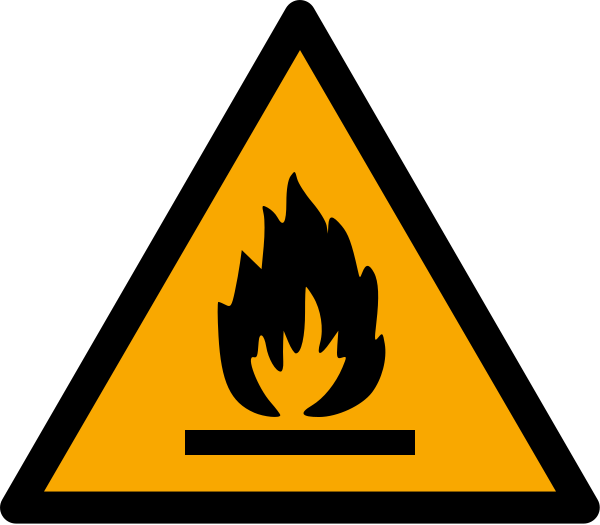
Complementary signage completes the picture: W021 warns of flammable material where the hazard itself should be flagged, and mandatory signs for eye and face protection belong where hot work is performed under permit. Supplementary text such as HOT WORK BY PERMIT ONLY beneath the pictogram is common and useful, converting a bare prohibition into an instruction that points contractors to the authorization process.
Where you will see P039
Permanent postings guard flammable liquid and gas storage, battery rooms, paint and solvent areas, grain elevators and woodworking shops handling combustible dust, and zones classified for explosive atmospheres, with refineries, chemical plants, and tank farms placing it at unit boundaries where contractors' routes enter the hazard. Facilities also deploy it temporarily during turnarounds, roofing projects, and construction phases, often with supplementary text such as HOT WORK BY PERMIT ONLY pointing trades to the authorization process.
Common questions about P039
What counts as hot work?
Any work that produces flame, sparks, or enough heat to ignite nearby material: welding, flame and plasma cutting, brazing, torch soldering, and abrasive grinding are the standard list, with many sites adding heat guns, thermal spraying, and hot roofing work. If the task can start a fire by its nature rather than by accident, treat it as hot work and check whether a permit is required.
What is the difference between P039 and P003?
P039 prohibits hot work — a class of planned activities like welding and grinding, typically controlled through a permit system. P003 prohibits ignition sources generally, including open flames and smoking that anyone might bring into an area. A site can need both: P039 to route contractors into the permit process, P003 to stop casual ignition sources that no permit would ever cover.
Does a hot works prohibited sign mean welding is never allowed there?
Usually it means not without authorization. Most facilities operate a hot work permit program — NFPA 51B is the widely used North American reference — under which the sign marks areas where torches and grinders may not be used until a permit specifies precautions such as clearing combustibles, providing a fire watch, and setting time limits. Some locations, like flammable storage, are effectively permanent bans because a permit would rarely be justifiable.
Why do insurers care about hot work signage and permits?
Because uncontrolled hot work is one of the most common causes of major industrial and construction fires, particularly when outside contractors work on unfamiliar sites. Property insurers therefore often require a documented permit system, fire watch procedures, and posted control areas as policy conditions, and P039 signage is the visible evidence that the program reaches the shop floor.
Reference details
| Symbol code | P039 |
|---|---|
| Sign family | ISO Prohibition Signs |
| Standard reference | ISO 7010:2019 / ISO 3864-1 ISO Online Browsing Platform: P039 |
| Screen color reference | #FF0000. Screen colors are not a production color specification. |
| Download formats | SVG reference artwork; a 1024 × 1024 pixel PNG conversion on a white canvas. |
| Record date | · How to interpret our dates |
| Page updated |
Choosing a physical sign size
Download dimensions are not installation dimensions. Select sign size, material, placement, and lighting using the applicable standard and the actual viewing conditions. Chemical label sizing follows its own rules. Read the artwork and sizing guide.
Sources and artwork credits
- Artwork source
- Wikimedia Commons file page
- Creator credited by source
- ISO
- License
- Public domain
- Source metadata checked
SVG files are local reference copies. PNG files are raster conversions. Check the linked file history and license terms before reuse; a source-metadata check is not certification of the artwork or a workplace installation.
Report a correction to this reference