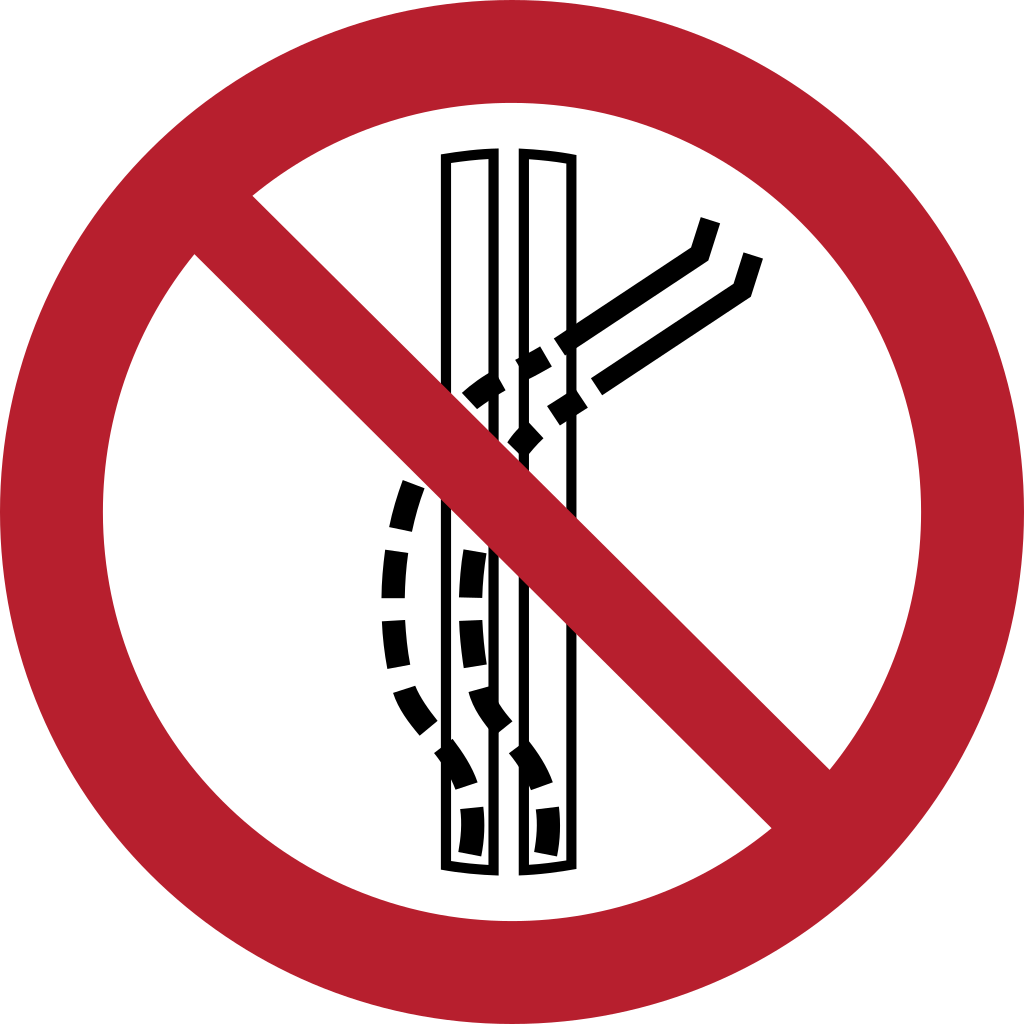
Do not leave the tow-track
Leaving the tow-track is prohibited.
Understanding this sign
Red circular signs with a diagonal bar identify an action that must not be taken in the marked area.
Check what object or action the symbol prohibits. A prohibition sign does not identify all the hazards in an area.
What ISO 7010 P037 Means
P037 tells passengers on a surface lift — a T-bar, platter (button) lift, or rope tow — to stay inside the prepared uphill track for the entire ride. Its official ISO 7010 referent is Do not leave the tow-track, and the register describes its function simply as prohibiting leaving the tow-track. Like every prohibition sign in the standard, it presents a black pictogram inside a red ring crossed by a diagonal bar on a white background, following the design rules of ISO 3864-1.
The sign belongs to the group of winter-sport signs added to ISO 7010 through its recreation-oriented amendments, which gave ski areas internationally understood pictograms in place of the text boards and national symbols each country had used before. On a surface lift, the passenger is not seated: skis or a snowboard stay on the snow while the lift pulls the rider uphill, so rider behavior directly affects everyone else on the line.
Why Tow-Track Discipline Matters
A surface lift track is groomed and aligned so the towing force stays roughly in line with the cable overhead. A rider who slaloms out of the track, cuts across to an adjacent trail, or lets the T-bar drag them sideways pulls the hanger off its intended path. That can swing the attachment hard enough to disturb the haul rope on its sheaves, strike other riders, or force the operator into an emergency stop that strands the whole line.
Leaving the track is also how riders end up in terrain the lift corridor was never meant to cross — snowmaking equipment, tower foundations, ditches, or unpatrolled snow beside the line. Falls inside the corridor create a second hazard, because following riders arrive at towing speed with limited room to steer. Operators therefore treat track discipline as a condition of carriage, and repeated violations are grounds for pulling a lift pass.
Where Lift Operators Post P037
The natural first location is the loading area, alongside the other boarding instructions, so riders see the rule before the platter or T-bar reaches them. On longer drag lifts, operators repeat the sign at towers along the ascent, particularly where the corridor passes close to a crossing trail or where riders are historically tempted to bail out early instead of riding to the top station.
P037 rarely stands alone. It is typically grouped with P038 (do not swing the chair) at resorts that run both lift types, with mandatory signs about keeping ski tips up, and with instructions on how to release the tow at the unload point. Marking a mid-station or emergency exit gate explicitly reinforces the message: riders may leave the track only where the operator has built a safe place to do so.
Relation to Other Slope Rules
Behavior on the mountain more broadly is governed by the FIS Rules for Conduct, the internationally recognized code of behavior for skiers and snowboarders on pistes. The FIS rules cover downhill traffic — speed, choice of route, overtaking — while P037 addresses the one uphill situation where a rider is attached to machinery and cannot simply be trusted to self-regulate.
If a rider does fall out of a drag lift track, the standard instruction is to clear the corridor immediately and descend beside it, not within it. Signage cannot cover every recovery scenario, which is why resorts back the pictogram with loading-area briefings, attendants at the bottom station, and stop buttons along the line. The sign sets the rule; the operation enforces it.
Where you will see P037
Ski areas post it at surface-lift loading areas alongside the other boarding instructions, then repeat it at towers along longer drag lifts where the corridor passes a crossing trail or riders are historically tempted to bail out early. It is typically grouped with P038 at resorts running both lift types, with keep-tips-up mandatory signs, and with marked mid-station exit gates showing where leaving the track is actually safe.
Common questions about P037
What is the tow-track on a ski lift?
It is the groomed corridor of snow directly under a surface lift — a T-bar, platter (button) lift, or rope tow — that riders slide along while the lift pulls them uphill. Unlike a chairlift, a surface lift keeps your skis or board on the snow, so the operator prepares and maintains a dedicated track that keeps riders aligned with the haul cable and clear of towers and other terrain.
Why can't you ski out of a T-bar track before the top?
Bailing out mid-ride releases the T-bar or platter under tension, which can whip the hanger into the cable line or into riders behind you, and it often forces an emergency stop of the whole lift. It also puts you in the lift corridor, where following riders arrive at towing speed. If you fall, get out of the track immediately and descend alongside it; otherwise ride to the marked unload point.
Where should a Do not leave the tow-track sign be installed?
At the surface lift loading station where every rider sees it before grabbing the tow, and repeated along the ascent at points where riders tend to exit early or where the corridor crosses other traffic. Pair it with unloading instructions at the top and with clear marking of any mid-station where exiting is actually permitted.
Is P037 part of the official ISO 7010 standard?
Yes. P037, Do not leave the tow-track, is a registered prohibition sign in ISO 7010, added among the winter-sport and recreation signs the standard gained through its amendments. It uses the standard ISO 3864-1 prohibition format, so it is recognizable internationally without translated text.
Reference details
| Symbol code | P037 |
|---|---|
| Sign family | ISO Prohibition Signs |
| Standard reference | ISO 7010:2019 / ISO 3864-1 ISO Online Browsing Platform: P037 |
| Screen color reference | #FF0000. Screen colors are not a production color specification. |
| Download formats | SVG reference artwork; a 1024 × 1024 pixel PNG conversion on a white canvas. |
| Record date | · How to interpret our dates |
| Page updated |
Choosing a physical sign size
Download dimensions are not installation dimensions. Select sign size, material, placement, and lighting using the applicable standard and the actual viewing conditions. Chemical label sizing follows its own rules. Read the artwork and sizing guide.
Sources and artwork credits
- Artwork source
- Wikimedia Commons file page
- Creator credited by source
- ISO
- License
- Public domain
- Source metadata checked
SVG files are local reference copies. PNG files are raster conversions. Check the linked file history and license terms before reuse; a source-metadata check is not certification of the artwork or a workplace installation.
Report a correction to this reference