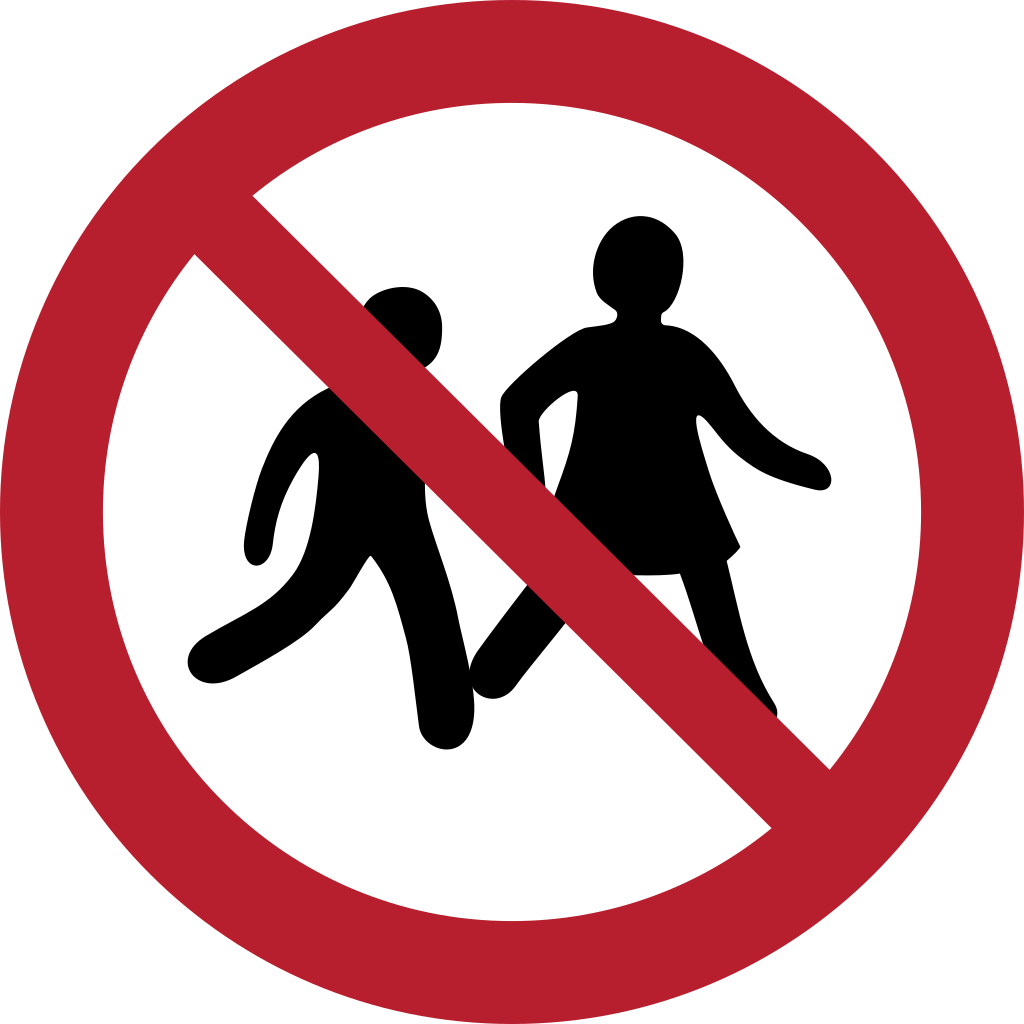
No children allowed
Children are not allowed in the marked area or activity. The pictogram itself does not give an age threshold.
Understanding this sign
Red circular signs with a diagonal bar identify an action that must not be taken in the marked area.
Check what object or action the symbol prohibits. A prohibition sign does not identify all the hazards in an area.
What ISO 7010 P036 Prohibits
P036 keeps children out of an area that is dangerous for them, using a red prohibition circle over a child pictogram. The ISO register defines its function as prohibiting children from entering a dangerous area — a restriction aimed at a group defined by age and capability rather than by behavior, which makes it unusual among prohibition signs.
The sign carries no age threshold. What counts as a child is set by the operator, by local rules, or by the equipment manufacturer, so P036 almost always needs a supplementary text panel when a specific cutoff matters — an age limit at a machine demonstration, a height limit at a ride, or a rule that minors must be accompanied by an adult.
Common Settings for the Sign
Farms and agricultural yards are a leading use case, because working farms double as family homes and machinery, slurry stores, grain bins, and livestock create hazards children approach without recognizing. Other regular locations include construction site hoardings, workshops and garages that customers walk through, loading docks behind shops, waste and recycling depots, electrical enclosures in public spaces, and self-storage or plant-hire yards.
In leisure settings, P036 appears at attractions and equipment unsuitable for young visitors: certain rides, high-power go-kart classes, gym floors and free-weight areas, saunas, and deep pools. Here it typically sits beside minimum-age or minimum-height text so ride operators have an objective criterion to enforce at the gate rather than a judgment call, and so parents can screen their own group before joining the queue.
Why Signs Alone Cannot Protect Children
Safety signage assumes the viewer can read a symbol, understand a hazard, and regulate their behavior — assumptions that fail for exactly the population P036 addresses. Young children may not comprehend the pictogram at all, and legal systems in many countries reflect this: the idea behind the attractive-nuisance doctrine in US law is that occupiers must anticipate that hazards which lure children require physical safeguards, not merely notices.
P036 is therefore best understood as a message to adults — parents, teachers, and supervisors — telling them where their duty of supervision begins, and as documentation that the operator identified the risk. The controls that actually stop a child are fencing, locked gates, covered pits, and machine guarding; the sign marks the line those measures defend.
Where you will see P036
Working farms are a leading setting, since machinery, slurry stores, grain bins, and livestock share ground with family homes, and the sign also appears on construction hoardings, customer-accessible workshops and garages, loading docks behind shops, and waste depots. Leisure operators post it with minimum-age or height text at rides, high-power go-kart classes, free-weight gym floors, saunas, and deep pools, understanding that fencing and locked gates, not the pictogram, actually stop a child.
Common questions about P036
What age does a no-children sign apply to?
The ISO 7010 pictogram defines no age. Operators set the threshold themselves and should state it on a supplementary panel — for example, no entry under 16, or under-14s only with an adult. Where a manufacturer's instructions or local regulations specify a minimum age for equipment or an attraction, that figure is the one to post.
Does posting P036 protect a business from liability if a child is injured?
Not by itself. Courts in many jurisdictions expect occupiers to anticipate that children do not obey signs, particularly where something on the premises attracts them, so physical barriers, supervision, and guarding remain the decisive controls. The sign helps demonstrate the hazard was identified and communicated, which supports a defense but rarely completes one.
Where should no-children signs be posted on a farm?
At the boundaries between the domestic and working parts of the holding: workshop and machinery shed doors, slurry store and lagoon fencing, grain bin and silo access points, chemical stores, and livestock handling areas. Because farm children live on site, signage should be backed by locked doors and fenced exclusion zones — the sign directs visiting families and reminds the household where the line is.
Is P036 the right sign for age limits on amusement rides?
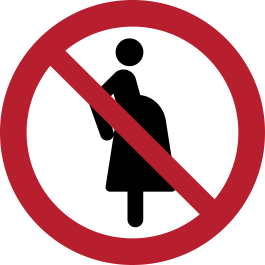
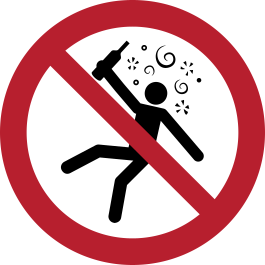
It works as the visual anchor, but rides usually restrict by height rather than age because height is checkable at the gate. The common arrangement is the P036 symbol or a ride-specific restriction board plus explicit text and a measuring bar, often alongside P042 (not for pregnant women) and P043 (not while intoxicated) on the same entrance panel.
Reference details
| Symbol code | P036 |
|---|---|
| Sign family | ISO Prohibition Signs |
| Standard reference | ISO 7010:2019 / ISO 3864-1 ISO Online Browsing Platform: P036 |
| Screen color reference | #FF0000. Screen colors are not a production color specification. |
| Download formats | SVG reference artwork; a 1024 × 1024 pixel PNG conversion on a white canvas. |
| Record date | · How to interpret our dates |
| Page updated |
Choosing a physical sign size
Download dimensions are not installation dimensions. Select sign size, material, placement, and lighting using the applicable standard and the actual viewing conditions. Chemical label sizing follows its own rules. Read the artwork and sizing guide.
Sources and artwork credits
- Artwork source
- Wikimedia Commons file page
- Creator credited by source
- ISO
- License
- Public domain
- Source metadata checked
SVG files are local reference copies. PNG files are raster conversions. Check the linked file history and license terms before reuse; a source-metadata check is not certification of the artwork or a workplace installation.
Report a correction to this reference