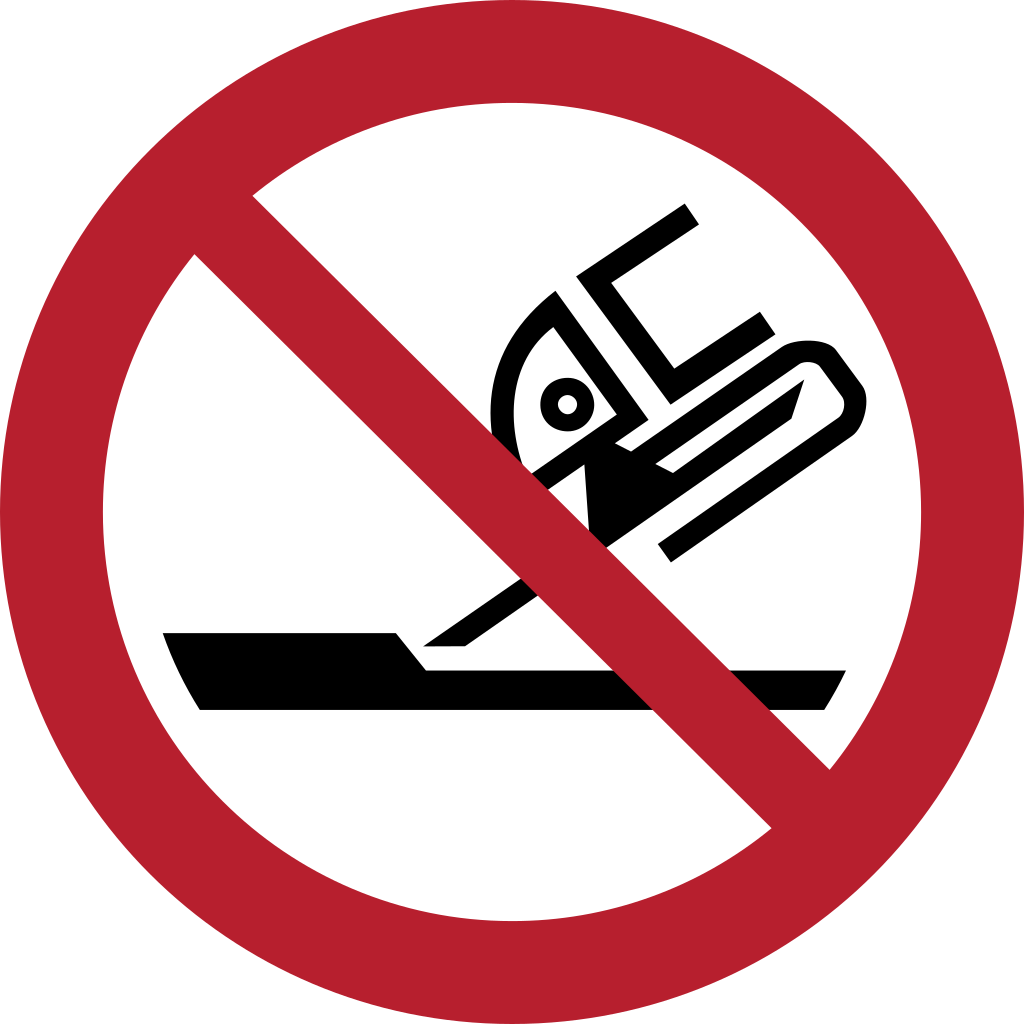
Do not use for face grinding
Use of the marked abrasive product for face grinding is prohibited.

Understanding this sign
Red circular signs with a diagonal bar identify an action that must not be taken in the marked area.
Check what object or action the symbol prohibits. A prohibition sign does not identify all the hazards in an area.
Side Loads on a Wheel Built for Its Edge
ISO 7010 P032 prohibits using the marked grinding disc for face grinding — that is, grinding with the flat side of the wheel instead of its periphery. Flat wheels and thin cut-off discs are engineered to take load on the rim, in the plane of rotation, where the bonded abrasive is deep and the structure is stiff. Pressed against the work sideways, the same disc is loaded in bending across its thinnest dimension, a direction its bond was never designed to resist.
The failure mode is not gradual wear but fracture. Lateral pressure flexes the disc, opens micro-cracks in the bond, and thins the cross-section unevenly; a cracked wheel spinning at operating speed can burst, throwing fragments at high velocity. Wheel-breakage incidents are the reason abrasive-safety codes such as ANSI B7.1 and EN 12413 restrict each wheel type to the grinding orientation it was designed for.
Which Discs Carry P032
The prohibition is type-specific, which is why it appears as a label on the wheel rather than a sign on the wall. Flat Type 1 wheels and thin cutting-off discs are the classic carriers: they cut and grind on the periphery only. Depressed-center wheels (Type 27 and similar), cup wheels, and discs expressly designed for side grinding do not carry it, because their geometry and reinforcement accept face contact at the intended working angle.
In practice the pictogram is printed on the disc label or blotter alongside the maximum operating speed, dimensions, and the other restriction pictograms from the FEPA abrasive-safety marking scheme. Anyone mounting a wheel should read that cluster of symbols before use — the crossed-out side-grinding icon is the manufacturer stating a structural limit of that specific product, not offering a general suggestion about technique.
The Behavior the Sign Targets
Face-grinding a cut-off disc is a habit born of convenience: the operator finishes a cut, then tilts the angle grinder to deburr or smooth the edge with the same disc rather than switching to a grinding wheel. Each such episode weakens the disc, and the burst may come later, during an ordinary cut, which is why operators often fail to connect the failure to the misuse.
Training and tool discipline close the gap the label alone cannot. Abrasive-wheel courses teach the one-disc-one-job rule; sites stock depressed-center grinding wheels next to cutting discs so the correct tool is at hand; and toolbox talks pair P032 with its siblings P033 (no wet grinding) and P034 (not for hand-held machines), the three standard misuse warnings of the bonded-abrasive family.
Where you will see P032
The symbol appears as a manufacturer label printed on flat Type 1 wheels and thin cutting-off discs, alongside the maximum operating speed and the other FEPA restriction pictograms, rather than as a wall sign. Fabrication shops and sites running angle grinders reinforce it through abrasive-wheel training and tool discipline, stocking depressed-center grinding wheels next to cutting discs so operators never tilt a cut-off disc to deburr an edge, and pairing it in toolbox talks with P033 and P034.
Common questions about P032
What does 'do not use for face grinding' mean on a cutting disc?
It means the disc may only cut or grind on its outer edge, never with its flat side pressed against the workpiece. Thin flat discs are structurally weak against sideways bending; side pressure cracks the bond and can make the disc burst at speed. Use a depressed-center or cup grinding wheel for surface and edge grinding instead.
Why do cut-off wheels break when used for side grinding?
A cut-off wheel is a thin bonded-abrasive plate designed for load in its plane of rotation. Side grinding bends it across its thickness, opening cracks in the bond and wearing the cross-section unevenly. The damage is cumulative and often invisible, and a cracked wheel can shatter later under normal use, ejecting fragments at high speed.
Which grinding wheels ARE allowed for face grinding?
Wheels whose geometry is designed for face contact: depressed-center (Type 27-style) grinding wheels used at the recommended working angle, cup wheels, and other products the manufacturer marks for side or face grinding. Check the label — discs restricted to peripheral use carry the crossed-out side-grinding pictogram (ISO 7010 P032).
Where does the P032 symbol usually appear?
Printed on the grinding disc's label or blotter, next to the speed rating and dimensions, as part of the standard set of abrasive restriction pictograms. It also appears in grinder manuals and sometimes at fixed grinding stations, but its primary home is on the product itself because the restriction depends on the individual wheel type.
Reference details
| Symbol code | P032 |
|---|---|
| Sign family | ISO Prohibition Signs |
| Standard reference | ISO 7010:2019 / ISO 3864-1 ISO Online Browsing Platform: P032 |
| Screen color reference | #FF0000. Screen colors are not a production color specification. |
| Download formats | SVG reference artwork; a 1024 × 1024 pixel PNG conversion on a white canvas. |
| Record date | · How to interpret our dates |
| Page updated |
Choosing a physical sign size
Download dimensions are not installation dimensions. Select sign size, material, placement, and lighting using the applicable standard and the actual viewing conditions. Chemical label sizing follows its own rules. Read the artwork and sizing guide.
Sources and artwork credits
- Artwork source
- Wikimedia Commons file page
- Creator credited by source
- Original: Unknown Vector: MaxxL
- License
- Public domain
- Source metadata checked
SVG files are local reference copies. PNG files are raster conversions. Check the linked file history and license terms before reuse; a source-metadata check is not certification of the artwork or a workplace installation.
Report a correction to this reference