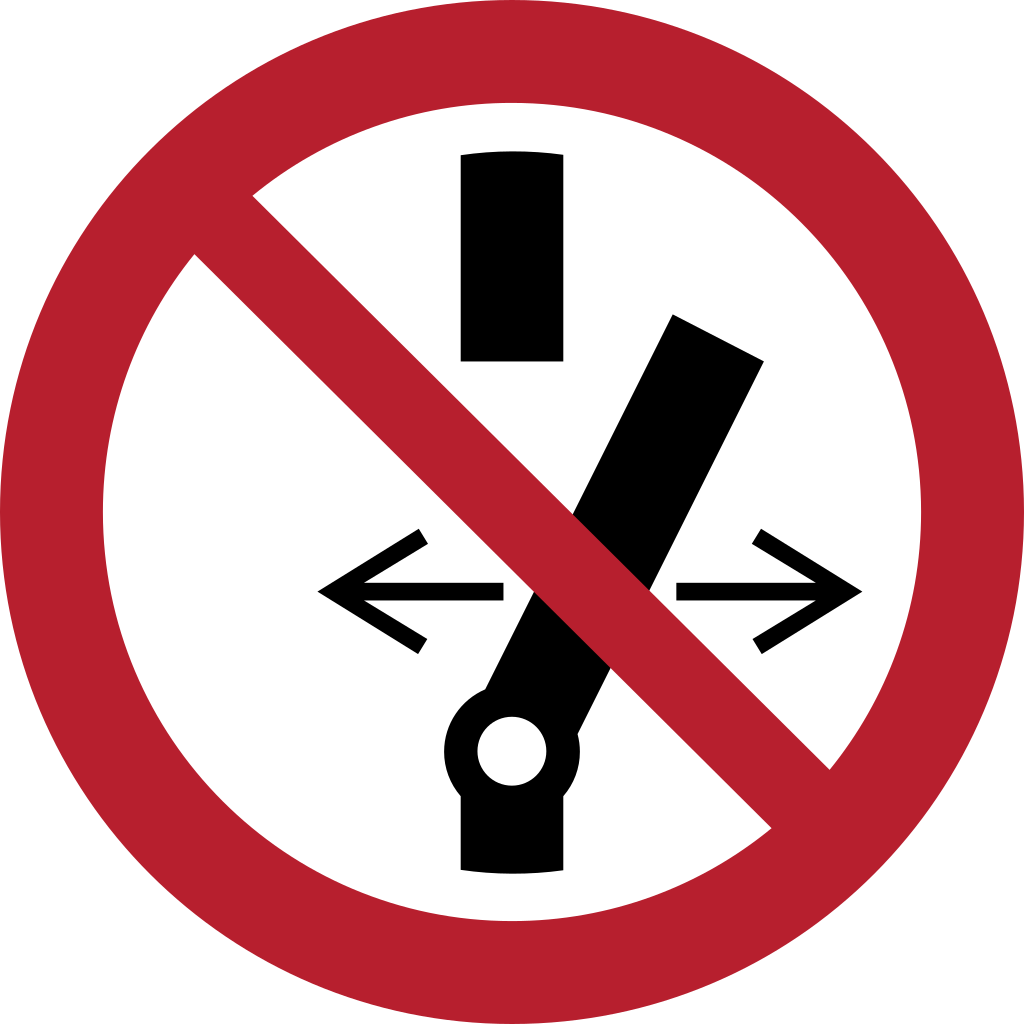
Do not alter the state of the switch
Changing the state of the marked switch is prohibited.

Understanding this sign
Red circular signs with a diagonal bar identify an action that must not be taken in the marked area.
Check what object or action the symbol prohibits. A prohibition sign does not identify all the hazards in an area.
What 'Do Not Alter the State of the Switch' Means
ISO 7010 P031 depicts a switch inside the prohibition circle, and its registered function is broad: to prohibit any change to the current energetic or mechanical state of a machine or piece of equipment. In plain terms, leave the switch exactly as you found it — do not turn on what is off, and do not turn off what is on. The sign is deliberately symmetric, because both directions can kill: energizing a machine someone is working inside, or de-energizing a pump, fan, or safety system that must keep running.
You will find P031 on electrical isolators and disconnects during maintenance, breaker panels feeding critical loads, valves and control switches in process plants, ventilation and extraction controls, fire-protection and alarm system switches, and test setups where a specific configuration must be preserved. Laboratories and commissioning teams use it the same way on temporary rigs, where an experiment or acceptance test depends on controls staying put overnight. It is the signage equivalent of 'this position is intentional.'
P031 and Lockout/Tagout
A P031 sign is not a lockout. Formal isolation programs — OSHA's control of hazardous energy rule (29 CFR 1910.147) in the United States, and equivalent lockout/tagout regimes elsewhere — require an energy-isolating device to be physically locked in the safe position with a personal lock and an identifying tag before servicing begins. A sign, unlike a lock, stops no one; it only informs.
The two work together rather than interchangeably. P031 posted permanently at a disconnect tells everyday passers-by that the switch is not theirs to operate, reducing casual interference between formal isolations. During actual maintenance, the padlock and tag take over as the legally required control. Using a P031 sign or a tag alone where a lock is feasible falls short of most lockout regulations, and auditors treat it that way.
Typical Installations and Good Practice
Mount P031 directly at the operating device — the handle, pushbutton, breaker, or valve wheel — because the prohibition is about that specific control, not the room. Where several similar switches sit in a row, the sign must unambiguously indicate which one it governs; a sign floating between two disconnects invites exactly the wrong-switch error it exists to prevent. Supplementary text stating why the state must not change ('supplies ventilation to confined space,' 'equipment under test') measurably improves compliance and is standard practice.
Machine and switchgear manufacturers also apply P031 as a product label on controls that end users must not operate — commissioning switches, parameter locks, bypass keyswitches — with the pictogram repeated in manuals. In safety-related control systems, the sign often marks devices whose position is part of a validated safety function, where an uninformed 'helpful' reset would defeat the protection.
Where you will see P031
Electrical isolators and disconnects during maintenance, breaker panels feeding critical loads, process plant valves, ventilation and fire-protection controls, and commissioning test rigs all carry it mounted directly at the operating device. Manufacturers also apply it as a product label on bypass keyswitches and parameter locks that end users must not operate, complementing rather than replacing formal lockout/tagout.
Common questions about P031
What does the ISO P031 switch prohibition sign actually forbid?
Any change to the current state of the marked switch or control — switching on, switching off, resetting, or repositioning it. The prohibition runs both ways because energizing equipment under maintenance and de-energizing equipment that must keep running (ventilation, pumps, fire systems) are both dangerous.
Is a do-not-switch sign enough for lockout/tagout compliance?
No. Lockout regulations such as OSHA 29 CFR 1910.147 require the energy-isolating device to be physically locked out with a personal lock and tag whenever feasible during servicing. P031 is an informational prohibition sign useful for everyday control of who touches a switch, but it does not replace the lock and tag during actual maintenance work.
Where should P031 be placed when several switches are grouped together?
Immediately at the specific operating device it applies to, positioned so there is no ambiguity about which handle or button is covered. In banks of similar disconnects or breakers, attach the sign to the individual device — a sign placed between switches creates exactly the wrong-switch confusion it should prevent — and add text stating why the state must be preserved.
Why would a manufacturer put P031 on equipment controls?
To mark controls that end users must leave alone: commissioning or service switches, safety-function keyswitches, bypass and parameter-lock devices. Changing them can defeat a validated safety function or put the machine into a state the operator is not trained for, so the pictogram appears on the control itself and in the manual.
Reference details
| Symbol code | P031 |
|---|---|
| Sign family | ISO Prohibition Signs |
| Standard reference | ISO 7010:2019 / ISO 3864-1 ISO Online Browsing Platform: P031 |
| Screen color reference | #FF0000. Screen colors are not a production color specification. |
| Download formats | SVG reference artwork; a 1024 × 1024 pixel PNG conversion on a white canvas. |
| Record date | · How to interpret our dates |
| Page updated |
Choosing a physical sign size
Download dimensions are not installation dimensions. Select sign size, material, placement, and lighting using the applicable standard and the actual viewing conditions. Chemical label sizing follows its own rules. Read the artwork and sizing guide.
Sources and artwork credits
- Artwork source
- Wikimedia Commons file page
- Creator credited by source
- ISO
- License
- Public domain
- Source metadata checked
SVG files are local reference copies. PNG files are raster conversions. Check the linked file history and license terms before reuse; a source-metadata check is not certification of the artwork or a workplace installation.
Report a correction to this reference