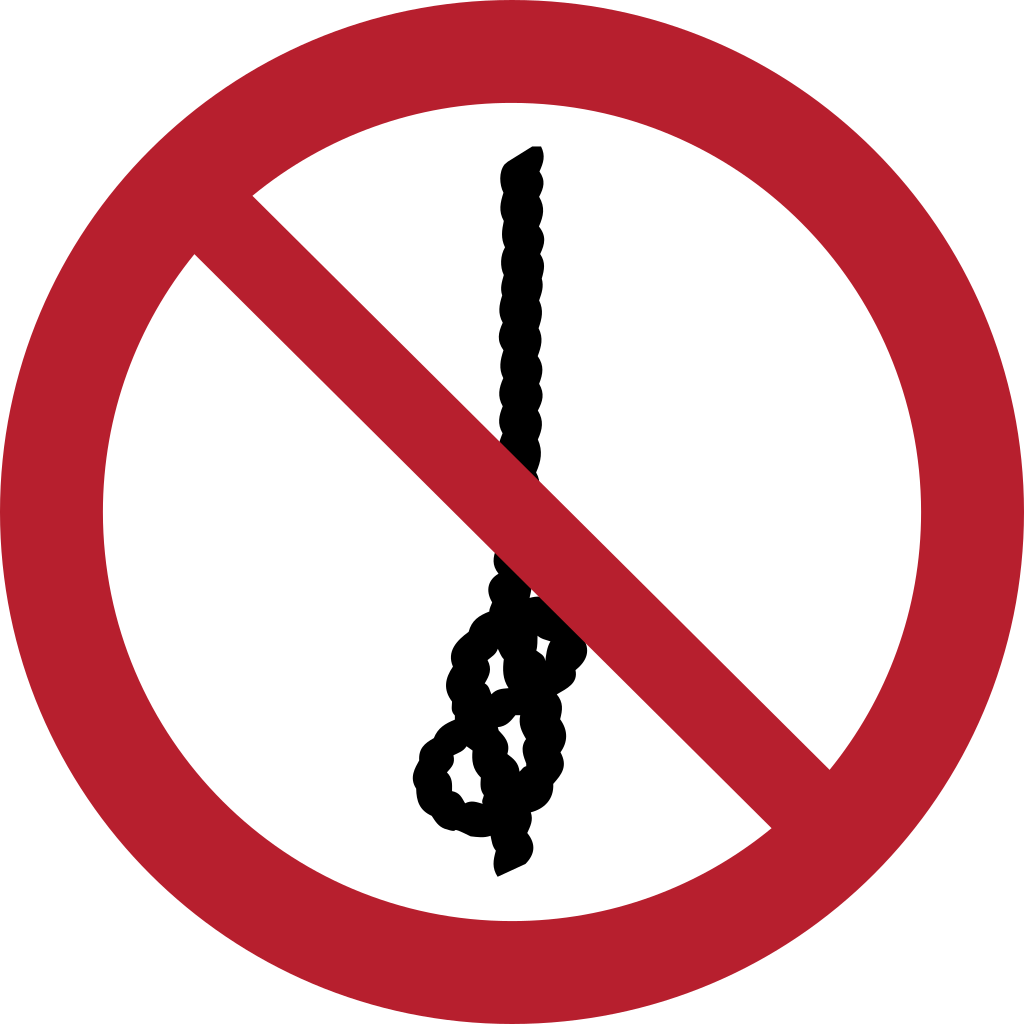
Do not tie knots in rope
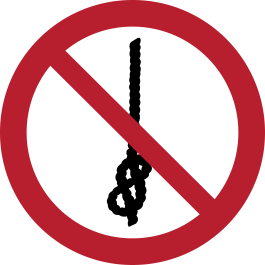
Tying knots in the marked rope is prohibited.
Understanding this sign
Red circular signs with a diagonal bar identify an action that must not be taken in the marked area.
Check what object or action the symbol prohibits. A prohibition sign does not identify all the hazards in an area.
What P030 Prohibits and Why
ISO 7010 P030 shows a knotted rope inside the red prohibition circle. Its registered function is to prohibit tying knots in a climbing rope, and the underlying engineering reason generalizes to most load-bearing rope and cordage: a knot concentrates stress where the rope bends sharply around itself, and the tighter the bend, the more of the fiber's strength is lost. A knotted rope always breaks at a lower load than the same rope without the knot, and it breaks at the knot.
How much strength is lost depends on the knot and the rope construction, but the reduction is substantial — commonly on the order of a quarter to a half of the rated breaking strength for typical knots, which is why rope manufacturers publish knot efficiency as a percentage of straight-line strength. In life-safety and lifting applications, that margin is precisely what the safety factor was supposed to protect.
Where This Sign and Label Appear
P030 shows up in climbing gyms and on climbing walls, adventure and high-ropes courses, and playground or amusement equipment that incorporates fixed ropes — settings where the rope was installed, tensioned, and terminated by the operator, and where a visitor adding a knot (as a hand-hold, a shortening, or a makeshift repair) would silently compromise it. It also appears in rope-access, arboriculture, and rescue contexts on equipment whose certification assumes manufactured terminations.
The same prohibition exists in lifting and rigging practice independently of the pictogram: slinging standards and rigger training uniformly forbid shortening or joining slings and lifting ropes with knots, because a knotted sling's working load limit can no longer be relied on. Where fiber-rope slings or winch lines are in use, P030 near the rigging store or on the equipment tag reinforces a rule inspectors already expect to see followed.
The Correct Alternatives to a Knot
The point of P030 is not that ropes may never be terminated or adjusted — it is that improvised knots are the wrong mechanism on equipment engineered without them. Proper alternatives preserve rated strength: sewn or spliced terminations, thimbles and shackles, rated rope grabs and adjusters, and shortening devices designed for the sling or rope in question. If a rope is too long, too short, or damaged, it should be replaced or professionally re-terminated, not knotted.
There is an important scope boundary here. In recreational climbing, tying in with a figure-eight knot is normal, trained practice on the climber's own dynamic rope; P030 on a facility's fixed ropes is not contradicting that technique. The sign governs the installed equipment it is attached to — top ropes, auto-belay lines, net and course ropes — where any user-added knot alters a system someone else certified.
Where you will see P030
Climbing gyms, high-ropes and adventure courses, and playground or amusement equipment with fixed ropes display it so visitors do not silently compromise top ropes, auto-belay lines, and net ropes with improvised hand-holds or repairs. It also appears in rope-access, arboriculture, and rescue contexts, and near rigging stores where fiber-rope slings and winch lines must never be shortened or joined with knots.
Common questions about P030
How much strength does a knot take out of a rope?
It varies by knot type and rope construction, but the loss is significant — for common knots, roughly a quarter to a half of the rope's straight-line breaking strength. Manufacturers express this as knot efficiency. The rope will fail at the knot, at a load well below its rating, which is why load-bearing systems use spliced or sewn terminations instead.
Where is the ISO P030 no-knots sign used?
Mainly at climbing walls, gyms, high-ropes and adventure courses, and on play or amusement equipment with fixed ropes, plus rope-access and rigging environments. It marks ropes that were installed and terminated by the operator, warning users not to add knots as grips, shorteners, or repairs.
Does P030 mean climbers can't tie into a rope?
No. Tying in with a figure-eight on the climber's own dynamic rope is standard, trained technique. P030 applies to the fixed equipment it is posted on — installed top ropes, auto-belay lines, course and net ropes — where an added knot would change a system that was certified without one.
Is it ever acceptable to shorten a lifting sling with a knot?
No. Rigging standards and sling manufacturers prohibit knotting slings or lifting ropes, because a knot invalidates the working load limit and creates a weak point that can fail under a normal load. Use a rated shortening device, a correctly sized sling, or have the rope professionally re-terminated.
Reference details
| Symbol code | P030 |
|---|---|
| Sign family | ISO Prohibition Signs |
| Standard reference | ISO 7010:2019 / ISO 3864-1 ISO Online Browsing Platform: P030 |
| Screen color reference | #FF0000. Screen colors are not a production color specification. |
| Download formats | SVG reference artwork; a 1024 × 1024 pixel PNG conversion on a white canvas. |
| Record date | · How to interpret our dates |
| Page updated |
Choosing a physical sign size
Download dimensions are not installation dimensions. Select sign size, material, placement, and lighting using the applicable standard and the actual viewing conditions. Chemical label sizing follows its own rules. Read the artwork and sizing guide.
Sources and artwork credits
- Artwork source
- Wikimedia Commons file page
- Creator credited by source
- ISO
- License
- CC0
- Source metadata checked
SVG files are local reference copies. PNG files are raster conversions. Check the linked file history and license terms before reuse; a source-metadata check is not certification of the artwork or a workplace installation.
Report a correction to this reference