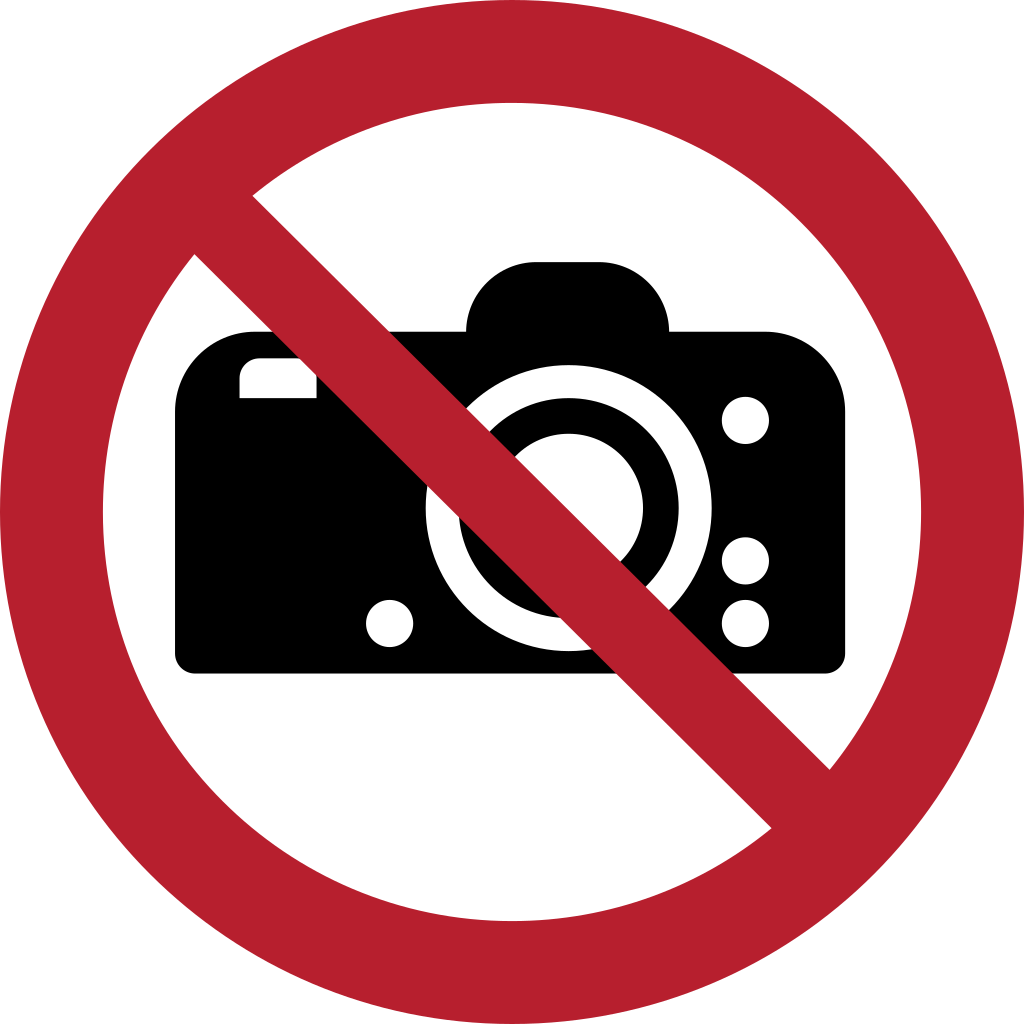
No photography
Photography is prohibited.
Understanding this sign
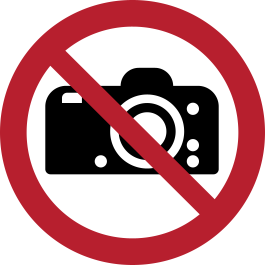
Red circular signs with a diagonal bar identify an action that must not be taken in the marked area.
Check what object or action the symbol prohibits. A prohibition sign does not identify all the hazards in an area.
What the Camera Pictogram Forbids
P029's registered function is to prohibit the taking of photographs in the area where it is displayed. The crossed-out camera applies to the act of capturing images, regardless of the device — a dedicated camera, a phone, a tablet, or a body-worn unit. It does not, on its own, forbid carrying imaging equipment, and it was drafted around still photography, so organizations that also intend to ban video recording, live streaming, or audio capture should spell that out in supplementary text.
It is worth being clear about what breaching the sign means legally. On private premises, P029 expresses a condition of entry: photographing despite it is a violation of site rules that can justify removal, confiscation-by-policy of media under an agreed visitor policy, or contract consequences, but it is not automatically a criminal act. Specific laws do criminalize photography of certain defense installations and of people in situations with an expectation of privacy, and those regimes operate independently of any sign.
Security, Trade Secrets, and Privacy Drivers
Industrial photography bans usually protect information rather than people. Manufacturers post P029 around prototype lines, tooling, formulations, and process layouts because a single image can undo trade-secret protection or leak a competitive advantage; defense and aerospace suppliers add export-control obligations, since photographs of controlled technical hardware can constitute a regulated technical-data release. Data centers and utilities restrict imagery of physical security arrangements for the same reason.
The privacy-driven cases look different on the ground. Hospitals limit photography to protect patients, schools and childcare settings to protect minors, and changing rooms, pools, and gyms to protect anyone in a state of undress. In these settings the ban shields individuals rather than the operator, enforcement tends to be immediate and absolute, and the sign is often backed by statutes on voyeurism or patient confidentiality rather than by site policy alone.
Not a Substitute for Data-Protection Notices
A common conflation deserves correction: P029 restricts what visitors photograph; it says nothing about the cameras the operator points at visitors. CCTV surveillance in the EU and UK triggers its own transparency duties under data-protection law — an information notice identifying the controller, the purpose, and where to learn more — and a no-photography symbol satisfies none of that. A monitored facility that bans visitor photography therefore needs two separate postings doing two separate jobs.
The reverse is also true. A GDPR-style CCTV notice grants the operator no power over visitors' cameras, and photographing people can create data-protection and publicity-rights questions for the photographer that the venue's signage neither creates nor resolves. Treat P029 as an access-condition and confidentiality tool, and route obligations about your own surveillance, employee imagery, and visitor consent through your privacy program.
Deploying the Ban So It Actually Sticks
Because nearly everyone carries a camera, placement at the point of entry matters more for P029 than for most prohibitions. Post it at reception, security checkpoints, and visitor sign-in, where the rule can be acknowledged before badges are issued, and repeat it at the doors of the specific protected areas so escorted guests are reminded at the threshold. Inside large plants, marking the restricted zones beats blanketing the whole site — a rule that visibly matches real sensitivity earns more compliance.
The sign works best as the visible edge of a written policy. Effective programs pair P029 with visitor NDAs, camera-disable stickers over phone lenses in high-sensitivity zones, an exception process for authorized photography such as insurance documentation or marketing shoots, and clear instructions to staff on what to do when they see a raised camera. Without those mechanics, the posting decays into decoration within months.
Where you will see P029
Manufacturers ring prototype lines, tooling, and process layouts with it, defense and aerospace suppliers add it for export-controlled hardware, and data centers and utilities restrict images of physical security arrangements. Privacy-driven placements cover hospitals, schools, changing rooms, pools, and gyms, while reception desks, security checkpoints, and visitor sign-in points carry it so the rule is acknowledged before badges are issued.
Common questions about P029
Is it against the law to take pictures where a no photography sign is posted?
Usually the sign itself creates a rule of entry, not a criminal offense: ignoring it on private premises can get you removed or expose you to civil consequences, but prosecution depends on separate laws. Photography of certain military and critical-infrastructure sites, and of people with a reasonable expectation of privacy, is independently illegal in many jurisdictions regardless of signage.
Does the P029 sign also prohibit video recording?
The symbol was defined for the taking of photographs, and a determined reader could argue video falls outside it. Most organizations intend both to be banned, so best practice is supplementary text such as NO PHOTOGRAPHY OR VIDEO RECORDING, which removes the ambiguity for phones that do both with the same lens.
Does a no photography sign cover my CCTV notification duties?
No. P029 governs visitors' cameras; CCTV transparency is a data-protection obligation about your cameras, requiring a notice that identifies who operates the surveillance and why. Under the GDPR and UK rules these are entirely separate postings, and a monitored site that bans photography needs both.
Can an employer ban photography inside the workplace?
Generally yes, as a condition of employment and site access, and it is standard where trade secrets, export-controlled hardware, or patient and customer privacy are present. In the US, blanket rules should be drafted with care because labor law protects some employee photography connected to working-conditions activity; a policy targeted at confidential areas is safer than an absolute ban.
Reference details
| Symbol code | P029 |
|---|---|
| Sign family | ISO Prohibition Signs |
| Standard reference | ISO 7010:2019 / ISO 3864-1 ISO Online Browsing Platform: P029 |
| Screen color reference | #FF0000. Screen colors are not a production color specification. |
| Download formats | SVG reference artwork; a 1024 × 1024 pixel PNG conversion on a white canvas. |
| Record date | · How to interpret our dates |
| Page updated |
Choosing a physical sign size
Download dimensions are not installation dimensions. Select sign size, material, placement, and lighting using the applicable standard and the actual viewing conditions. Chemical label sizing follows its own rules. Read the artwork and sizing guide.
Sources and artwork credits
- Artwork source
- Wikimedia Commons file page
- Creator credited by source
- ISO
- License
- CC0
- Source metadata checked
SVG files are local reference copies. PNG files are raster conversions. Check the linked file history and license terms before reuse; a source-metadata check is not certification of the artwork or a workplace installation.
Report a correction to this reference