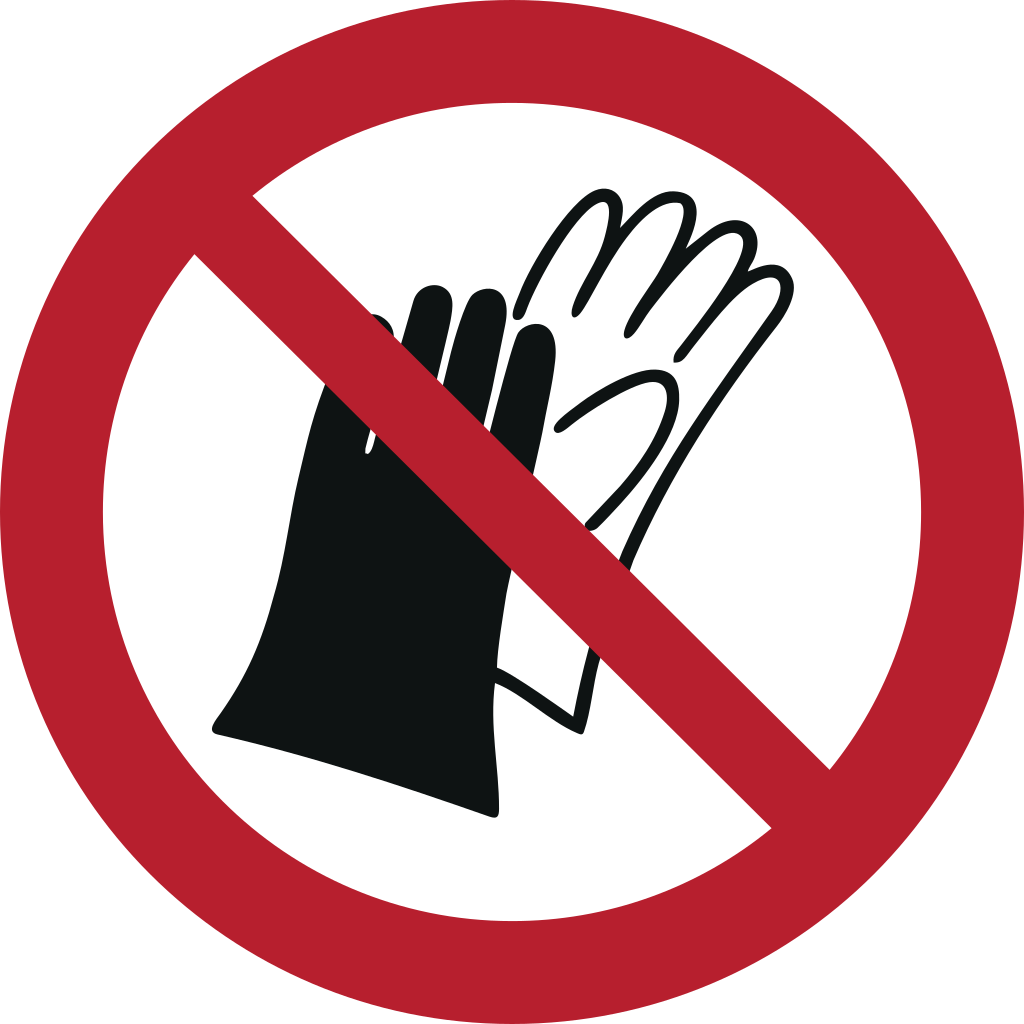
Do not wear gloves
Wearing gloves is prohibited for the indicated task or location.
Understanding this sign
Red circular signs with a diagonal bar identify an action that must not be taken in the marked area.
Check what object or action the symbol prohibits. A prohibition sign does not identify all the hazards in an area.
A Counterintuitive Prohibition
ISO 7010 P028 orders workers to take their gloves off. That runs against years of PPE conditioning, which is exactly why the sign exists: at machines with a drawing-in hazard — pedestal and bench drills, lathes, milling machines, rotating spindles, shafts, and feed rollers — a glove makes an accident worse, not better. If a rotating tool snags fabric or leather, it does not tear free the way skin sometimes can; it winds the glove in and pulls the hand and arm after it.
Bare skin contacting a spinning drill bit usually produces a cut. A glove caught by the same bit can produce a degloving injury, crushed fingers, or a fractured wrist in a fraction of a second, faster than anyone can react or reach a stop button. The ISO register description for P028 is explicit that the sign applies to operating machines with a drawing-in hazard, and machine-shop safety guidance from regulators consistently prohibits gloves at rotating drills and lathes for this reason.
P028 Against M009: When Each Applies
M009, the blue mandatory sign 'Wear protective gloves,' and P028 are direct opposites, and a single workshop legitimately needs both. Gloves defend against cuts, chemicals, heat, and abrasion during handling tasks — moving stock, deburring finished parts, changing coolant. The moment the same worker steps to a machine with exposed rotating parts, the risk calculus flips and P028 governs.
The practical answer is task-specific rules rather than a blanket glove policy. Post P028 at the drill press and lathe; post M009 at the materials bench and chemical station; and train operators on why the requirement changes between stations. Loose sleeves, lanyards, jewelry, and long unrestrained hair carry the same entanglement risk as gloves, so sites often reinforce P028 with those adjacent rules in supplementary text.
Where and How to Post It
Fix P028 on or immediately beside each machine where the prohibition applies, at the operator position — not as a general wall sign, because the message is machine-specific and a blanket posting would wrongly forbid gloves at tasks that need them. Machine manufacturers include the pictogram on the equipment and in manuals prepared under machinery-safety documentation practice, and ANSI Z535.4-style product labels in North America pair the symbol with a signal word and text such as 'Entanglement hazard. Do not operate this machine wearing gloves.'
Because the sign contradicts default PPE habits, signage alone changes behavior poorly here. Effective programs treat P028 as the visible anchor of a trained rule: induction covers the entanglement mechanism, supervisors enforce glove removal at rotating machinery, and risk assessments document which machines carry the prohibition, so the boundary between glove-required and glove-forbidden tasks stays unambiguous for every operator and visitor on the floor.
Where you will see P028
Pedestal and bench drills, lathes, milling machines, rotating spindles and shafts, and feed rollers are where the prohibition applies, with the sign fixed on or immediately beside each machine at the operator position rather than as a general wall posting. Workshops commonly pair it with M009 glove mandates at nearby materials benches and chemical stations, using task-specific rules and supplementary text covering loose sleeves, jewelry, and unrestrained hair.
Common questions about P028
Why would a safety sign tell you NOT to wear gloves?
Because at machines with rotating parts — drill presses, lathes, milling spindles, feed rollers — a glove that touches the rotating element gets caught and wound in, dragging the hand with it. The resulting entanglement injuries are far more severe than the cuts bare hands might suffer, so the drawing-in risk outweighs the protection gloves normally provide.
Which machines does the P028 no-gloves sign apply to?
Machines with a drawing-in or entanglement hazard at the operator position: bench and pedestal drills, lathes, milling machines, rotating shafts and spindles, and roller feeds. It is posted per machine rather than per room, because gloves remain appropriate — often mandatory — for handling tasks elsewhere in the same workshop.
How can P028 and the wear-gloves sign M009 both be right?
They apply to different tasks. M009 mandates gloves where the hazard is cuts, chemicals, heat, or abrasion during handling. P028 forbids them where rotating machinery could snag the glove and pull the hand in. A worker may correctly wear gloves to carry sharp stock to a drill press and be required to remove them before operating it.
Do cut-resistant gloves make it safe to use a lathe or drill?
No. Cut resistance does not prevent entanglement — a cut-resistant glove that snags on a rotating bit or chuck is drawn in just the same, and some tightly woven cut-resistant materials grip and wind on even more readily. Where P028 is posted, the rule applies regardless of glove type.
Reference details
| Symbol code | P028 |
|---|---|
| Sign family | ISO Prohibition Signs |
| Standard reference | ISO 7010:2019 / ISO 3864-1 ISO Online Browsing Platform: P028 |
| Screen color reference | #FF0000. Screen colors are not a production color specification. |
| Download formats | SVG reference artwork; a 1024 × 1024 pixel PNG conversion on a white canvas. |
| Record date | · How to interpret our dates |
| Page updated |
Choosing a physical sign size
Download dimensions are not installation dimensions. Select sign size, material, placement, and lighting using the applicable standard and the actual viewing conditions. Chemical label sizing follows its own rules. Read the artwork and sizing guide.
Sources and artwork credits
- Artwork source
- Wikimedia Commons file page
- Creator credited by source
- ISO
- License
- Public domain
- Source metadata checked
SVG files are local reference copies. PNG files are raster conversions. Check the linked file history and license terms before reuse; a source-metadata check is not certification of the artwork or a workplace installation.
Report a correction to this reference