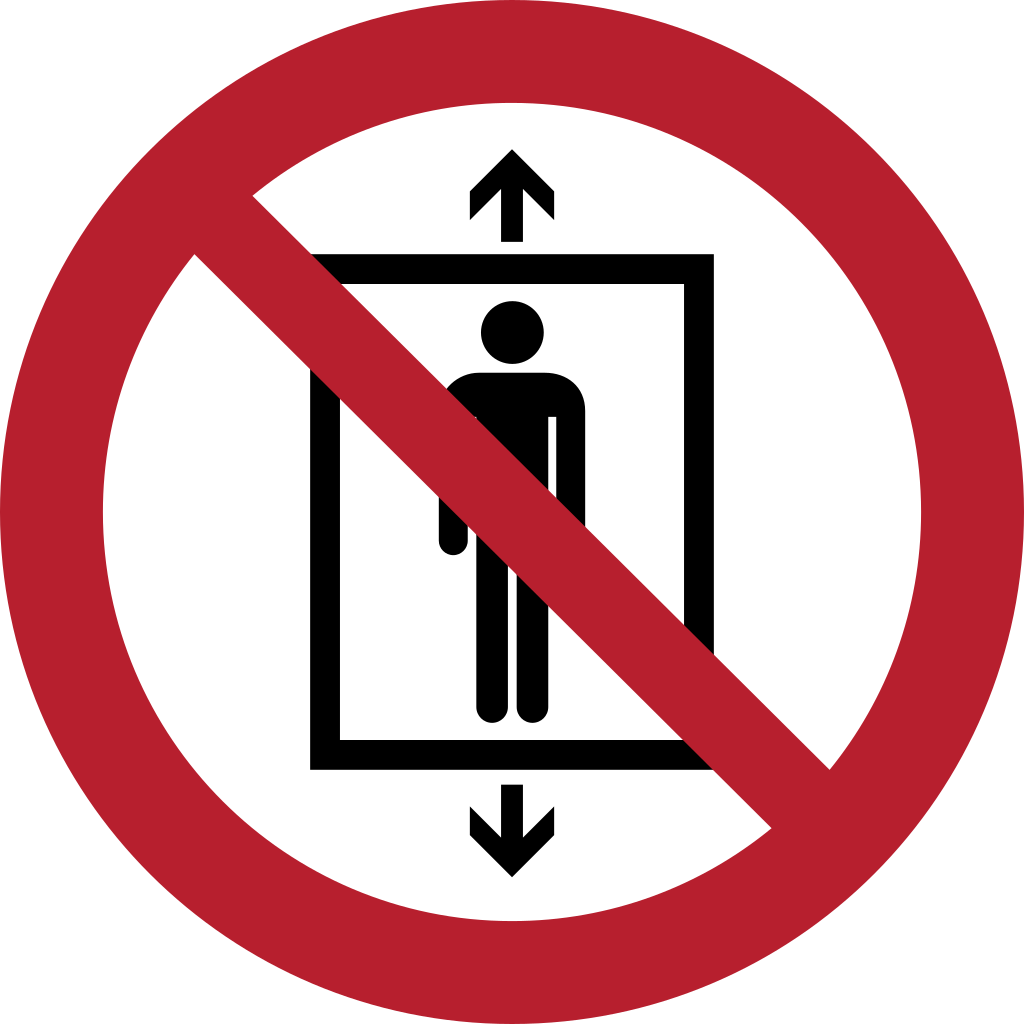
Do not use this lift for people
The marked lift is not to be used to carry people.
Understanding this sign
Red circular signs with a diagonal bar identify an action that must not be taken in the marked area.
Check what object or action the symbol prohibits. A prohibition sign does not identify all the hazards in an area.
Goods Lifts Are Not Passenger Lifts
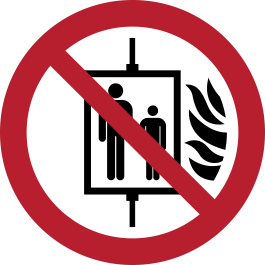
P027 prohibits riding in the lift it is fixed to. It belongs on goods-only lifts, service hoists, dumbwaiters, mezzanine floor lifts, and construction material hoists — equipment built to move loads between levels but never certified to carry a person. The pictogram shows a figure inside a lift car under the red prohibition band, and the platform or car it marks often looks rideable, which is precisely the problem.
The difference between the two machine types is invisible from the landing. A passenger lift carries layers of protection a goods lift omits: overspeed governors and safety gear that grip the rails if the suspension fails, door interlocks on car and landing, emergency alarms and communication, lighting, and ventilation. A goods platform may hang on a single rope with none of these, so a snapped cable or control fault that would strand a passenger lift can kill a rider on a goods hoist.
A Certification Line, Not Just a Habit
Regulation draws the boundary sharply. In the European Union, lifts that carry people fall under the Lifts Directive with its stringent conformity assessment, while goods-only lifts whose car is not accessible to persons are covered by the Machinery Directive instead — a lighter regime justified only because no one rides them. Comparable splits exist elsewhere: material hoists on construction sites and dumbwaiters are certified under separate rules from passenger elevators, with riding expressly forbidden.
Stepping onto a goods lift therefore does more than break a site rule; it moves the machine outside everything its certification assumed. Insurance inspections, thorough examinations of lifting equipment, and manufacturer instructions all rest on the no-passengers condition, and enforcement bodies have prosecuted employers after workers rode goods hoists that failed. P027 at every landing is how the certification boundary is made visible to the people it protects.
Placement and Reinforcement
Fix the sign at each landing gate and on or inside the platform itself, since the temptation arises at every level the lift serves. Pair it with the load-capacity plate so the two governing limits — no people, stated maximum weight — read together. On dumbwaiters and small service lifts the message extends to body parts: workers must not lean into the shaft or ride partway to nudge a stuck load.
Sites where the rule fails usually share a pattern: the goods lift is faster or closer than the stairs, and enforcement is left to signage alone. Effective operators add engineering measures — gates interlocked so the platform moves only with the enclosure shut from outside, controls positioned at landings rather than on the platform — and cover the prohibition explicitly at induction, naming the specific machine rather than lifts in general.
Where you will see P027
It belongs at every landing gate and on the platform itself of mezzanine floor lifts in warehouses, construction material hoists, and dumbwaiters in restaurants and hotels. Well-run sites fix it beside the load-capacity plate so the two governing limits read together, and back it with interlocked enclosures and controls positioned at landings rather than on the platform.
Common questions about P027
Why can't people ride in a goods lift?
Because it lacks the protective systems passenger lifts must have: safety gear that stops a falling car, overspeed detection, interlocked doors, alarm and communication equipment, and certified evacuation arrangements. A goods hoist is engineered and inspected on the assumption that a suspension or control failure damages cargo, not people. Riding one converts every such failure into a potential fatality.
What is the legal difference between a passenger lift and a goods-only lift?
They are certified under different regimes. In the EU, person-carrying lifts must satisfy the Lifts Directive's conformity assessment, while goods-only lifts with no rideable car fall under machinery rules; other jurisdictions make an equivalent split between elevator codes and material hoist or dumbwaiter standards. The lighter certification is lawful only while nobody rides, which is the condition P027 enforces.
Where should the P027 sign be displayed on a goods lift?
At every landing where the lift can be loaded or called, positioned on or beside the gate at eye level, plus on the platform or inside the car. One sign at the ground floor does not reach a worker loading at the mezzanine. Mount it next to the rated-load plate so the no-passenger rule and the weight limit are read as a pair.
Can a worker ride a goods lift just to accompany a fragile load?
No. Accompanying a load is still riding, and it is the exact scenario behind many hoist fatalities. If a load genuinely needs a person with it between floors, the task requires a lift certified for passengers or an attended goods-and-passenger lift designed for that duty. Otherwise the load travels alone and the worker takes the stairs to meet it.
Reference details
| Symbol code | P027 |
|---|---|
| Sign family | ISO Prohibition Signs |
| Standard reference | ISO 7010:2019 / ISO 3864-1 ISO Online Browsing Platform: P027 |
| Screen color reference | #FF0000. Screen colors are not a production color specification. |
| Download formats | SVG reference artwork; a 1024 × 1024 pixel PNG conversion on a white canvas. |
| Record date | · How to interpret our dates |
| Page updated |
Choosing a physical sign size
Download dimensions are not installation dimensions. Select sign size, material, placement, and lighting using the applicable standard and the actual viewing conditions. Chemical label sizing follows its own rules. Read the artwork and sizing guide.
Sources and artwork credits
- Artwork source
- Wikimedia Commons file page
- Creator credited by source
- ISO
- License
- Public domain
- Source metadata checked
SVG files are local reference copies. PNG files are raster conversions. Check the linked file history and license terms before reuse; a source-metadata check is not certification of the artwork or a workplace installation.
Report a correction to this reference