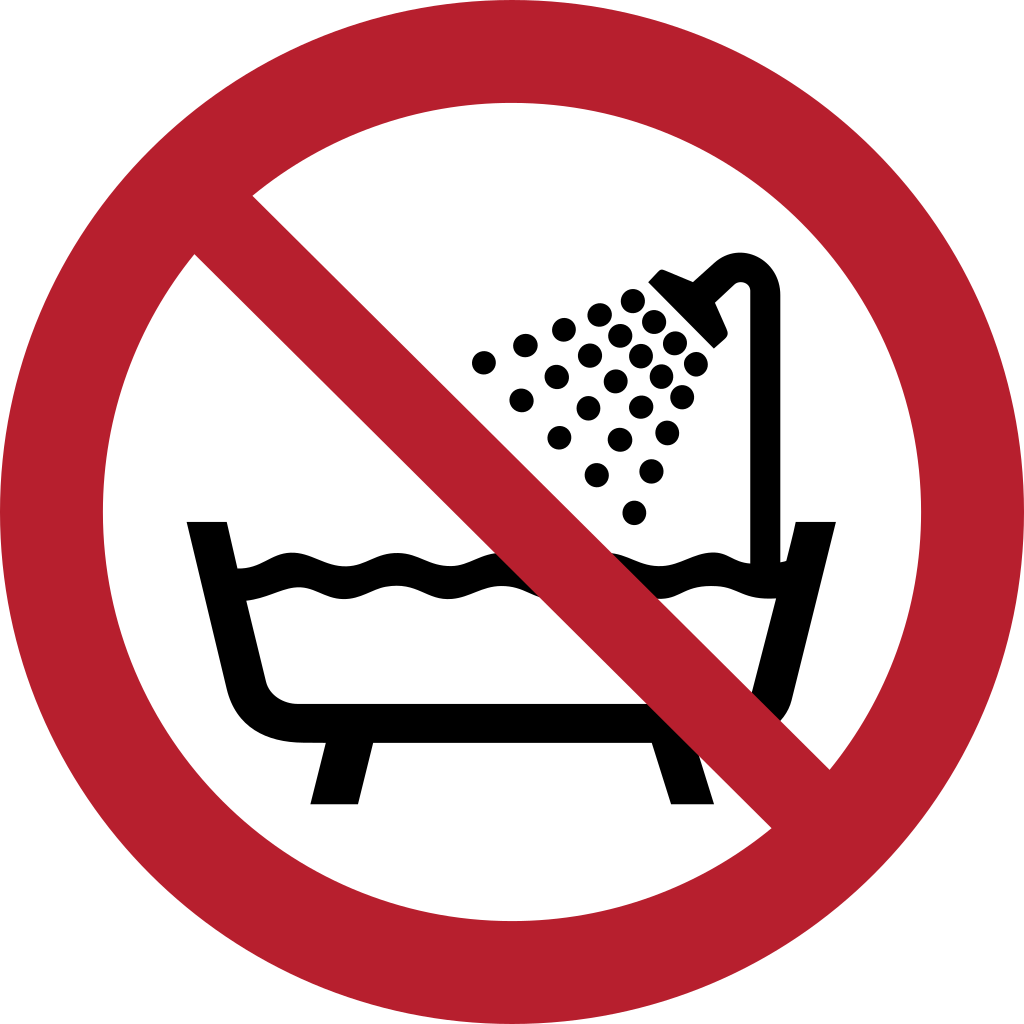
Do not use this device in a bathtub, shower or water-filled reservoir
Use of the device in a bathtub, shower, or water-filled reservoir is prohibited.
Understanding this sign
Red circular signs with a diagonal bar identify an action that must not be taken in the marked area.
Check what object or action the symbol prohibits. A prohibition sign does not identify all the hazards in an area.
An Appliance Marking as Much as a Wall Sign
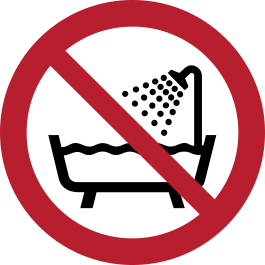
P026 prohibits using the marked device in a bathtub, shower, or any water-filled reservoir. Its pictogram condenses the scenario: an electrical appliance above a tub of water, struck through in red. Unlike most ISO 7010 prohibitions, its natural home is the product itself — molded into or labeled on hair dryers, portable heaters, radios, curling irons, and similar mains-powered devices — rather than a wall.
The hazard it addresses is domestic electrocution. A plugged-in appliance that falls into bath water energizes the water around the occupant, and the current path through a wet, immersed body is exceptionally dangerous. Critically, the switch position is irrelevant: an appliance that is switched off but still connected to the socket can electrify the water just as lethally.
Where the Symbol Appears
Appliance manufacturers apply this warning under product safety standards — the IEC 60335 family for household appliances and comparable national rules embed anti-immersion warnings for devices likely to be used in bathrooms, and the ISO 7010 P026 pictogram is one recognized way to render it graphically. Hair dryers are the canonical case, carrying the marking on the body or a permanently attached tag in many markets.
Facilities use it too. Hotels, hospitals, care homes, gyms, and campgrounds post P026 in bathrooms and beside pools, spas, and hydrotherapy tubs to govern guest-brought devices the operator cannot label. Industrial versions appear near open process tanks, plating baths, and wash-down areas where portable electrical tools must not be brought to the water's edge. Pool operators extend it to portable pumps, heaters, and lighting used poolside during maintenance.
The Engineering Controls Behind the Sign
P026 is the behavioral layer over electrical protections that modern wiring codes already demand. Residual current devices in Europe and ground-fault circuit interrupters in North America — required for bathroom receptacles under the respective wiring codes — disconnect a faulted circuit in milliseconds, and some jurisdictions restrict which socket types may exist in bathroom zones at all. Immersion detection circuit interrupters built into hair dryer plugs add a device-level cutoff in several markets.
None of those layers justifies ignoring the sign, because each has failure modes: older buildings lack RCD or GFCI protection, travel appliances get used through unprotected adapters, and protective devices themselves fail unnoticed without periodic testing. The prohibition removes the scenario instead of betting on the hardware, which is why the marking persists on appliances that also contain electronic protection.
Where you will see P026
Manufacturers mold or label it onto hair dryers, curling irons, portable heaters, and radios under product safety standards such as the IEC 60335 family. Hotels, hospitals, care homes, gyms, and campgrounds post it in bathrooms and beside pools, spas, and hydrotherapy tubs, while industrial versions appear near open process tanks, plating baths, and wash-down areas where portable electrical tools must stay clear of the water's edge.
Common questions about P026
Why is it dangerous to use a hair dryer near a bathtub even when it is switched off?
Because the switch only interrupts one point in the circuit. While the plug is in the socket, live conductors inside the appliance remain energized, and if it drops into the water the bath and everyone in it can become part of the circuit. The safe rule the P026 marking encodes is distance and disconnection: keep the device away from the water and unplug it after use.
Do GFCI or RCD protected outlets make the P026 warning unnecessary?
No. Residual current protection dramatically improves survival odds by cutting power within milliseconds of a fault, and bathroom circuits in modern buildings must have it, but devices can fail, older installations lack it, and adapters can bypass it. The prohibition eliminates the immersion scenario entirely rather than relying on a protective device working perfectly on the day it matters.
Which appliances carry the do-not-use-in-bathtub symbol?
Mains-powered devices plausibly used near water: hair dryers above all, plus curling and straightening irons, portable fan heaters, radios, and some personal care and grooming devices. Product safety standards for household appliances require an anti-immersion warning on such products, delivered as text, the P026-style pictogram, or both, typically on the housing or a permanent tag near the cord.
Should a hotel or care home post P026 in its bathrooms?
It is common and sensible where guests or residents bring their own appliances. Operators cannot control the condition of a visitor's hair dryer or charger, so a P026 sign near the tub or shower, often alongside a socket restricted to shavers, states the house rule in language-independent form. In care settings it also supports staff enforcing safe routines with vulnerable residents.
Reference details
| Symbol code | P026 |
|---|---|
| Sign family | ISO Prohibition Signs |
| Standard reference | ISO 7010:2019 / ISO 3864-1 ISO Online Browsing Platform: P026 |
| Screen color reference | #FF0000. Screen colors are not a production color specification. |
| Download formats | SVG reference artwork; a 1024 × 1024 pixel PNG conversion on a white canvas. |
| Record date | · How to interpret our dates |
| Page updated |
Choosing a physical sign size
Download dimensions are not installation dimensions. Select sign size, material, placement, and lighting using the applicable standard and the actual viewing conditions. Chemical label sizing follows its own rules. Read the artwork and sizing guide.
Sources and artwork credits
- Artwork source
- Wikimedia Commons file page
- Creator credited by source
- ISO
- License
- CC0
- Source metadata checked
SVG files are local reference copies. PNG files are raster conversions. Check the linked file history and license terms before reuse; a source-metadata check is not certification of the artwork or a workplace installation.
Report a correction to this reference