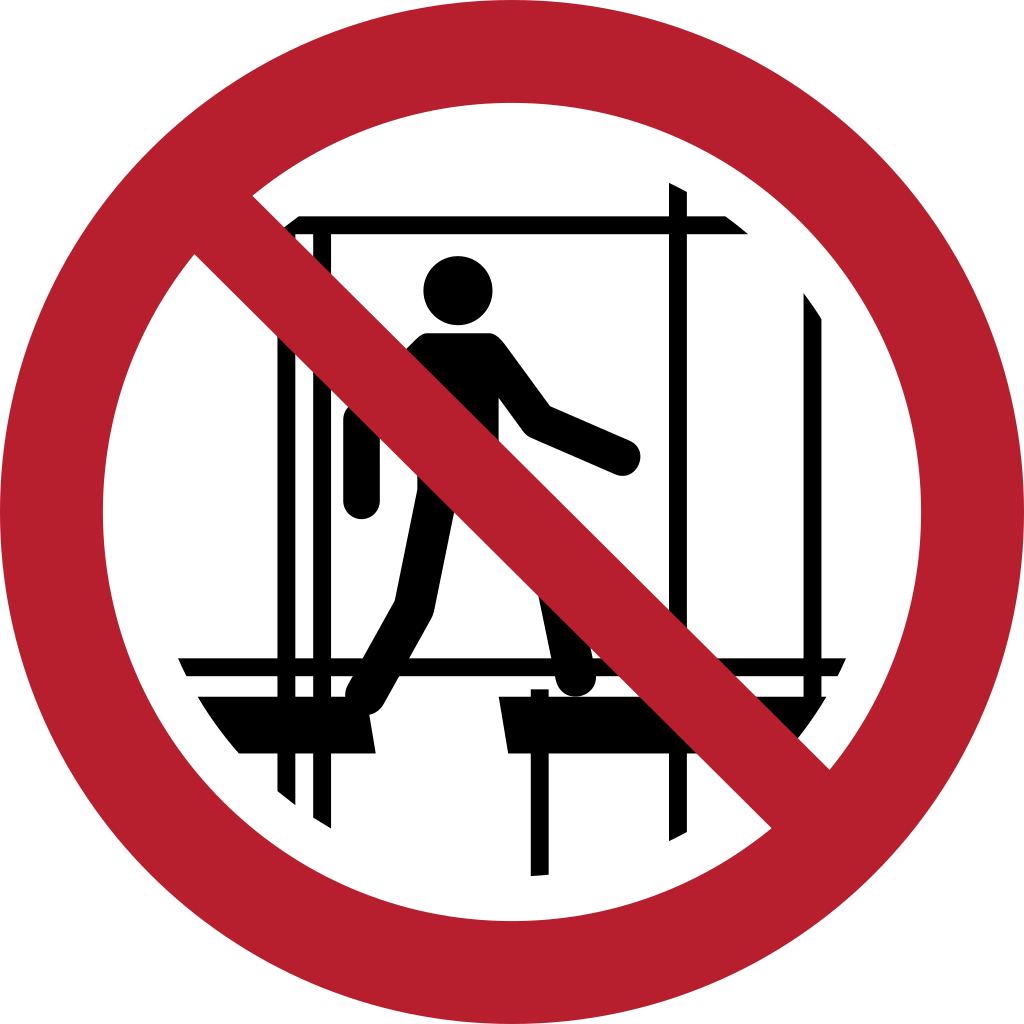
Do not use this incomplete scaffold
Use of the incomplete scaffold is prohibited.
Understanding this sign
Red circular signs with a diagonal bar identify an action that must not be taken in the marked area.
Check what object or action the symbol prohibits. A prohibition sign does not identify all the hazards in an area.
The Sign for Scaffolds Not Yet Fit to Use
P025 prohibits using a scaffold that is incomplete. The pictogram shows a figure climbing scaffold framing under the red prohibition band. It applies during the vulnerable windows in a scaffold's life: while it is being erected, while it is being altered or partially dismantled, and any time an inspection has found it deficient — missing guardrails, unsecured boards, absent ties, or unfinished access.
The risk profile explains the dedicated sign. A part-built scaffold looks nearly identical to a finished one from the ground, yet the missing components are exactly the ones that arrest a fall or keep the structure stable. Trades under schedule pressure will climb whatever is standing unless something tells them the structure has not been handed over.
How It Fits the Tagging System
On most sites, P025 operates inside a scaffold tag regime. Tag holders fixed at each access point display a green tag when a competent person has inspected the scaffold and released it for use; a red tag, or an empty holder, means do not use — and the P025 symbol is the pictographic form of that red state. Some systems add a yellow or amber tier for scaffolds usable only under stated restrictions.
The sign and the inspection record answer different questions. P025 tells a worker at the ladder right now that the structure is off-limits; the tag and register tell a supervisor who inspected it, when, and what was found. Erection crews hang P025 the moment the first standards go up and remove it only when the handover certificate is issued, so the default state of any scaffold is prohibited until proven complete.
The Regulatory Backdrop
US construction rules make inspection the gatekeeper: OSHA 29 CFR 1926.451 requires a competent person to inspect scaffolds before each work shift and after any event that could affect structural integrity, and workers may not use scaffold that has not passed. In Great Britain, the Work at Height Regulations require scaffold inspections at regular intervals — every seven days is the standard cycle — plus after alteration or weather that could weaken it, with results recorded.
Neither regime names the P025 pictogram, but both create the condition it communicates: a scaffold that is unfinished or uninspected is legally unusable, and the employer must convey that status to everyone on site. Posting P025 at each access ladder and stair, in the language-independent ISO format, is the accepted way to do that on multilingual construction sites where written notices fail.
Where you will see P025
Construction sites hang P025 at every scaffold access ladder and stair from the moment the first standards go up, removing it only when the handover certificate is issued. It operates inside scaffold tag regimes as the pictographic form of the red do-not-use state, complementing the inspection duties of OSHA 29 CFR 1926.451 and the UK Work at Height Regulations, and its language-independent format suits multilingual construction crews where written notices fail.
Common questions about P025
What do green, yellow, and red scaffold tags mean?
Green means the scaffold has been inspected by a competent person and released for use. Yellow or amber, where used, means restricted use under stated conditions, such as harness required because a section lacks guardrails. Red — or a missing tag — means the scaffold must not be used at all. P025 signage corresponds to the red state and stays up until handover.
Who is allowed to declare a scaffold complete?
A competent person: someone with the training and experience to evaluate scaffold integrity, named in the site's procedures. Under OSHA 1926.451 that person must inspect before each shift and after any incident affecting the structure; UK rules require inspection at handover, then at intervals of no more than seven days. Erectors themselves cannot self-certify outside that framework on most sites.
Where should the P025 sign be attached?
At every point a person could get onto the scaffold — each ladder, stair tower, and gate — at eye level on the access route, not buried mid-elevation. On partially complete scaffolds where some bays are released and others are not, physical barriers should close off the prohibited sections and the sign should mark those barriers, because a sign alone will not stop someone traversing internally.
Does an incomplete scaffold also need physical access prevention?
Yes. Signage flags the status, but recognized practice is to remove or board over the bottom ladder, fit a locked gate, or barrier the access points so casual use is physically difficult. Regulators treat an unguarded, climbable, incomplete scaffold as an open hazard even when signed, particularly on sites where the public or children could reach it out of hours.
Reference details
| Symbol code | P025 |
|---|---|
| Sign family | ISO Prohibition Signs |
| Standard reference | ISO 7010:2019 / ISO 3864-1 ISO Online Browsing Platform: P025 |
| Screen color reference | #FF0000. Screen colors are not a production color specification. |
| Download formats | SVG reference artwork; a 1024 × 1024 pixel PNG conversion on a white canvas. |
| Record date | · How to interpret our dates |
| Page updated |
Choosing a physical sign size
Download dimensions are not installation dimensions. Select sign size, material, placement, and lighting using the applicable standard and the actual viewing conditions. Chemical label sizing follows its own rules. Read the artwork and sizing guide.
Sources and artwork credits
- Artwork source
- Wikimedia Commons file page
- Creator credited by source
- ISO
- License
- CC0
- Source metadata checked
SVG files are local reference copies. PNG files are raster conversions. Check the linked file history and license terms before reuse; a source-metadata check is not certification of the artwork or a workplace installation.
Report a correction to this reference