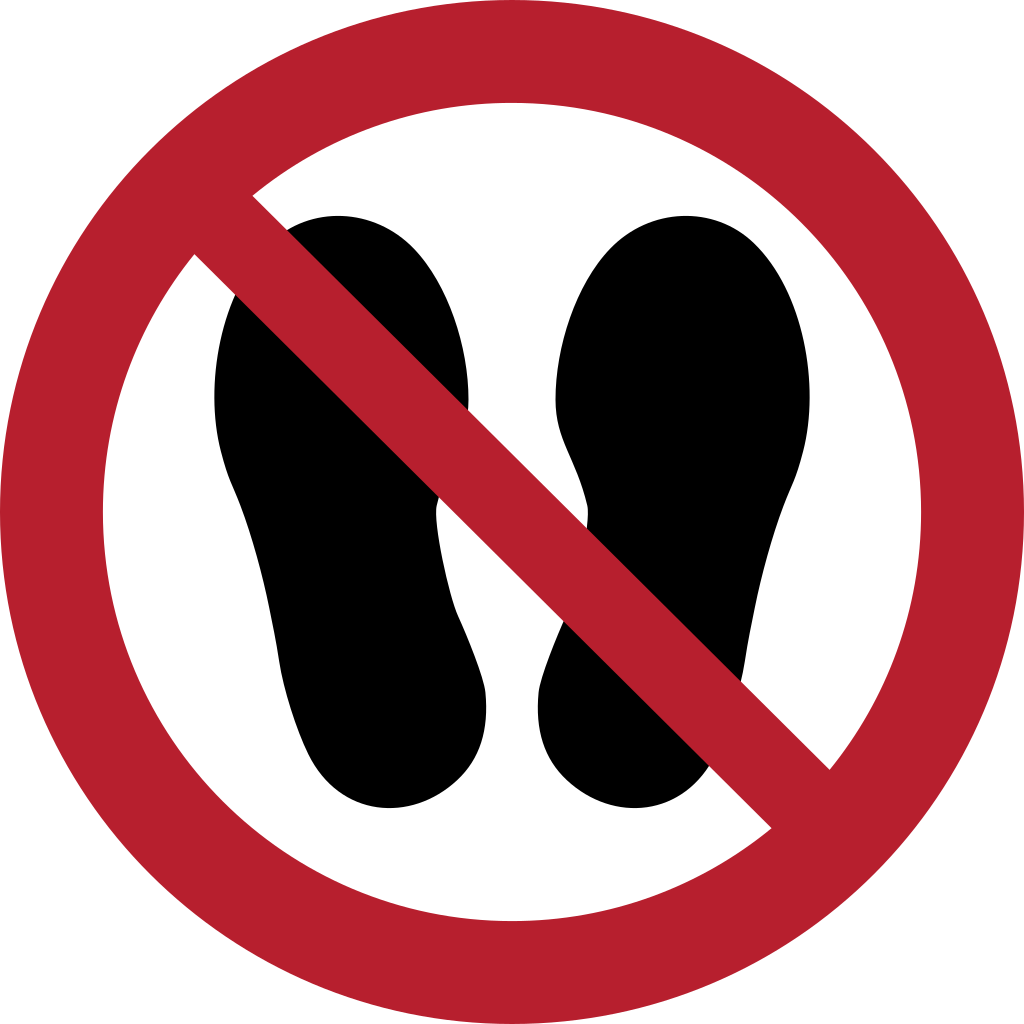
Do not walk or stand here
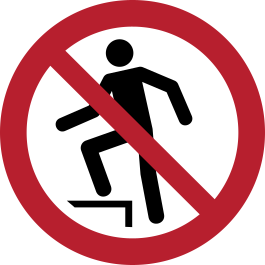
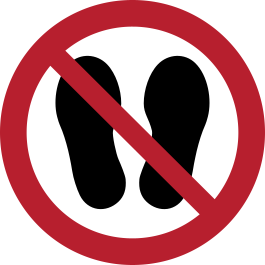
Walking or standing at the marked location is prohibited.
Understanding this sign
Red circular signs with a diagonal bar identify an action that must not be taken in the marked area.
Check what object or action the symbol prohibits. A prohibition sign does not identify all the hazards in an area.
Marking Ground People Must Not Occupy
P024 prohibits walking or standing on a designated area. The pictogram shows a figure standing on a hatched zone, crossed through in red. The floor itself is usually perfectly sound — the prohibition is about what happens in that airspace: loads swing overhead, vehicles sweep through, machinery rotates outward, or material can fall from work above.
This makes P024 the signature sign of the exclusion zone. Crane lift plans ban personnel from the area beneath and around suspended loads; P024 at the zone boundary is how that paper rule reaches the person about to take a shortcut. The same logic applies under scaffolds and mast climbers during loading, beneath open floor edges on construction sites, and inside the slew radius of excavators.
Vehicle Routes and Machine Envelopes
In warehouses and yards, P024 marks the ground pedestrians must cede to machines: forklift charging lanes and blind corners, the sweep of articulated vehicles at dock aprons, the travel path of automated guided vehicles, and rail sidings inside plants. Separation of people and vehicles is a core duty in workplace transport regulation, and this sign draws the line where barriers or full segregation are impractical.
Around fixed machinery it covers the danger envelope rather than the machine: the arc of a robot arm outside its fence gate, the drop zone beside a palletizer, the area below counterweights and tipping stations. Because the hazard is intermittent — the space looks harmless whenever the machine is idle — the sign has to carry the rule through the quiet periods when standing there seems obviously fine.
Deploying P024 So It Gets Obeyed
Define the zone visibly before signing it. Hatched floor paint, contrasting surface color, or chain posts give P024 an unambiguous footprint; a sign gesturing at unmarked concrete leaves every reader to guess the boundary and most will guess generously in their own favor. Position signs at the natural approach paths and at any gap in barriers, angled to face oncoming foot traffic.
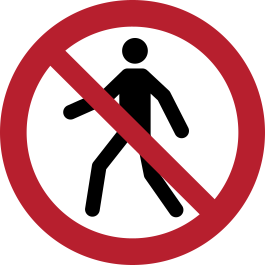
Do not stretch P024 to jobs other signs do better. A corridor or gate closed to all passage takes P004 (no thoroughfare); a surface that would collapse underfoot takes P019; pedestrians banned from a whole route while vehicles use it takes the dedicated pedestrian prohibition. P024 is for a bounded patch of ground that stays off-limits while normal work continues around it.
Where you will see P024
Construction sites post it at crane lift exclusion zones, under scaffolds and mast climbers during loading, and inside the slew radius of excavators. In warehouses and yards it marks forklift lanes and blind corners, dock aprons swept by articulated vehicles, and automated guided vehicle paths, and around fixed machinery it covers robot-arm arcs, palletizer drop zones, and the ground below counterweights and tipping stations, ideally bounded by hatched floor paint.
Common questions about P024
When should I use P024 instead of P004 no thoroughfare?
P024 forbids occupying a specific patch of ground — standing on it or crossing it — typically an exclusion zone under loads, beside machinery, or in a vehicle sweep. P004 closes a passage or route to through traffic entirely. If the rule is stay out of this area, use P024; if it is do not pass this way, use P004.
Does an exclusion zone under a crane need signage?
Lift planning rules in most jurisdictions require keeping people out from under suspended loads, and the practical control is a marked exclusion zone: barriers or taped boundaries, a banksman controlling access, and P024 signs at the approaches. The sign alone does not satisfy the duty, but it is the standard way the boundary is communicated to workers not involved in the lift.
How big should a do-not-stand area be around machinery or vehicle paths?
Size it from the hazard, not the machine footprint: the full slew or swing radius plus load overhang for cranes and excavators, the rear sweep of trailers at docks, the reach of a robot plus any thrown-part distance identified in the risk assessment. Then mark that boundary on the floor so P024 refers to a line people can actually see.
Is the floor unsafe where a P024 sign is posted?
Usually not — that is the point of the sign. The surface is normally sound; the danger comes from above or from moving equipment passing through the space. When the surface itself cannot bear weight, such as a fragile rooflight or thin cover, the correct sign is P019 no stepping on surface instead.
Reference details
| Symbol code | P024 |
|---|---|
| Sign family | ISO Prohibition Signs |
| Standard reference | ISO 7010:2019 / ISO 3864-1 ISO Online Browsing Platform: P024 |
| Screen color reference | #FF0000. Screen colors are not a production color specification. |
| Download formats | SVG reference artwork; a 1024 × 1024 pixel PNG conversion on a white canvas. |
| Record date | · How to interpret our dates |
| Page updated |
Choosing a physical sign size
Download dimensions are not installation dimensions. Select sign size, material, placement, and lighting using the applicable standard and the actual viewing conditions. Chemical label sizing follows its own rules. Read the artwork and sizing guide.
Sources and artwork credits
- Artwork source
- Wikimedia Commons file page
- Creator credited by source
- ISO
- License
- Public domain
- Source metadata checked
SVG files are local reference copies. PNG files are raster conversions. Check the linked file history and license terms before reuse; a source-metadata check is not certification of the artwork or a workplace installation.
Report a correction to this reference