Do not obstruct
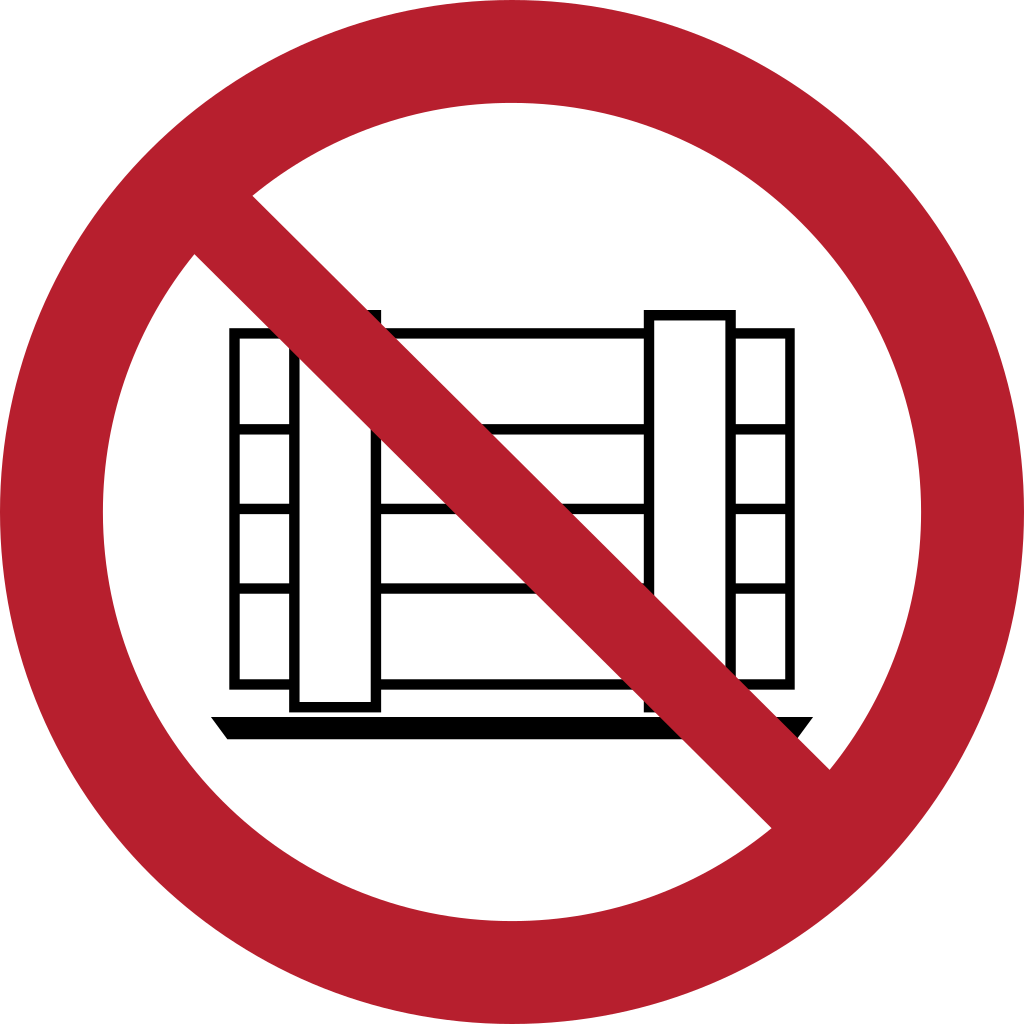
Obstructing the marked location is prohibited; keep it clear.
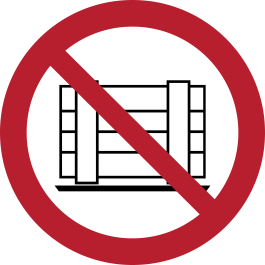
Understanding this sign
Red circular signs with a diagonal bar identify an action that must not be taken in the marked area.
Check what object or action the symbol prohibits. A prohibition sign does not identify all the hazards in an area.
Keeping Designated Areas Clear
P023 prohibits obstructing a designated clear area. Where most prohibition signs govern a moment of behavior, this one governs a state: nothing may be parked, stored, stacked, or left in the marked zone at any time. The pictogram — a crossed-out obstacle blocking a space — is deliberately generic because the protected asset behind it varies from a fire door to a switchboard.
The sign matters because obstruction is the quietest way a safety system fails. A pallet set down in front of a hose reel for just an hour, a delivery cage rolled against a fire exit, chairs drifted into an escape corridor — none of it looks like a violation until the emergency arrives and the equipment or route cannot be reached. P023 converts an invisible rule into a visible boundary.
What the Clear Zones Protect
Escape routes and exits are the classic application. OSHA's exit-route rule, 29 CFR 1910.37, requires routes to remain free of obstructions and unlocked in the direction of travel, and European workplace regulations impose the same duty; P023 on and around fire doors, final exits, and corridor pinch points is how facilities police it day to day. Fire equipment comes next: extinguishers, hose reels, alarm call points, sprinkler valves, and hydrants all lose their value if reaching them takes minutes.
Electrical installations form the third pillar. Electrical codes require a clear working space in front of panels and switchgear — under the US National Electrical Code this is generally around three feet deep — so that equipment can be operated and de-energized safely in an emergency. Loading areas add their own cases: roller shutter doors, dock levelers, machine access hatches, and emergency vehicle lanes outside the building.
Making the Prohibition Stick
P023 works far better as the label on a marked zone than as a lone plaque. The standard pattern is a hatched yellow-and-black or red floor box painted or taped to the exact footprint that must stay empty, with the sign at eye level on the wall or door behind it. Storage crews respect an outlined rectangle they can see from a forklift seat much more reliably than a sign at head height they pass at speed.
Enforcement is a housekeeping discipline, so build the zones into inspection checklists and give supervisors authority to have items moved immediately rather than logged for later. Where the same spot is blocked repeatedly, treat it as a layout problem: the aisle is too narrow, the staging area too small, or the bin in the wrong place. Signage cannot outargue a workflow that has nowhere else to put things.
Where you will see P023
It polices exit routes, final exits, and corridor pinch points under rules like OSHA 1910.37, guards access to extinguishers, hose reels, alarm call points, and sprinkler valves, and preserves the working clearance in front of electrical panels and switchgear. Loading docks, roller shutter doors, machine hatches, and emergency vehicle lanes carry it too, usually above a hatched floor box marking the exact footprint.
Common questions about P023
What is the ISO P023 do not obstruct sign used for?
It marks zones that must stay permanently clear: in front of fire exits and fire doors, around extinguishers, hose reels, and alarm call points, before electrical panels and switchgear, at roller shutters and dock doors, and along emergency access lanes. Anything stored or parked there — even briefly — defeats equipment or routes that only matter in an emergency.
How much space must be kept clear in front of an electrical panel?
Electrical codes define a required working space so panels can be operated and maintained safely; in the US the National Electrical Code generally calls for a clearance on the order of three feet in front of the equipment, with the full width of the panel or more kept open. Requirements vary by voltage and configuration, so confirm the figure for your installation and mark that footprint on the floor with P023 above it.
Is blocking a fire exit actually illegal?
Yes, in essentially every jurisdiction. OSHA 1910.37 requires exit routes to be kept free of obstructions in US workplaces, and fire safety legislation in the UK, EU, and elsewhere places the same duty on whoever controls the premises. Inspectors treat blocked exits as a serious finding because the obstruction removes the escape route precisely when it is needed.
Should do-not-obstruct areas be marked on the floor as well as signed?
Strongly recommended. A hatched floor box showing the exact keep-clear footprint communicates the rule to forklift drivers and staff carrying loads who never look up at wall signs, and it removes arguments about how close is too close. The P023 sign then explains what the marking means and signals that the zone is a safety requirement, not a suggestion.
Reference details
| Symbol code | P023 |
|---|---|
| Sign family | ISO Prohibition Signs |
| Standard reference | ISO 7010:2019 / ISO 3864-1 ISO Online Browsing Platform: P023 |
| Screen color reference | #FF0000. Screen colors are not a production color specification. |
| Download formats | SVG reference artwork; a 1024 × 1024 pixel PNG conversion on a white canvas. |
| Record date | · How to interpret our dates |
| Page updated |
Choosing a physical sign size
Download dimensions are not installation dimensions. Select sign size, material, placement, and lighting using the applicable standard and the actual viewing conditions. Chemical label sizing follows its own rules. Read the artwork and sizing guide.
Sources and artwork credits
- Artwork source
- Wikimedia Commons file page
- Creator credited by source
- ISO
- License
- Public domain
- Source metadata checked
SVG files are local reference copies. PNG files are raster conversions. Check the linked file history and license terms before reuse; a source-metadata check is not certification of the artwork or a workplace installation.
Report a correction to this reference