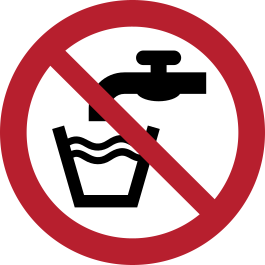
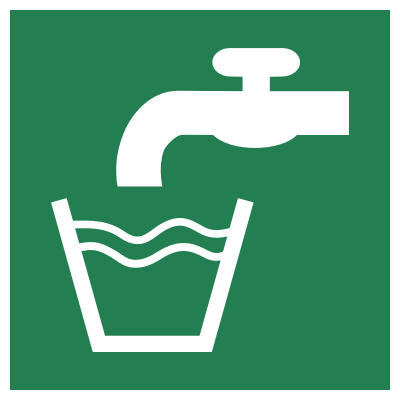
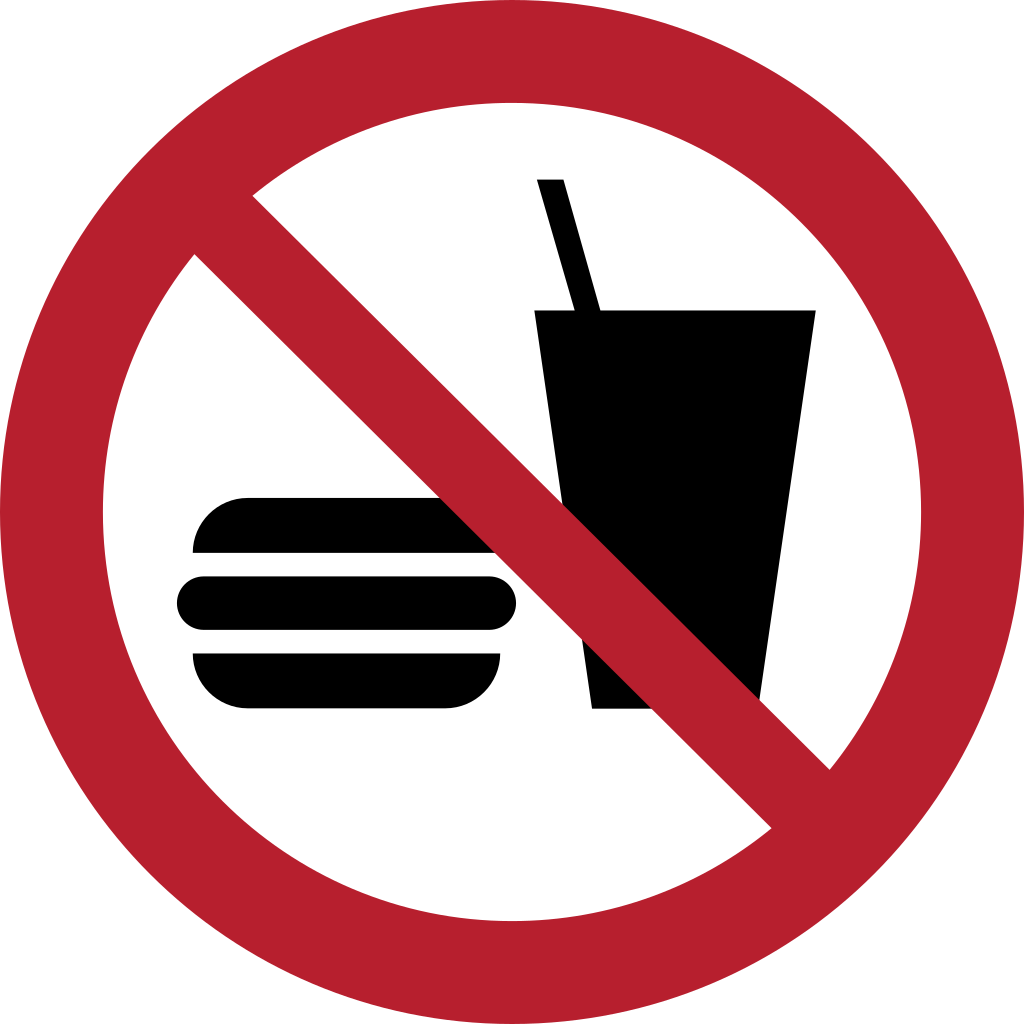
No eating or drinking
Eating and drinking are prohibited in the marked area.
Understanding this sign
Red circular signs with a diagonal bar identify an action that must not be taken in the marked area.
Check what object or action the symbol prohibits. A prohibition sign does not identify all the hazards in an area.
What ISO 7010 P022 Prohibits
P022 bans consuming food and beverages in the area where it is posted. The prohibition runs in two directions at once: it protects people from ingesting hazardous substances that transfer from surfaces and air to hands, food, and mouth, and it protects sensitive products and environments from crumbs, spills, aerosols, and the packaging and behavior that eating brings with it.
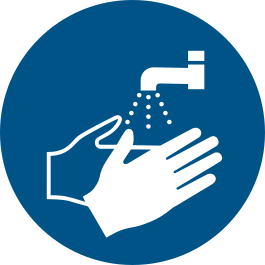
Because hand-to-mouth transfer is the main exposure route it interrupts, P022 rarely stands alone. It typically appears with related hygiene controls — mandatory hand-washing signage such as M011, glove requirements, and designated break areas — and its effectiveness depends on those alternatives existing: a workforce with nowhere permitted to eat will eat where the sign hangs.
Laboratories and Toxic-Material Areas
Laboratories are the canonical P022 location. Under OSHA's laboratory standard (29 CFR 1910.1450), chemical hygiene plans conventionally prohibit eating, drinking, and applying cosmetics in areas where hazardous chemicals are used, and OSHA's sanitation rule (29 CFR 1910.141) separately forbids employees from consuming food or beverages in any area exposed to toxic material. Biosafety practice imposes the same rule in microbiology labs at every containment level.
Substance-specific OSHA standards go further: the lead and cadmium rules, among others, ban food, drink, and tobacco in regulated areas outright, because ingestion is a significant uptake route for those metals. In battery plants, radiator shops, and firing ranges, the P022 boundary effectively maps the regulated area, and lunchrooms must sit outside it with washing facilities in between.
Cleanrooms, Food Plants, and Electronics
In contamination-controlled manufacturing, the sign protects the product. Cleanroom protocols for semiconductor, pharmaceutical, and medical device production exclude food and drink because a sip releases particles and droplets that gowning is designed to suppress, and a sugary spill in a raised-floor plenum is a lasting contamination source. Data centers and electronics assembly lines apply the same logic to liquids near energized and ESD-sensitive hardware.
Food factories use P022 in what sounds like a paradox: no eating on the production floor. Personal food introduces undeclared allergens into an allergen-controlled process, and wrappers, seeds, and crumbs become foreign-body risks in the product stream. Good manufacturing practice therefore confines eating to segregated staff rooms, with the sign marking every entrance back into production.
Drawing the Boundary Well
Post P022 at each entrance to the controlled space and at internal transition points such as gowning rooms and airlocks, so the rule is restated exactly where someone carrying a coffee makes the decision. Signs inside the area serve as reminders, but the entrance placement is what stops the cup crossing the line in the first hand.
Two scope questions recur and deserve a written policy answer. Water bottles: some labs allow sealed bottles in designated clean corners for heat-stress reasons, while most toxic-material areas allow none — the sign itself makes no exception, so any carve-out must be explicit. Chewing gum and cosmetics: usually banned alongside food in lab and cleanroom rules, via supplementary text since the pictogram shows only eating and drinking.
Where you will see P022
Laboratories are the canonical location, with chemical hygiene plans and biosafety practice prohibiting eating at every containment level, and lead and cadmium regulated areas in battery plants, radiator shops, and firing ranges banning food outright. Cleanrooms in semiconductor, pharmaceutical, and medical device production use it to protect the product, food factories post it at every entrance back into allergen-controlled production floors, and it is placed at entrances, gowning rooms, and airlocks where someone carrying a coffee makes the decision.
Common questions about P022
Is it a legal requirement to ban eating and drinking in laboratories?
In effect, yes for most labs. OSHA's sanitation rule prohibits consuming food or beverages in areas exposed to toxic materials, the laboratory standard requires a chemical hygiene plan that in practice always includes this rule, and substance-specific standards like lead impose an explicit statutory ban. Comparable duties exist under EU chemical agents and biosafety rules, so the P022 sign usually announces an obligation that already exists.
Are water bottles allowed in an area with a no-eating-or-drinking sign?
Not unless the site's written policy creates an exception — the sign covers all drinking, water included. Some facilities designate a clean zone or anteroom for sealed bottles to manage heat stress, but in labs handling toxic or infectious materials and in cleanrooms the ban is normally absolute, and hydration is handled by scheduled breaks outside the boundary.
Why is eating banned inside food factories?
Because employees' own food threatens the product. A peanut snack in an allergen-controlled plant can contaminate lines whose labels declare no peanut; wrappers, pits, and crumbs are foreign-body hazards; and eating encourages hand-to-face contact that undermines hygiene. Production areas therefore carry P022, and eating happens only in segregated break rooms with hand-washing on re-entry.
Does P022 cover chewing gum, smoking, or applying makeup?
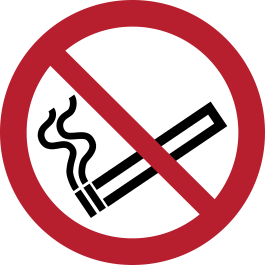
The pictogram itself depicts only eating and drinking. Smoking has its own sign, P002, and gum and cosmetics need supplementary text — though lab and cleanroom rules almost always ban them for the same hand-to-mouth and contamination reasons. A combination sign listing all prohibited consumption behaviors avoids leaving gaps a literal reader could exploit.
Reference details
| Symbol code | P022 |
|---|---|
| Sign family | ISO Prohibition Signs |
| Standard reference | ISO 7010:2019 / ISO 3864-1 ISO Online Browsing Platform: P022 |
| Screen color reference | #FF0000. Screen colors are not a production color specification. |
| Download formats | SVG reference artwork; a 1024 × 1024 pixel PNG conversion on a white canvas. |
| Record date | · How to interpret our dates |
| Page updated |
Choosing a physical sign size
Download dimensions are not installation dimensions. Select sign size, material, placement, and lighting using the applicable standard and the actual viewing conditions. Chemical label sizing follows its own rules. Read the artwork and sizing guide.
Sources and artwork credits
- Artwork source
- Wikimedia Commons file page
- Creator credited by source
- ISO
- License
- Public domain
- Source metadata checked
SVG files are local reference copies. PNG files are raster conversions. Check the linked file history and license terms before reuse; a source-metadata check is not certification of the artwork or a workplace installation.
Report a correction to this reference