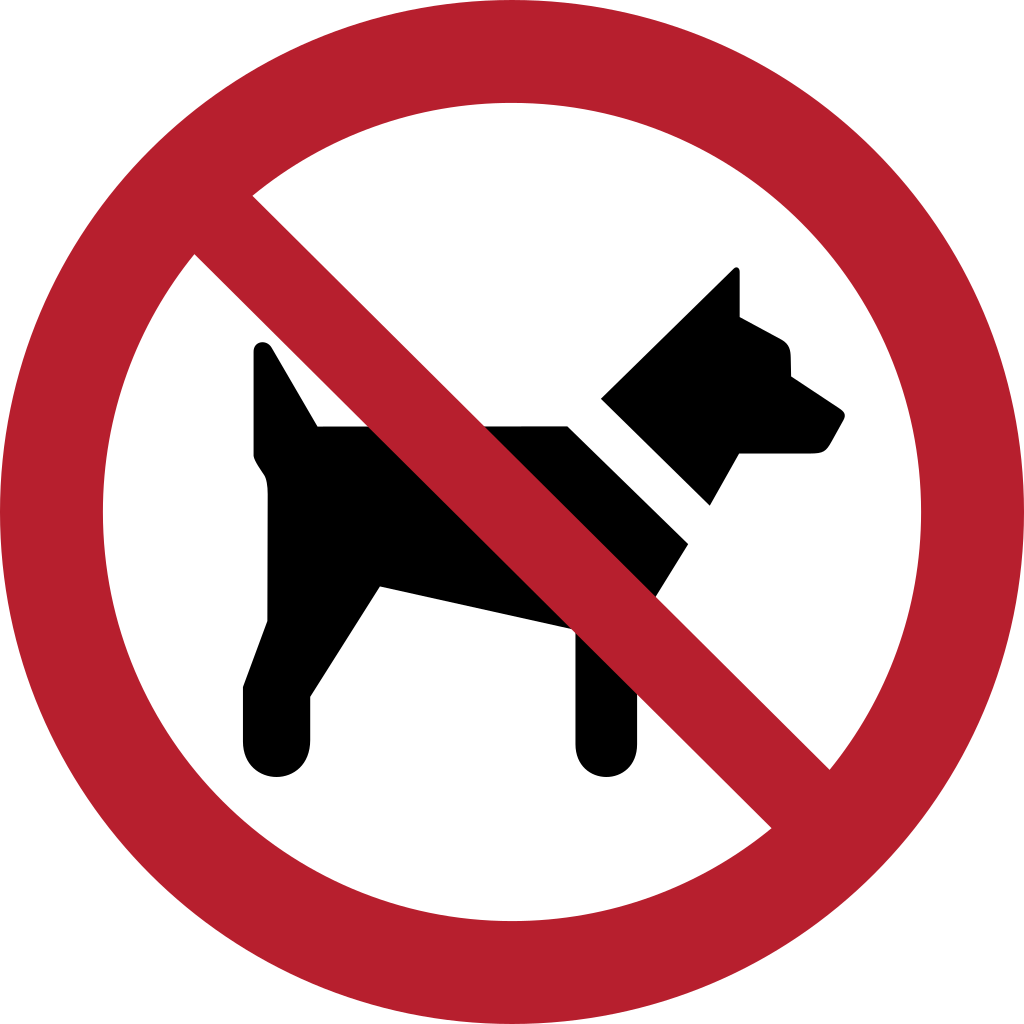
No dogs
Dogs are prohibited in the marked area.
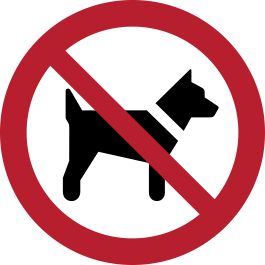
Understanding this sign
Red circular signs with a diagonal bar identify an action that must not be taken in the marked area.
Check what object or action the symbol prohibits. A prohibition sign does not identify all the hazards in an area.
One Species, One Rule
P021's registered purpose is to prohibit taking dogs into a designated area. The crossed-out dog pictogram is species-specific: it does not communicate a ban on cats, birds, or pets in general, and a venue that wants animals of every kind excluded should add text such as NO ANIMALS rather than expect the symbol to stretch. The prohibition attaches to the handler — the person bringing the dog — which is why it typically stands at gates, doorways, and property boundaries rather than deep inside a site.
The reasons behind a no-dogs posting vary more than for most prohibition signs. Food businesses exclude dogs for hygiene, hospitals and cleanrooms for infection and contamination control, livestock farms for biosecurity against disease transmission between dogs and animals, nature reserves for wildlife disturbance, and industrial yards because an unrestrained animal near vehicles and machinery endangers itself and distracts operators. The sign looks identical in each setting; the enforcement stakes do not.
Service and Assistance Dogs: Where the Sign Yields
In the United States, a posted no-dogs rule cannot lawfully exclude service animals from most public-facing places. Under the Americans with Disabilities Act, businesses and state and local government facilities open to the public must admit dogs individually trained to perform tasks for a person with a disability, even where pets are banned; staff may ask only whether the dog is required because of a disability and what task it performs. Emotional support animals do not carry the same ADA access rights, though housing and some state laws treat them differently.
Exclusion remains possible in narrow circumstances: a service dog that is out of control or not housebroken can be asked to leave, and food-safety rules keep all animals, including service dogs, out of food preparation areas even while admitting them to customer areas. The UK's Equality Act 2010 produces a similar result for assistance dogs. Because the bare P021 symbol admits no exceptions, US and UK premises should add wording such as EXCEPT SERVICE ANIMALS to avoid posting a rule they cannot enforce.
Settings Where Dog Exclusion Is Backed by Law
Some no-dogs postings restate a regulatory duty rather than a preference. Food establishments operate under hygiene codes that bar animals from rooms where food is handled, so P021 at a production hall or commercial kitchen door reflects an obligation the operator cannot waive. Livestock premises may exclude dogs as part of disease-control planning, and many beaches, parks, and protected habitats carry seasonal or year-round dog bans under local bylaws, where the posting is the public notice of an enforceable rule.
In these regulated contexts the sign should cite its source. A line such as FOOD PRODUCTION AREA — ANIMALS PROHIBITED BY HYGIENE REGULATIONS or a bylaw reference on a beach sign converts a seemingly arbitrary red circle into a rule with visible authority, which both improves voluntary compliance and supports enforcement when a visitor objects. It also helps staff explain, accurately, why the service-animal exception applies at the café tables but not past the kitchen door.
Posting Strategy and Companion Messages
Place P021 where the decision to bring the dog is still reversible: car park entrances, farm gates, trailheads, and the street door, not only the inner threshold. A visitor who discovers the ban after walking the dog across the site has no good option, and tethering animals at an unsupervised entrance creates its own problems. Where practical, tell people what to do instead — a dog-friendly route, shaded waiting area, or nearby facility — because a prohibition with an alternative is followed far more often than one without.
Consider whether a full ban is actually the intended rule. Many sites really mean dogs on leads only, dogs excluded from one zone, or no fouling, and each of those is a different message that P021 overstates. Mixed-use destinations often deploy the symbol selectively — at the playground, the food court, the livestock barn — while leaving the wider grounds open, which keeps the strong red-circle message credible exactly where it matters.
Where you will see P021
Food production halls and commercial kitchens post it to satisfy hygiene codes barring animals from food-handling rooms, while livestock farms use it for biosecurity and hospitals and cleanrooms for contamination control. Beaches, parks, and nature reserves display it as public notice of dog bans under local bylaws, ideally placed at car parks, farm gates, and trailheads.
Common questions about P021
Can a business with a no dogs sign turn away a service dog?
In the US, generally not. The ADA requires public accommodations to admit service dogs — dogs individually trained to perform tasks for a person with a disability — regardless of pet policies, and staff may ask only two limited questions. Exclusion is allowed if the dog is out of control or not housebroken, and animals can be kept out of food preparation areas. The UK Equality Act 2010 gives assistance dogs comparable protection.
Does the P021 sign ban all pets or only dogs?
Only dogs. The pictogram depicts a dog and the ISO-registered function is limited to that species. A venue intending to exclude cats, birds, or animals generally needs supplementary text such as NO ANIMALS, since visitors with other pets can reasonably read the bare symbol as not applying to them.
Why are dogs prohibited at food factories and farms?
Food hygiene codes bar animals from rooms where food is prepared or handled, so the posting at a production area restates a legal duty. On livestock farms the driver is biosecurity: dogs can carry diseases such as those transmitted between dogs and sheep or cattle, and can stress or chase stock, so exclusion forms part of the farm's disease-control and animal-welfare measures.
What wording should be added to a no dogs sign in the US?
Add EXCEPT SERVICE ANIMALS so the posted rule matches what the ADA lets you enforce, and cite the basis where one exists, such as a hygiene regulation or park bylaw. If the real policy is narrower — dogs on leads, or exclusion from one zone — state that instead of posting a blanket ban you do not intend to apply.
Reference details
| Symbol code | P021 |
|---|---|
| Sign family | ISO Prohibition Signs |
| Standard reference | ISO 7010:2019 / ISO 3864-1 ISO Online Browsing Platform: P021 |
| Screen color reference | #FF0000. Screen colors are not a production color specification. |
| Download formats | SVG reference artwork; a 1024 × 1024 pixel PNG conversion on a white canvas. |
| Record date | · How to interpret our dates |
| Page updated |
Choosing a physical sign size
Download dimensions are not installation dimensions. Select sign size, material, placement, and lighting using the applicable standard and the actual viewing conditions. Chemical label sizing follows its own rules. Read the artwork and sizing guide.
Sources and artwork credits
- Artwork source
- Wikimedia Commons file page
- Creator credited by source
- ISO
- License
- Public domain
- Source metadata checked
SVG files are local reference copies. PNG files are raster conversions. Check the linked file history and license terms before reuse; a source-metadata check is not certification of the artwork or a workplace installation.
Report a correction to this reference