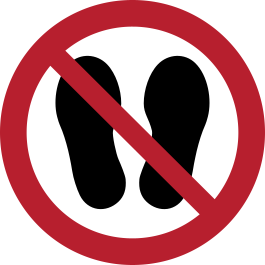
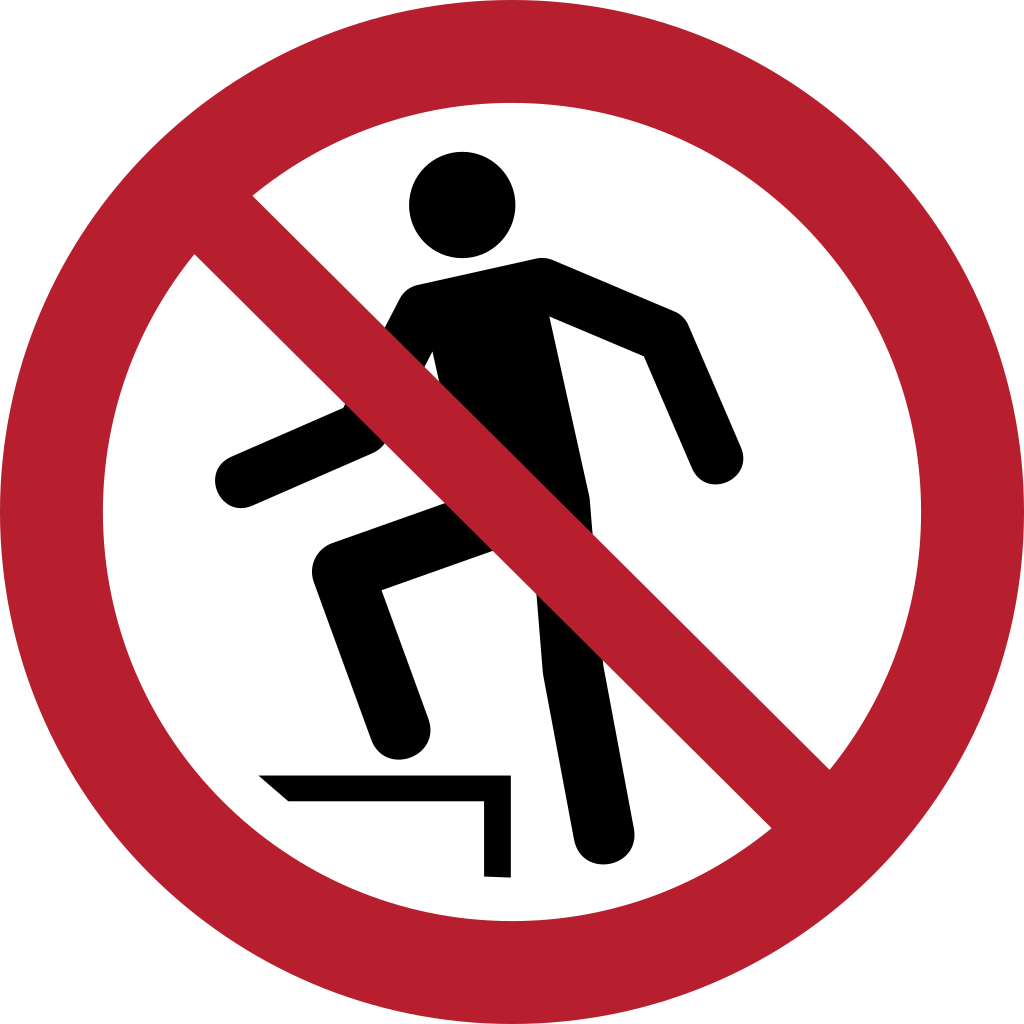
No stepping on surface
Stepping on the marked surface is prohibited.
Understanding this sign
Red circular signs with a diagonal bar identify an action that must not be taken in the marked area.
Check what object or action the symbol prohibits. A prohibition sign does not identify all the hazards in an area.
A Sign About Surfaces That Will Not Hold You
P019 prohibits stepping onto the surface it marks. The pictogram — a foot descending onto a hatched plane, struck through in red — flags materials that cannot be trusted with a person's weight: fragile rooflights, corrugated cement sheeting, false ceilings, glass canopies, tank tops, machine covers, and grating that has been removed or left unsecured.
The deception is what makes these surfaces kill. A weathered rooflight dulls to the same grey as the metal sheets around it; a ceiling tile looks continuous with the walkway beside it. Nothing about the view underfoot signals that one panel carries a roofer and the next drops them ten meters onto a factory floor. P019 supplies the information the surface itself hides.
Fragile Roofs: The Highest-Stakes Application
Falls through fragile roof materials are one of the recurring killers in construction and building maintenance. Britain's Health and Safety Executive has long singled out asbestos cement sheets and rooflights as the classic culprits, and its guidance calls for warning notices at every access point to a fragile roof — a duty that ISO 7010 P019, often with the supplementary text FRAGILE ROOF, is used to meet. The Work at Height Regulations require fragile surfaces to be identified and either avoided or protected.
Effective practice puts the sign where the decision is made, not where the fall happens: at roof-access ladders, hatches, and door thresholds onto the roof, before anyone commits their weight. On the roof itself, signage is a last line behind physical measures — crawling boards, covers over rooflights, and barriers keeping foot traffic on load-rated routes.
Beyond Roofs
Inside plants, P019 belongs on the tops of tanks, silos, and ductwork that maintenance staff might use as shortcuts, on acoustic or weather enclosures around machinery, and on suspended-ceiling access zones where only the grid framing is walkable. Logistics operations mark trailer roofs and the tops of certain containers. Glazed floors, skylight strips in walkable decks, and older wired-glass panels get the sign whenever their load rating is unknown or expired.
Choose P019 over P024 deliberately. P019 says the surface itself will fail underfoot; P024 says the location is dangerous to occupy even though the ground is sound, as beneath a suspended load. If workers must sometimes cross a fragile area for maintenance, the sign should be paired with a permit-to-work system and specified equipment rather than treated as an absolute that will quietly be violated.
Where you will see P019
Its highest-stakes application is fragile roofs: weathered rooflights and asbestos cement sheets, with the sign posted at roof-access ladders, hatches, and thresholds before anyone commits their weight, often with FRAGILE ROOF text. Inside plants it marks the tops of tanks, silos, and ductwork used as shortcuts, suspended-ceiling access zones where only the grid is walkable, machine enclosures, and in logistics the roofs of trailers and containers.
Common questions about P019
What counts as a fragile surface that needs a P019 sign?
Any surface that could give way under a person's weight: rooflights and skylights, asbestos cement or fiber cement sheeting, corroded metal decking, glass, false ceilings, unsecured gratings, and lightweight covers on tanks or machinery. Age and weathering matter — a roof that was walkable when new may be fragile now, which is why surveys treat unverified roofs as fragile by default.
Where should fragile roof warning signs be placed?
At every point where someone can get onto the roof: fixed ladders, hatches, doors from plant rooms, and the tops of external stairs. UK HSE guidance takes this approach because the access point is where a worker can still change plan. Marking only the fragile panels themselves is too late — by then the person is already at height among them.
Is a sign enough to manage a fragile roof, legally speaking?
No. Under work-at-height rules in the UK and equivalent duties elsewhere, signage is one control among several, and the hierarchy runs avoidance first, then physical protection such as covers, barriers, and crawling boards, then warnings. A P019 sign documents the hazard and stops casual access, but planned roof work still needs platforms or fall protection specified in the method statement.
How is P019 different from P024 do not walk or stand here?
P019 concerns the surface: it will break or collapse if stepped on. P024 concerns the space: the ground is solid but the position is hazardous, for example under crane loads or in a vehicle lane. If a rooflight would shatter underfoot, post P019; if a floor area must stay clear of people, post P024.
Reference details
| Symbol code | P019 |
|---|---|
| Sign family | ISO Prohibition Signs |
| Standard reference | ISO 7010:2019 / ISO 3864-1 ISO Online Browsing Platform: P019 |
| Screen color reference | #FF0000. Screen colors are not a production color specification. |
| Download formats | SVG reference artwork; a 1024 × 1024 pixel PNG conversion on a white canvas. |
| Record date | · How to interpret our dates |
| Page updated |
Choosing a physical sign size
Download dimensions are not installation dimensions. Select sign size, material, placement, and lighting using the applicable standard and the actual viewing conditions. Chemical label sizing follows its own rules. Read the artwork and sizing guide.
Sources and artwork credits
- Artwork source
- Wikimedia Commons file page
- Creator credited by source
- ISO
- License
- CC0
- Source metadata checked
SVG files are local reference copies. PNG files are raster conversions. Check the linked file history and license terms before reuse; a source-metadata check is not certification of the artwork or a workplace installation.
Report a correction to this reference