No pushing
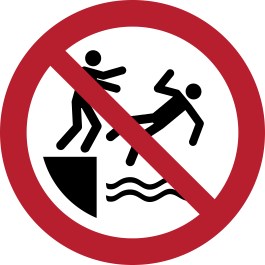
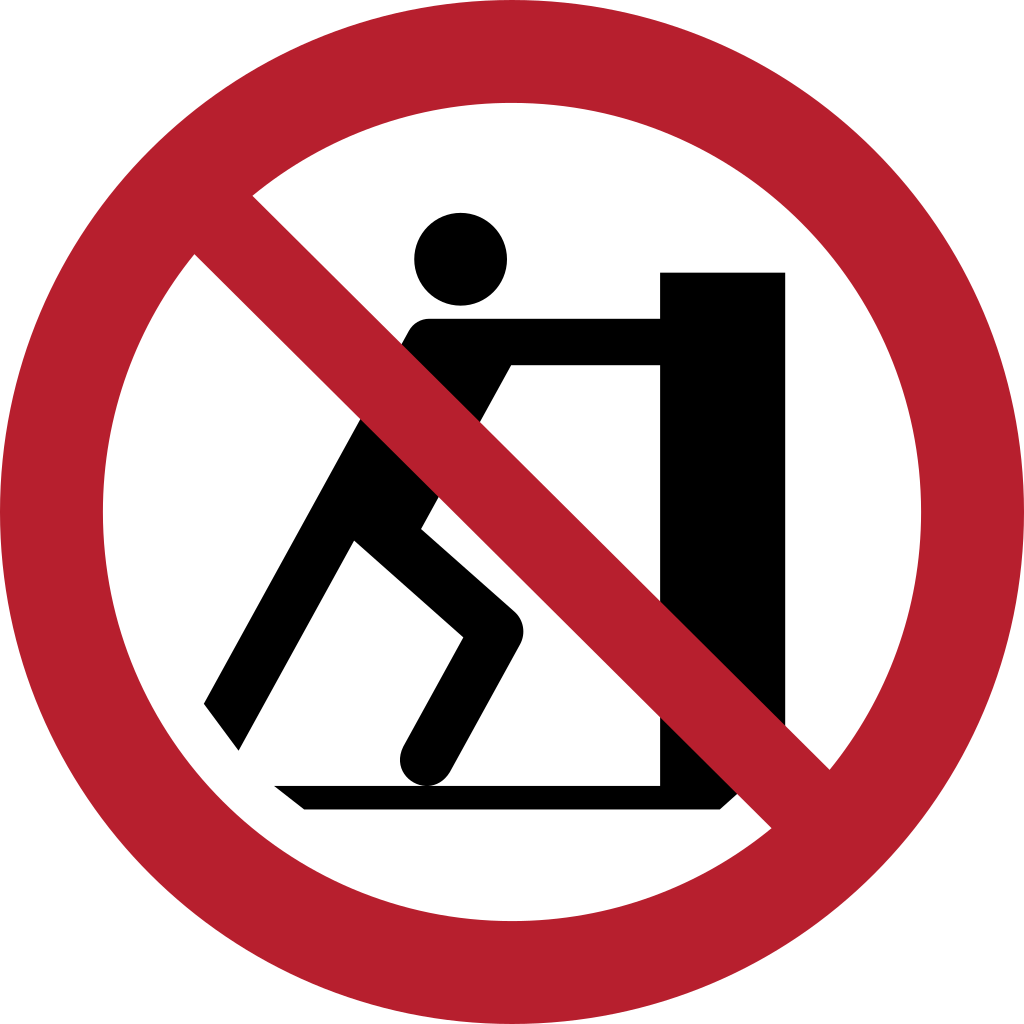
Pushing the marked object is prohibited.
Understanding this sign
Red circular signs with a diagonal bar identify an action that must not be taken in the marked area.
Check what object or action the symbol prohibits. A prohibition sign does not identify all the hazards in an area.
The Behavior P017 Bans
P017 prohibits pushing against an object. The pictogram — two hands pressing against a vertical surface inside the red ISO 3864-1 prohibition circle — marks structures and equipment that will move, tip, break, or fail if someone applies horizontal force to them. Unlike a warning sign, it does not describe what would happen; it simply forbids the action at the point where the action becomes tempting. The object may be a wall, a stack, a barrier, or the person ahead in a queue; the mounting location tells the reader which.
The objects it protects share one trait: they look sturdier than they are against sideways loading. A stacked pallet load, a freestanding partition, a glass panel, or an unbraced rack can carry substantial weight vertically yet topple or shatter under a modest shove. P017 exists precisely because people cannot judge lateral stability by eye. Powered doors and gates belong in the same category, since forcing them by hand strips or jams the mechanism.
Where Facilities Post It
Warehouses use P017 on racking uprights and beside block-stacked goods, where leaning into a stack to reach something can bring a column of pallets down. Construction and events sites apply it to temporary hoarding, fencing panels, and staging that is pinned rather than fixed. Retail and public buildings put it on large glazed panels, display units, and movable partitions that separate crowds from drops or machinery.
It also appears in crowd-management settings — queue rails at venues, stadium concourses, and transit stations — where pushing endangers the people ahead rather than the structure itself. In those locations P017 addresses crushing risk, and event operators typically combine it with stewarding and one-way flow rather than relying on the sign alone. Turnstiles, boarding gates, and escalator landings are recurring positions, since bottlenecks are where shoving concentrates.
Choosing Between P017 and Its Neighbors
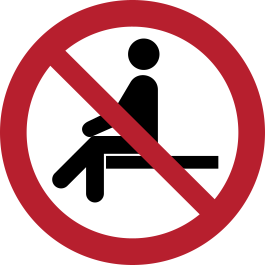
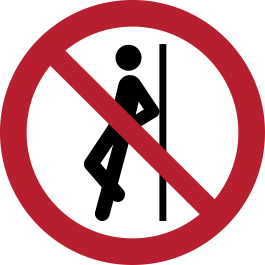
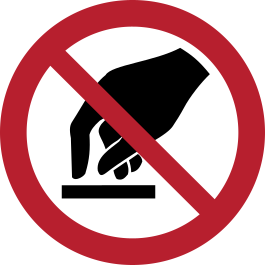
ISO 7010 splits body-contact prohibitions into distinct signs, and picking the right one matters for clarity. Use P018 when the risk is someone sitting on the object, P041 when the concern is leaning body weight against it, and P010 when any touch at all is dangerous, as with energized or contaminated surfaces. P017 is the correct choice only when deliberate pressing or shoving is the failure mode.
Because the sign is meaningful only at the surface it protects, mount it on or immediately beside that surface at hand height rather than grouping it on a distant signboard. On long runs of fencing or glazing, repeat it at intervals so no stretch is more than a few paces from a visible copy. On glass, printed adhesive labels are the usual format, and they double as manifestation that makes the pane itself easier to see.
Where you will see P017
Warehouses apply it to racking uprights and beside block-stacked pallets, construction and event sites put it on temporary hoarding, fencing panels, and pinned staging, and public buildings label large glazed panels and movable partitions. Crowd-management placements include queue rails, stadium concourses, transit stations, turnstiles, and escalator landings, where shoving concentrates at bottlenecks.
Common questions about P017
What does the ISO 7010 P017 no pushing sign actually prohibit?
It forbids applying pushing force to the object or structure it is mounted on. Typical targets are stacked goods, storage racking, temporary fencing and hoarding, glass panels, and movable partitions — things stable under vertical load but liable to tip, collapse, or break when shoved sideways. In crowd settings it also bans pushing against other people in queues.
What is the difference between P017, P018, and P041?
All three restrict body contact with a structure, but each names a different action: P017 bans pushing, P018 bans sitting, and P041 bans leaning. A guardrail overlooking a drop might legitimately carry P018 and P041 together, while a stack of palletized goods gets P017. Choose the sign that matches the behavior people actually attempt at that spot.
Where should a no pushing sign be mounted?
Directly on the vulnerable surface or immediately next to it, at roughly hand or eye height, so the prohibition registers at the moment someone reaches out. On extended barriers, fences, or glazed walls, repeat the sign every few meters. A single copy at the end of a long run will not be seen by someone mid-span.
Reference details
| Symbol code | P017 |
|---|---|
| Sign family | ISO Prohibition Signs |
| Standard reference | ISO 7010:2019 / ISO 3864-1 ISO Online Browsing Platform: P017 |
| Screen color reference | #FF0000. Screen colors are not a production color specification. |
| Download formats | SVG reference artwork; a 1024 × 1024 pixel PNG conversion on a white canvas. |
| Record date | · How to interpret our dates |
| Page updated |
Choosing a physical sign size
Download dimensions are not installation dimensions. Select sign size, material, placement, and lighting using the applicable standard and the actual viewing conditions. Chemical label sizing follows its own rules. Read the artwork and sizing guide.
Sources and artwork credits
- Artwork source
- Wikimedia Commons file page
- Creator credited by source
- ISO
- License
- CC0
- Source metadata checked
SVG files are local reference copies. PNG files are raster conversions. Check the linked file history and license terms before reuse; a source-metadata check is not certification of the artwork or a workplace installation.
Report a correction to this reference