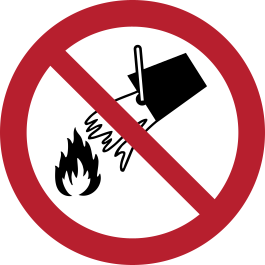
Do not spray with water
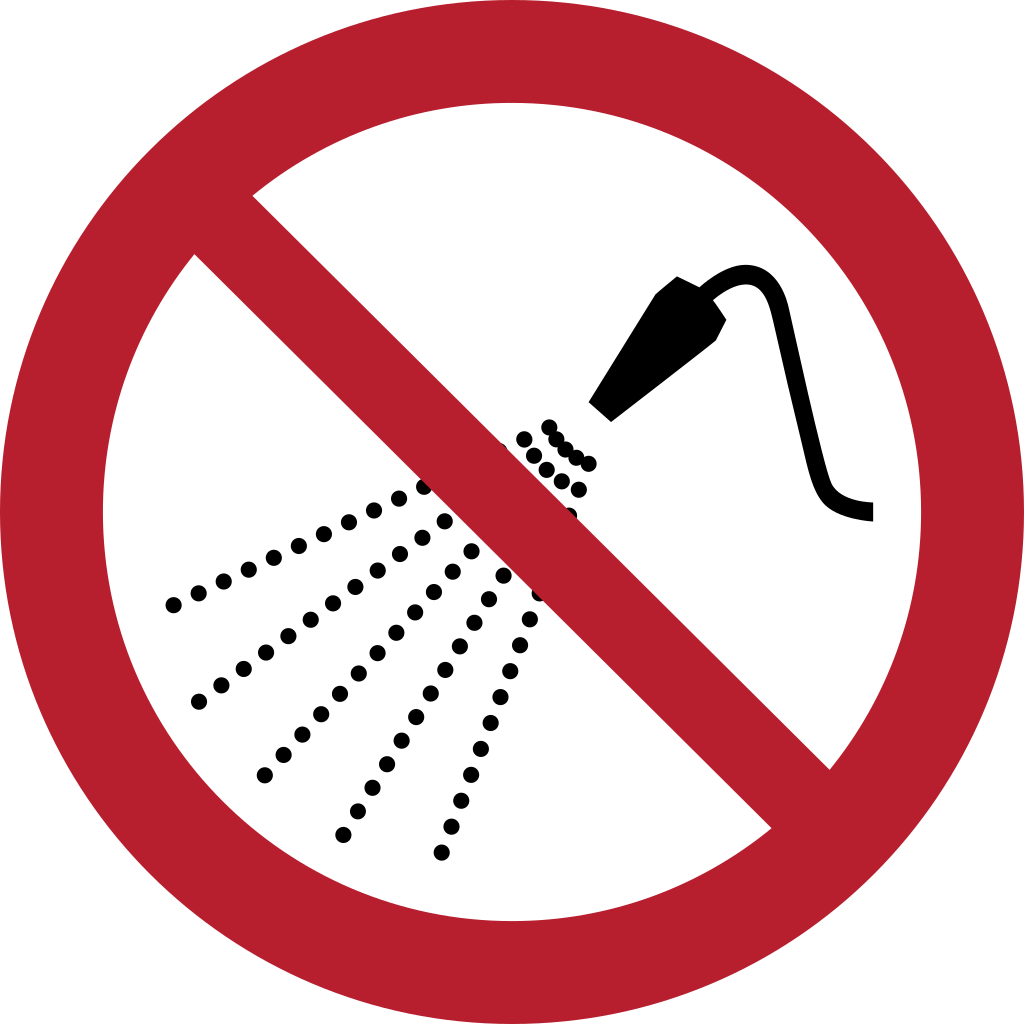
Spraying the marked equipment or surface with water is prohibited.
Understanding this sign
Red circular signs with a diagonal bar identify an action that must not be taken in the marked area.
Check what object or action the symbol prohibits. A prohibition sign does not identify all the hazards in an area.
The Rule P016 Communicates
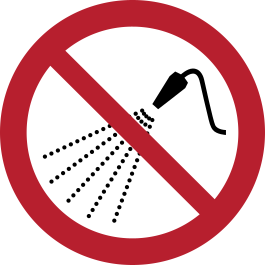
ISO 7010 P016 forbids directing sprayed or jetted water at the marked equipment or area. The pictogram shows a stream of water droplets inside the red prohibition ring. It is most often found on or near live electrical equipment — switchgear, control cabinets, distribution boards, battery installations — and on machinery, materials, or processes that water would damage or turn dangerous, such as certain chemical stores where water reacts with the contents.
The sign targets routine activities rather than emergencies: washdown crews hosing a food-production hall, cleaners pressure-washing a loading bay, groundskeepers with irrigation or hose lines. In wet-cleaned environments such as dairies, breweries, and meat plants, where hosing everything down is the daily norm, electrical enclosures and equipment not sealed against jets are the weak point, and P016 marks the boundary of where the hose must not point.
P016 Versus P011: Cleaning Versus Firefighting
ISO 7010 contains a separate sign, P011 'Do not extinguish with water,' and the two are frequently confused. P011 addresses fire response — it tells a person facing a fire not to use water on it, typically because the installation is electrical or the burning material reacts violently with water. P016 addresses ordinary operations: no hosing, spraying, or jet-washing here, fire or no fire.
The distinction matters when specifying signage. A transformer room may legitimately carry both: P016 so cleaning crews never bring a hose inside, and P011 so anyone responding to a fire reaches for a CO2 or dry-powder extinguisher instead of a water one. Choosing only one leaves half the risk uncommunicated — a room labeled solely against water firefighting says nothing to the contractor arriving with a pressure washer on an ordinary Tuesday.
Why Equipment Carries This Label
Enclosure protection against water is graded by the IP rating system of IEC 60529, and the second digit is what matters here: only equipment rated IPX5 or higher is tested against water jets, and hose-down duty in practice calls for IPX6 or the high-pressure, high-temperature IPX9 rating. A cabinet rated IP54, common for industrial controls, tolerates splashes but not a directed jet — spraying it can drive water past the seals onto live parts.
Manufacturers therefore print P016 on housings, in installation manuals, and on rating plates of products whose enclosures are not jet-proof, alongside the instructions required by machinery and low-voltage product documentation. Beyond the immediate shock and short-circuit risk to whoever holds the hose, water ingress corrodes contacts, terminals, and circuit boards over the following weeks, so the same label protects both people and the equipment's service life.
Where you will see P016
Wet-cleaned food plants such as dairies, breweries, and meat works rely on it to keep washdown hoses away from switchgear, control cabinets, and distribution boards not sealed against jets. Manufacturers also print it on housings and rating plates of equipment below IPX5 jet protection, and a transformer room may carry it alongside P011 so cleaning crews and anyone fighting a fire each receive the correct water rule.
Common questions about P016
What does the crossed-out water spray symbol mean?
It is ISO 7010 P016, 'Do not spray with water.' It prohibits hosing, jetting, or spraying water at the marked equipment or area — usually because live electrical parts are behind an enclosure that is not sealed against jets, or because the material inside would be damaged or react dangerously with water.
Is P016 the same as the do-not-extinguish-with-water sign?
No. P016 covers normal operations such as cleaning and washdown. P011, 'Do not extinguish with water,' covers fire response and tells you to use a non-water extinguishing agent. Electrical rooms often display both, because the water hazard exists during routine cleaning and during a fire alike.
Can I pressure-wash equipment that has a do-not-spray label?
No — that is precisely the activity the label prohibits. Pressure washers exceed the water exposure the enclosure was designed for unless it carries a high jet-proof rating such as IPX6 or IPX9 under IEC 60529. Clean labeled equipment with the method the manufacturer specifies, typically dry wiping or low-moisture techniques with power isolated.
Where is the P016 sign normally installed?
On or immediately beside the vulnerable item: electrical cabinets and switchrooms in washdown areas, outdoor equipment enclosures, battery charging stations, and stores holding water-reactive materials. Manufacturers also apply it directly to product housings and repeat it in the installation and cleaning sections of manuals.
Reference details
| Symbol code | P016 |
|---|---|
| Sign family | ISO Prohibition Signs |
| Standard reference | ISO 7010:2019 / ISO 3864-1 ISO Online Browsing Platform: P016 |
| Screen color reference | #FF0000. Screen colors are not a production color specification. |
| Download formats | SVG reference artwork; a 1024 × 1024 pixel PNG conversion on a white canvas. |
| Record date | · How to interpret our dates |
| Page updated |
Choosing a physical sign size
Download dimensions are not installation dimensions. Select sign size, material, placement, and lighting using the applicable standard and the actual viewing conditions. Chemical label sizing follows its own rules. Read the artwork and sizing guide.
Sources and artwork credits
- Artwork source
- Wikimedia Commons file page
- Creator credited by source
- ISO
- License
- Public domain
- Source metadata checked
SVG files are local reference copies. PNG files are raster conversions. Check the linked file history and license terms before reuse; a source-metadata check is not certification of the artwork or a workplace installation.
Report a correction to this reference