No activated mobile phone
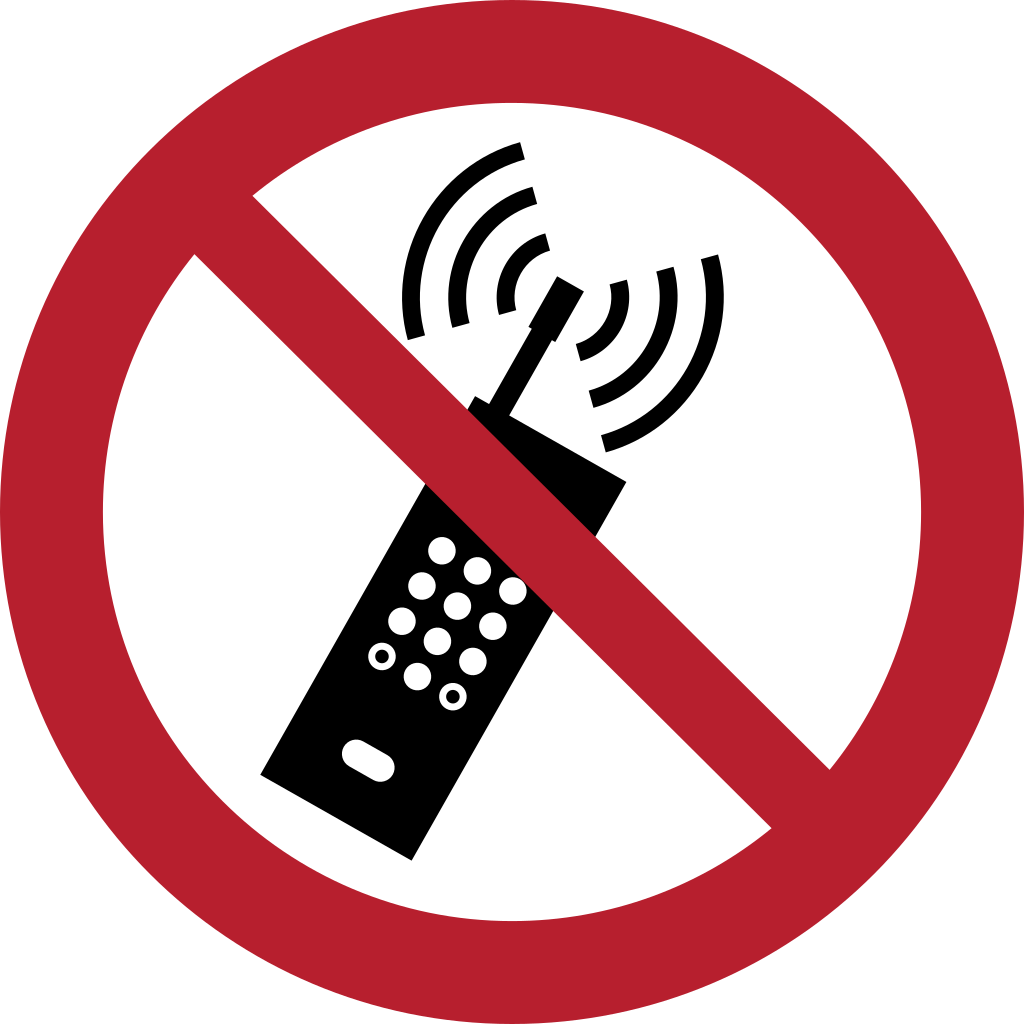
Activated mobile phones are prohibited.
Understanding this sign
Red circular signs with a diagonal bar identify an action that must not be taken in the marked area.
Check what object or action the symbol prohibits. A prohibition sign does not identify all the hazards in an area.
"Activated" Is the Operative Word
P013 prohibits mobile phones that are switched on. The ISO register frames the referent as the activated device, not the object itself: a powered-off phone in a pocket is, strictly read, outside the pictogram's scope. That precision exists because the classic reasons for the ban — radio transmission and live electronics — disappear when the device is off. Sites that instead want phones left outside entirely, common in secure facilities, should say so in supplementary text rather than assume P013 carries that stricter rule.
Ambiguity around flight mode is the practical weak point. A phone in airplane mode is not transmitting but remains an energized electronic device, which matters in explosive atmospheres even though it may be acceptable in interference-sensitive ones. Because viewers cannot resolve that from the symbol, facilities where the distinction is safety-relevant should state the policy explicitly: SWITCH OFF COMPLETELY, or NO TRANSMITTING DEVICES, depending on which risk drives the rule.
Four Different Reasons Sites Ban Phones
In classified hazardous areas, an ordinary phone is uncertified electrical equipment: its battery and circuitry are potential ignition sources in a flammable atmosphere, so ATEX and DSEAR regimes exclude it unless it carries the appropriate Ex rating. Blasting operations add a second mechanism — radio-frequency energy near electric detonators — which is why quarries and demolition sites post phone prohibitions around loading areas. Petrol forecourts commonly display the sign too, largely as precautionary policy, since documented cases of phones igniting fuel vapor are essentially absent.
The other two drivers have nothing to do with fire. Electromagnetic interference concerns lead hospitals to restrict phone use near certain monitoring and life-support equipment and lead test laboratories to keep transmitters away from sensitive measurements. Distraction and security round out the list: phone bans at crane cabs, production lines, and confidential areas target attention and cameras rather than radio emissions, though the same P013 symbol ends up on the door.
Vehicles, Operators, and Site Traffic Rules
Many industrial sites apply P013 to their internal traffic rules: no active phone in forklift seats, crane cabs, yard tractors, or while walking through vehicle routes. Unlike public road law, which varies by jurisdiction but widely restricts handheld phone use when driving, an on-site rule can be as strict as the operator's risk assessment demands — and prohibiting any activated phone during vehicle operation is a defensible standard given the attention demands of pedestrian-dense yards.
Enforceability improves when the sign marks a transition rather than a vague zone. Post P013 at the cab door, the fuel island approach, the battery bay entrance, or the gate to the blasting area, paired with a defined place to leave or stow devices — lockers at a secure entrance, a holster rule for drivers. A prohibition with no compliant alternative for the phone tends to produce hidden use, which is worse than managed use.
Not the Same Sign: P008 and Neighboring Prohibitions
P013 is often confused with P008, the prohibition on metallic articles and watches, because both appear at MRI suites. Their scopes barely overlap: P008 addresses ferromagnetic and metallic objects that a strong magnetic field turns into projectiles or that the field damages, while P013 addresses the device being electronically active. An MRI facility typically needs both messages, since a titanium tool violates one rule and a transmitting phone the other.
In flammable-atmosphere zones, P013 complements rather than duplicates P003. The no-open-flame sign covers matches, lighters, and smoking but is silent on electronics; P013 closes that gap for phones specifically, while the site's Ex equipment regime governs radios, torches, and instruments. Where cameras are the true concern, P029 (no photography) states that rule directly instead of leaving viewers to infer it from a phone symbol.
Where you will see P013
ATEX-classified hazardous areas, quarry and demolition blasting zones with electric detonators, and petrol forecourts post it because an ordinary phone is uncertified electrical equipment. Hospitals restrict phones near certain monitoring and life-support equipment, test laboratories keep transmitters away from sensitive measurements, and industrial sites apply it at forklift seats, crane cabs, fuel islands, and secure-area entrances.
Common questions about P013
Does a no mobile phone sign mean I cannot carry my phone at all?
Strictly, P013 prohibits phones that are switched on, not possession of a powered-off device. However, many facilities enforce a stricter local rule, especially in security-controlled or explosion-classified areas. Read any supplementary text, and where none exists, assume the sign at minimum requires the phone to be fully off, not merely silenced.
Why are mobile phones banned at petrol stations?
The posted rule is precautionary. A phone is an unclassified electronic device near fuel vapor, and forecourt operators prefer a simple blanket rule; confirmed incidents of a phone igniting petrol vapor are essentially absent from the record. Distraction while dispensing fuel is arguably the better-evidenced reason. Either way, the sign reflects site policy you are expected to follow.
What is the difference between P013 and P008?
P013 prohibits activated mobile phones — the issue is a live, transmitting electronic device. P008 prohibits metallic articles and watches — the issue is metal objects near a strong magnetic field, classically an MRI magnet. They address different hazards and MRI facilities generally post both.
Is a phone in airplane mode allowed where a P013 sign is posted?
It depends on why the ban exists, which the symbol alone cannot tell you. Flight mode stops radio transmission, which may satisfy an interference-based rule, but the phone remains powered electronics, which still violates ignition-based rules in explosive atmospheres. Unless posted text explicitly permits flight mode, treat the requirement as fully off.
Reference details
| Symbol code | P013 |
|---|---|
| Sign family | ISO Prohibition Signs |
| Standard reference | ISO 7010:2019 / ISO 3864-1 ISO Online Browsing Platform: P013 |
| Screen color reference | #FF0000. Screen colors are not a production color specification. |
| Download formats | SVG reference artwork; a 1024 × 1024 pixel PNG conversion on a white canvas. |
| Record date | · How to interpret our dates |
| Page updated |
Choosing a physical sign size
Download dimensions are not installation dimensions. Select sign size, material, placement, and lighting using the applicable standard and the actual viewing conditions. Chemical label sizing follows its own rules. Read the artwork and sizing guide.
Sources and artwork credits
- Artwork source
- Wikimedia Commons file page
- Creator credited by source
- ISO
- License
- Public domain
- Source metadata checked
SVG files are local reference copies. PNG files are raster conversions. Check the linked file history and license terms before reuse; a source-metadata check is not certification of the artwork or a workplace installation.
Report a correction to this reference