No heavy load
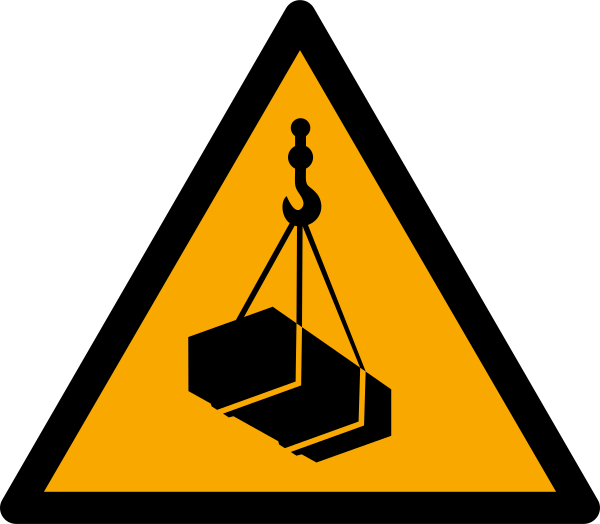
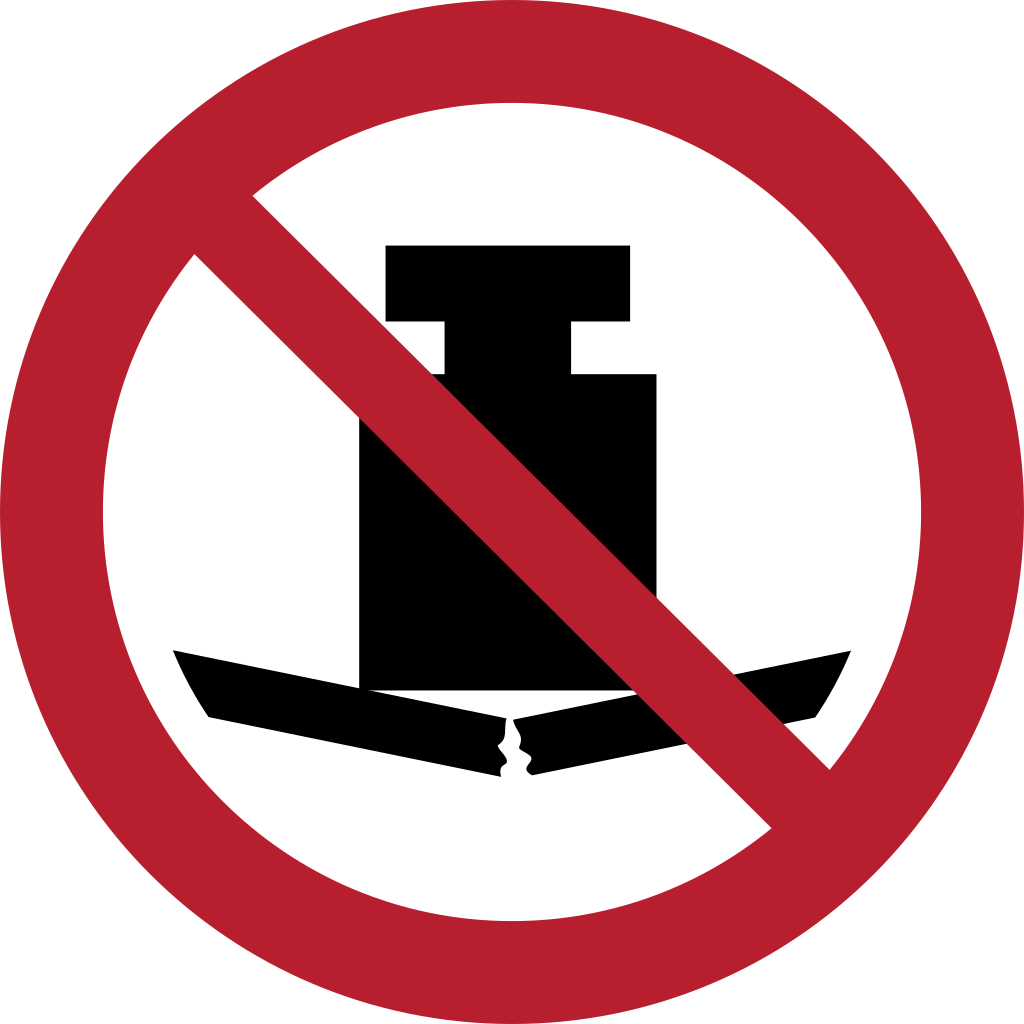
Heavy loads are prohibited on the marked surface or in the marked area.

Understanding this sign
Red circular signs with a diagonal bar identify an action that must not be taken in the marked area.
Check what object or action the symbol prohibits. A prohibition sign does not identify all the hazards in an area.
What ISO 7010 P012 Prohibits
P012 prohibits placing heavy objects on the surface it marks. The target of the sign is a structure with limited bearing capacity — a lightweight platform, a suspended floor, a cover, a housing — where a load that seems reasonable to the person carrying it could deform, crack, or collapse the surface beneath it, sometimes bringing down whatever and whoever is underneath as well.
Heavy is deliberately undefined by the pictogram, which is both its flexibility and its weakness. On its own the sign communicates only that this surface is not for loading; wherever a real limit exists, it should be paired with a supplementary panel stating the figure — for example MAX 50 KG or MAX 300 KG PER SQUARE METER — so the rule is checkable rather than a matter of feel.
Surfaces That Get This Sign
Mezzanine floors and storage platforms designed to a specific rating are frequent hosts, along with raised access floors in server rooms, inspection and trench covers, skylights and lightweight roof decks reached during maintenance, tail lifts and dock levellers loaded beyond their plate, and the tops of machines, control cabinets, and ductwork that maintenance crews treat as shelving.
Packaging is a second family of uses: crates and cartons carry the symbol to stop heavier freight being stacked on top during transport and warehousing. In racking installations the sign supplements — never replaces — the load notice, flagging beams or decks with a lower rating than the bay around them, such as a repaired section pending requalification.
Load Ratings and the Rules Behind Them
The sign is the visible edge of a structural duty. OSHA's walking-working surfaces rule requires employers to ensure every such surface can support its maximum intended load, and building codes require storage floors and platforms to be designed and, in many cases, placarded for their live load. Racking codes of practice likewise call for load notices displayed on each run, stating bay and beam capacities from the manufacturer's design.
P012 earns its place where the engineered rating is easy to violate casually — a pallet set down on a mezzanine walkway rated for foot traffic, a toolbox on a fragile cover — and where exceeding it fails suddenly rather than visibly. Deciding where it goes is therefore an engineering task: the rating comes from calculation or the manufacturer, and the sign merely publishes the result at the point of temptation.
Where you will see P012
Mezzanine floors and storage platforms designed to a specific rating carry this sign, along with raised access floors in server rooms, inspection and trench covers, skylights and lightweight roof decks, tail lifts and dock levellers, and the tops of machines and control cabinets that maintenance crews treat as shelving. It also appears on crates and cartons to stop heavier freight being stacked on top during transport and warehousing.
Common questions about P012
What weight counts as a heavy load under the P012 sign?
The pictogram sets no number; the limit is whatever the surface was engineered for. That is why P012 should carry supplementary text with the actual figure taken from the structural design or the manufacturer's rating. Without a stated limit, treat the sign as meaning place nothing on this surface beyond what a person walking across it represents.
What is the difference between a P012 sign and a rack load notice?
A load notice is an information placard giving the permitted loads for a racking run — bay capacity, beam capacity, configuration — and every installation should have one. P012 is a prohibition aimed at behavior, used where loading must not happen at all or must stay under a stated cap, such as a derated bay, a walkway, or the top shelf of a structure not designed for storage. They complement each other rather than substitute.
Is a no-heavy-load sign required by OSHA or building regulations?
The sign itself is rarely named in regulation, but the duty behind it is: OSHA requires walking-working surfaces to support their maximum intended load, and building codes require floors used for storage to be designed for the loads imposed. Posting P012 with the rated capacity is the recognized way to demonstrate the limit was communicated to the people able to exceed it.
Why do shipping crates carry a no-heavy-load symbol?
To control stacking. A crate rated to protect its contents can still be crushed by heavier freight placed on top during transit or warehousing, so packers mark the lid to tell handlers that nothing heavy may be stacked there. It works alongside other package handling marks such as this-way-up and fragile symbols, and it binds every handler in the chain, not just the shipper.
Reference details
| Symbol code | P012 |
|---|---|
| Sign family | ISO Prohibition Signs |
| Standard reference | ISO 7010:2019 / ISO 3864-1 ISO Online Browsing Platform: P012 |
| Screen color reference | #FF0000. Screen colors are not a production color specification. |
| Download formats | SVG reference artwork; a 1024 × 1024 pixel PNG conversion on a white canvas. |
| Record date | · How to interpret our dates |
| Page updated |
Choosing a physical sign size
Download dimensions are not installation dimensions. Select sign size, material, placement, and lighting using the applicable standard and the actual viewing conditions. Chemical label sizing follows its own rules. Read the artwork and sizing guide.
Sources and artwork credits
- Artwork source
- Wikimedia Commons file page
- Creator credited by source
- ISO
- License
- Public domain
- Source metadata checked
SVG files are local reference copies. PNG files are raster conversions. Check the linked file history and license terms before reuse; a source-metadata check is not certification of the artwork or a workplace installation.
Report a correction to this reference