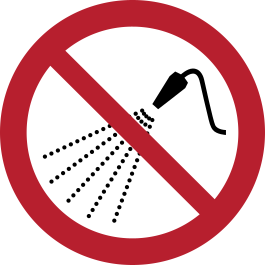
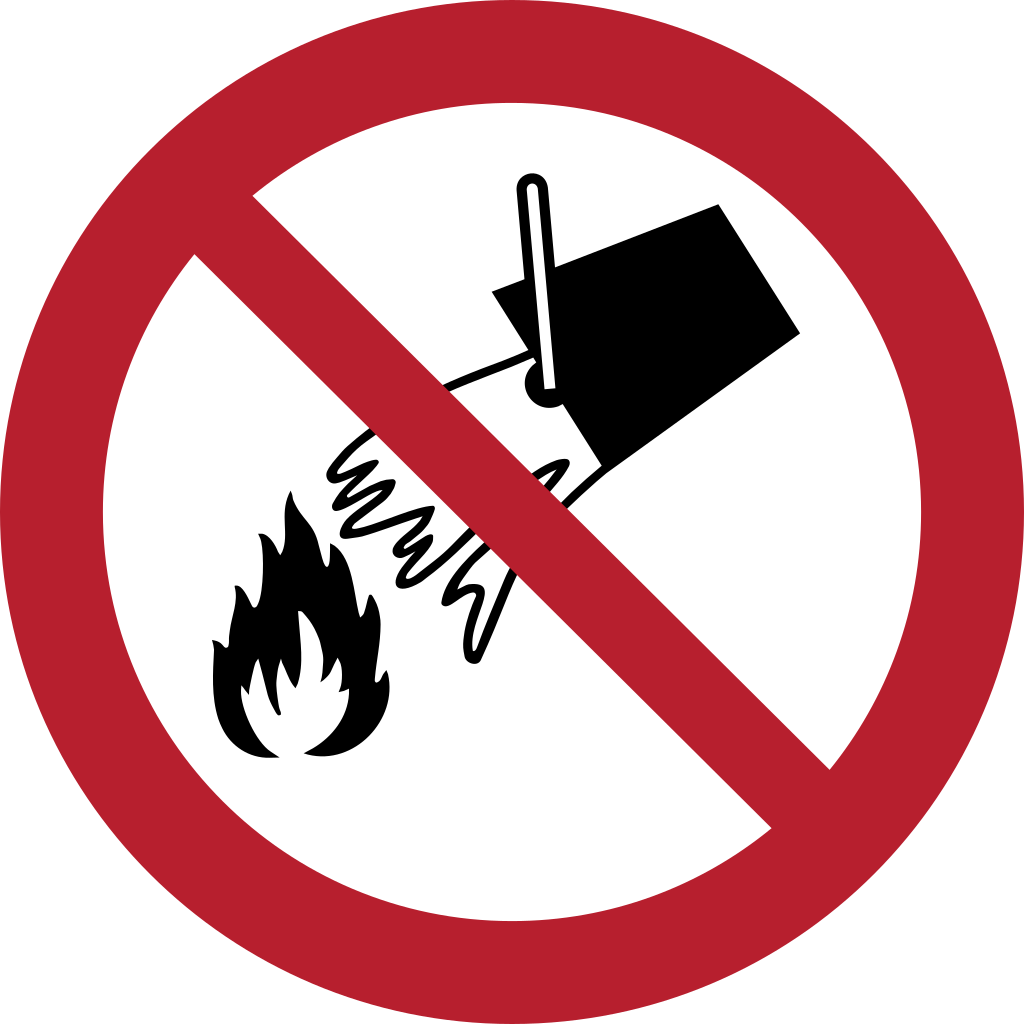
Do not extinguish with water
Water is not to be used for extinguishing a fire in the indicated situation.
Understanding this sign
Red circular signs with a diagonal bar identify an action that must not be taken in the marked area.
Check what object or action the symbol prohibits. A prohibition sign does not identify all the hazards in an area.
What P011 Means
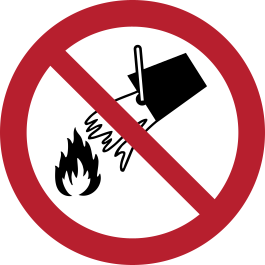
ISO 7010 P011 tells anyone responding to a fire at this location that water must not be used as the extinguishing medium. The pictogram shows water being poured from a bucket onto flames, struck through with the red prohibition band defined in ISO 3864-1. Its ISO register function is short and absolute: to prohibit using water to extinguish a fire.
The sign exists because the instinctive response to fire — throw water on it — is lethal for several fire classes. Water conducts electricity back to the person holding the hose or extinguisher, reacts violently with burning metals, and turns instantly to expanding steam when it hits burning oil or fat, ejecting flaming liquid across the room. P011 interrupts that instinct at the exact spot where it would do harm.
Fires Where Water Makes Things Worse
Live electrical equipment is the most common reason to post P011: transformer rooms, switchgear, server rooms, battery charging bays, and control cabinets. A water stream onto energized parts can electrocute the firefighter and destroy equipment that a clean agent or CO2 would have spared. Combustible metals are the second major case. Burning magnesium, sodium, lithium, or titanium — Class D fires — split water into hydrogen and oxygen, producing explosive flare-ups; machining shops with fine swarf and battery processing areas fall in this group.
The third case is hot cooking oil and fat, classed as Class K in the United States and Class F in Europe. Water sinking into oil far above its boiling point flashes to steam and erupts, which is why commercial kitchens post P011 beside fryers. Some chemical stores also qualify, such as areas holding calcium carbide or other water-reactive substances flagged by their safety data sheets.
Pairing With Extinguishing Equipment Signage
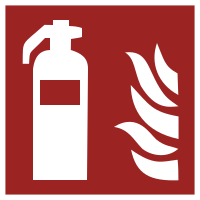
P011 is only half of a message. Telling people what not to use without pointing to the correct medium invites hesitation during the seconds that decide whether a fire stays small. Facilities normally mount it alongside the ISO F-series equipment signs — F001 marking the extinguisher itself — with the extinguisher selected for the actual hazard: CO2 or clean agent for electrical rooms, Class D powder for metal fires, wet chemical for fryers.
The sign also earns a place directly on equipment. Oil-filled transformers, fryer stations, and metal-chip collection bins are frequently labeled with P011 so the prohibition travels with the hazard rather than staying on a wall someone may not glance at. Fire response plans and hot-work permits should repeat the restriction in text, since responders under stress read pictograms faster than procedures but training has to establish the meaning first.
Where you will see P011
Transformer rooms, switchgear, server rooms, battery charging bays, and control cabinets are the most common hosts, along with machining shops handling magnesium or titanium swarf and commercial kitchens, where it sits beside fryers. The sign is also applied directly to oil-filled transformers and metal-chip collection bins, normally mounted with F-series signage pointing to the correct medium — CO2 or clean agent, Class D powder, or wet chemical.
Common questions about P011
Which types of fire should never be put out with water?
Fires involving live electrical equipment, combustible metals such as magnesium, sodium, lithium, and titanium (Class D), and hot cooking oils or fats (Class K in the US, Class F in Europe). Water conducts current on electrical fires, generates explosive hydrogen on metal fires, and flashes to steam on oil fires, throwing burning liquid outward. Flammable liquids that float on water can also spread when hosed.
What extinguisher should be used where a P011 sign is posted?
It depends on the hazard the sign protects. Electrical rooms typically stock CO2 or clean-agent extinguishers, metal-working areas need specialist Class D powder, and commercial kitchens use wet chemical units designed for fat fires. The site fire risk assessment determines the medium; the P011 sign should always sit near an F-series sign marking the correct equipment.
Why does water make a grease or oil fire explode?
Cooking oil burns at temperatures far above 100 C. Water poured on it sinks, boils instantly, and expands to many times its liquid volume as steam. That eruption ejects droplets of burning oil into the air, turning a contained pan fire into a fireball. Smothering with a lid, fire blanket, or wet chemical extinguisher is the safe response.
Is the do-not-extinguish-with-water sign legally required?
No law names P011 specifically, but general fire safety duties get you there. Fire risk assessment regimes in the EU and UK, and OSHA's fire protection rules in the US, require employers to match extinguishing equipment to the hazard and communicate restrictions to workers. Where using water would endanger responders, posting P011 is the recognized way to discharge that duty.
Reference details
| Symbol code | P011 |
|---|---|
| Sign family | ISO Prohibition Signs |
| Standard reference | ISO 7010:2019 / ISO 3864-1 ISO Online Browsing Platform: P011 |
| Screen color reference | #FF0000. Screen colors are not a production color specification. |
| Download formats | SVG reference artwork; a 1024 × 1024 pixel PNG conversion on a white canvas. |
| Record date | · How to interpret our dates |
| Page updated |
Choosing a physical sign size
Download dimensions are not installation dimensions. Select sign size, material, placement, and lighting using the applicable standard and the actual viewing conditions. Chemical label sizing follows its own rules. Read the artwork and sizing guide.
Sources and artwork credits
- Artwork source
- Wikimedia Commons file page
- Creator credited by source
- ISO
- License
- Public domain
- Source metadata checked
SVG files are local reference copies. PNG files are raster conversions. Check the linked file history and license terms before reuse; a source-metadata check is not certification of the artwork or a workplace installation.
Report a correction to this reference