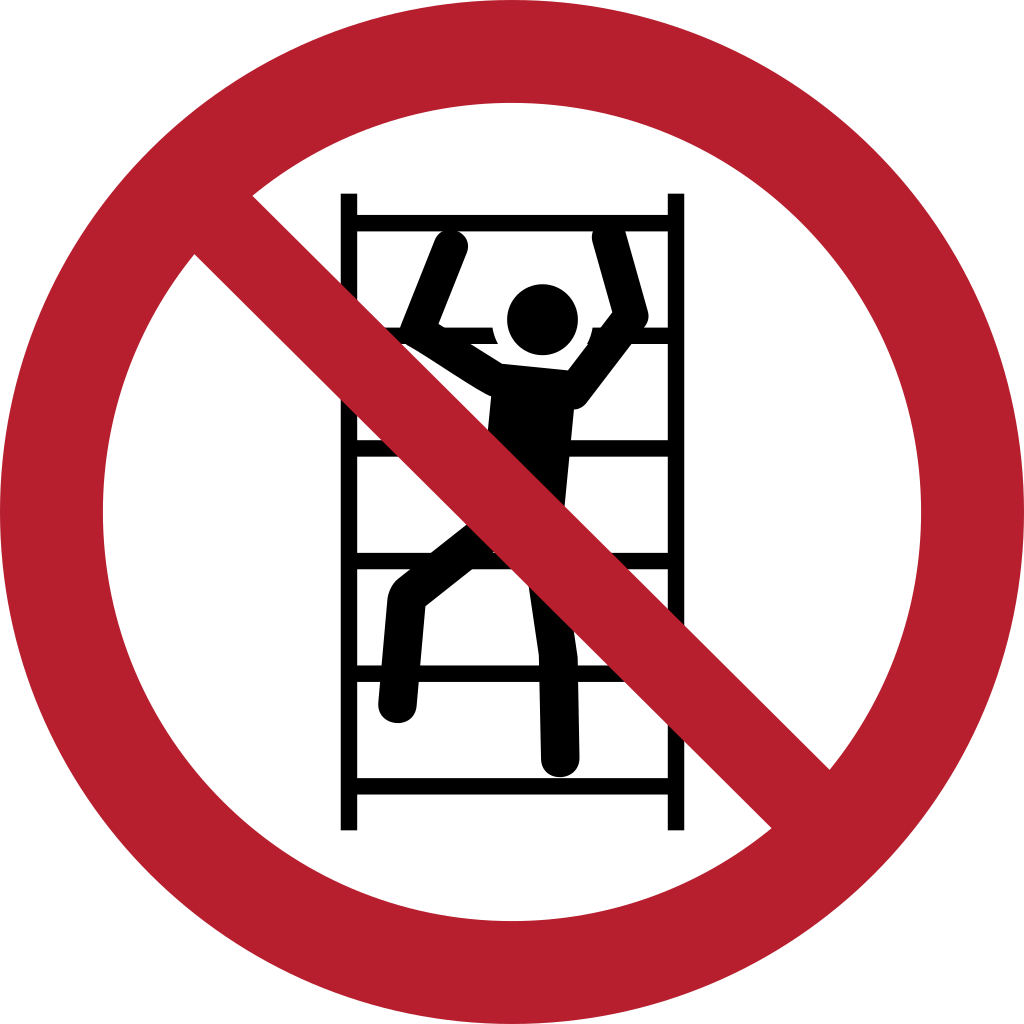
No climbing
Climbing on the marked structure is prohibited.
Understanding this sign
Red circular signs with a diagonal bar identify an action that must not be taken in the marked area.
Check what object or action the symbol prohibits. A prohibition sign does not identify all the hazards in an area.
What ISO 7010 P009 Prohibits
P009 prohibits climbing on the structure where it is mounted. The behavior it targets is improvised ascent — scaling shelving to reach stock, stepping on a conveyor guard to see over it, going up a fence or gate, using a machine frame as a ladder — rather than the use of proper access equipment, which remains permitted and is usually the alternative the sign is pointing people toward.
The hazards are twofold. The climber can fall, and structures never designed as footholds fail without warning: a rack beam dislodges, a guard panel flexes, a gate swings. The structure can also fail under the climber — pallet racking loaded with tonnes of stock can be destabilized by someone pulling themselves up a front upright, endangering everyone in the aisle below.
Where Facilities Post It
Warehouses put P009 on racking uprights because climbing for a quick pick is a persistent shortcut culture problem wherever ladders or order pickers feel slow. Other regular hosts include perimeter fences and gates (both to keep intruders off and to stop staff vaulting them), conveyors and machine enclosures, stacked pallets and materials, tank and silo exteriors without engineered access, scaffolding closed to non-erectors, and streetworks barriers.
Public-facing uses matter too: balustrades and parapets in stadiums and shopping centers, monuments and plinths, electricity pylons and substation fences, railway embankment fencing, and playground boundaries facing hazards. For children, who climb by default and read signs poorly, P009 documents the rule for supervising adults while the fence design — anti-climb profile, height, no horizontal rails — does the actual preventing.
The Sign Is the Weakest Control
People climb when climbing is the fastest route to the task, so a prohibition without an alternative mostly generates violations. Effective programs pair P009 with reachable means of access — steps, platform ladders, mobile elevating work platforms, kick stools — positioned close enough that the compliant option costs seconds, not minutes, and with stock placement that keeps frequent picks at low levels.
In workplace law terms, P009 sits at the bottom of the hierarchy of controls: an administrative measure that neither removes the height nor guards it. Fall protection regulations still govern any legitimate work at the location, and anti-climb design — smooth uprights, mesh instead of rungs, angled toppings on fences — outperforms any sticker. Use the sign to state the rule, not to discharge the duty.
Where you will see P009
Warehouses fix it to pallet racking uprights, where climbing for a quick pick is a persistent shortcut culture, and it also guards perimeter fences and gates, conveyors and machine enclosures, tanks and silos without engineered access, and scaffolding closed to non-erectors. Public-facing placements include stadium balustrades, monuments, electricity pylons, and substation fences, with anti-climb design and nearby steps or platform ladders doing the work the sticker cannot.
Common questions about P009
Does a no-climbing sign apply to ladders and access platforms?
No. P009 prohibits climbing on the structure itself — racking, fencing, machinery, stacked goods — not the use of equipment designed for ascent. Fixed ladders, stair towers, and mobile platforms remain the approved route, and the sign is often installed precisely to push people onto them instead of the shortcut.
Why is climbing pallet racking so dangerous?
Racking is engineered to carry vertical pallet loads on beams, not point loads from hands and feet on uprights and braces. A climber can dislodge a poorly seated pallet onto themselves, bend a brace that later contributes to a collapse, or simply fall onto concrete from picking height. Rack manufacturers and racking codes of practice treat climbing as prohibited misuse, and P009 on the end frames states that.
Is a no-climbing sign enough to stop trespassers on fences or pylons?
Legally it strengthens the operator's position by proving warning was given, but physically it stops nobody determined. Anti-climb measures — flat-faced palisade, fine mesh, height, rotating or angled toppings, guard rings on pylon legs — do the real work, with the sign layered on top. For energized infrastructure, warning signs about the electrical danger belong alongside the prohibition.
Where on racking should P009 signs be fixed?
On the upright faces at aisle ends and at intervals along long runs, at standing eye height where a would-be climber grips the frame. Placing them beside the rack load notice groups the misuse rules in one spot, and repeating the symbol in pick zones with known shortcut pressure targets the sign at the moment of decision.
Reference details
| Symbol code | P009 |
|---|---|
| Sign family | ISO Prohibition Signs |
| Standard reference | ISO 7010:2019 / ISO 3864-1 ISO Online Browsing Platform: P009 |
| Screen color reference | #FF0000. Screen colors are not a production color specification. |
| Download formats | SVG reference artwork; a 1024 × 1024 pixel PNG conversion on a white canvas. |
| Record date | · How to interpret our dates |
| Page updated |
Choosing a physical sign size
Download dimensions are not installation dimensions. Select sign size, material, placement, and lighting using the applicable standard and the actual viewing conditions. Chemical label sizing follows its own rules. Read the artwork and sizing guide.
Sources and artwork credits
- Artwork source
- Wikimedia Commons file page
- Creator credited by source
- ISO
- License
- Public domain
- Source metadata checked
SVG files are local reference copies. PNG files are raster conversions. Check the linked file history and license terms before reuse; a source-metadata check is not certification of the artwork or a workplace installation.
Report a correction to this reference