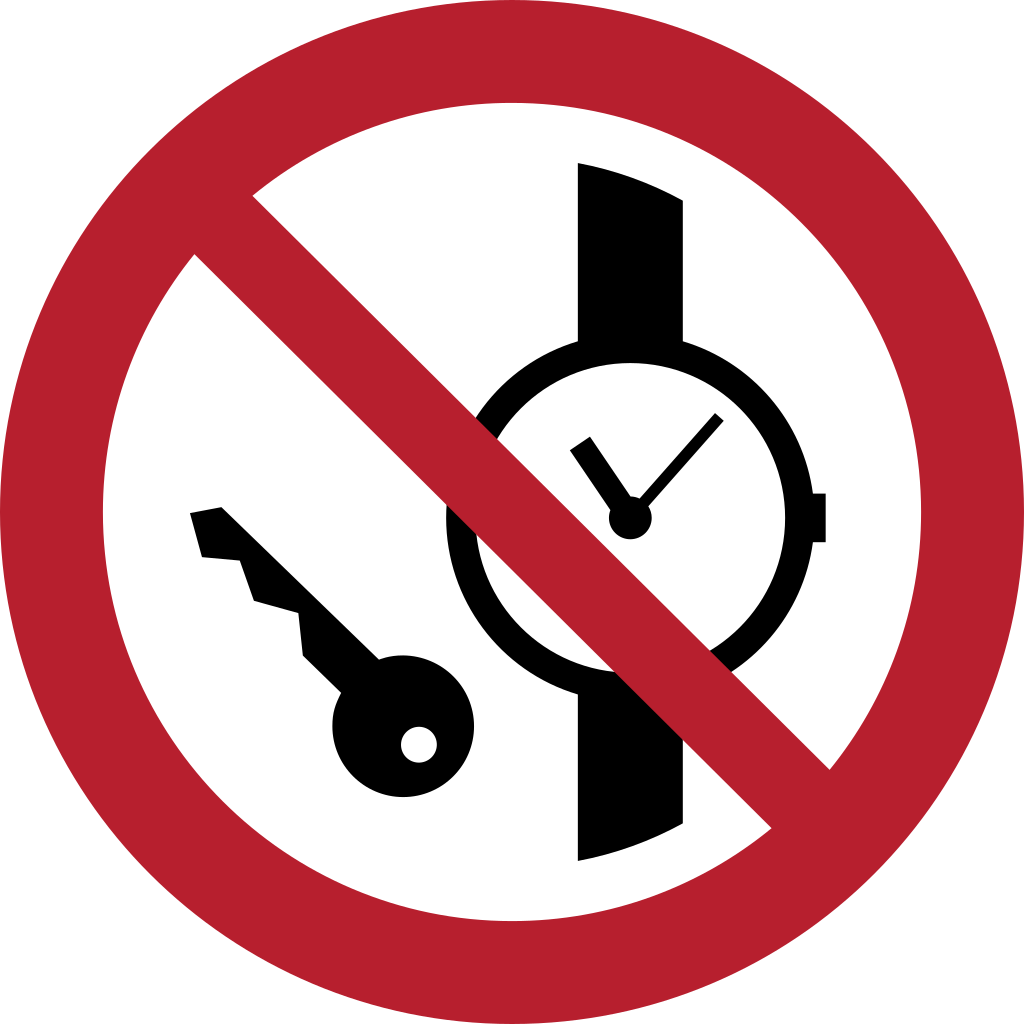
No metallic articles or watches
Metallic articles and watches are prohibited.
Understanding this sign
Red circular signs with a diagonal bar identify an action that must not be taken in the marked area.
Check what object or action the symbol prohibits. A prohibition sign does not identify all the hazards in an area.
What ISO 7010 P008 Prohibits
P008 forbids bringing metallic articles or watches past the point where it is displayed. That covers the loose ferromagnetic objects people routinely carry — keys, coins, multitools, pocket knives, belt buckles, hairpins, steel-toed footwear in some site rules — plus watches, which the pictogram calls out separately because both mechanical movements and the watch body itself are vulnerable to strong fields.
The reason is the projectile effect. Near a powerful static magnet, a steel object experiences a pull that grows extremely fast as distance closes; a hand tool can be ripped from a pocket and accelerate toward the magnet bore with enough force to injure anyone in its path. Gas cylinders, floor buffers, and stretchers have all been pulled into MRI magnets in documented incidents, which is why the rule extends down to the smallest carried item.
Typical Locations and Boundary Setup
P008 appears at the door of MRI magnet rooms (Zone IV in ACR-style layouts), NMR and EPR spectroscopy labs, magnet test and calibration benches, degaussing stations, and around superconducting magnets in physics facilities. Some sites also use it at induction heating equipment, where a carried steel item can heat rapidly in the alternating field, and at magnetic media archives where a stray magnetized tool threatens stored data rather than people.
The sign only works if there is somewhere to put the prohibited items, so it is normally paired with lockers or trays immediately outside the boundary and, in clinical MRI, with a ferromagnetic detection portal as a technical backstop. Making the P008 position the final divest point — after which nothing metallic is carried further — is the practical design goal.
How P008 Differs from P007 and P014
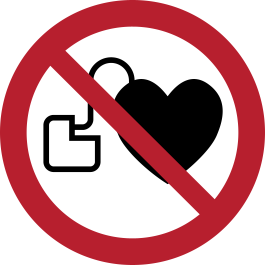
Within the ISO 7010 magnetic-field trio, P008 is the only sign about things rather than people. Its prohibition can be satisfied on the spot: empty your pockets, remove your watch, leave the toolbox outside. P007 (active implanted cardiac devices) and P014 (metallic implants) address hazards inside the body that cannot be removed, so those two exclude the person entirely.
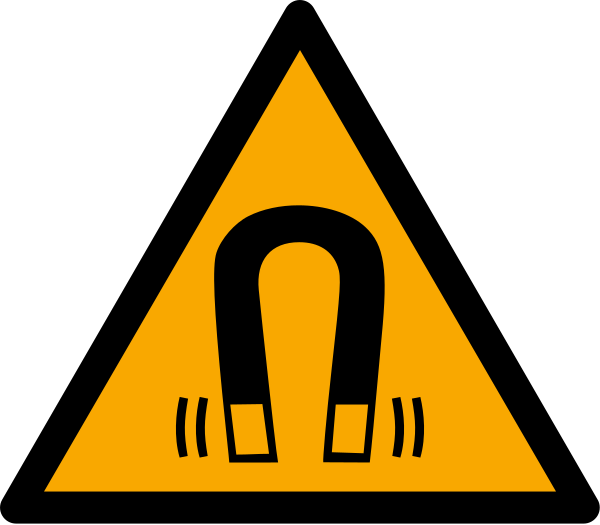
All three are typically grouped with the W006 magnetic field warning at the same threshold. If a facility posted only P008, a visitor with a pacemaker or an aneurysm clip could reasonably believe they were compliant after emptying their pockets — the trio exists because each sign closes a gap the others leave open, and the boundary is only as safe as its least-covered category.
Running a Metal-Free Zone in Practice
Strictly, only ferromagnetic materials are pulled by the field — aluminum, brass, and titanium are not — but most facilities enforce a blanket no-metal rule at the sign line because staff cannot verify alloy composition at a glance. Where work inside the zone genuinely requires tools, sites procure tools tested and labeled for MR environments rather than granting exceptions to the general rule.
Watches deserve their own briefing point. A mechanical watch can be magnetized and permanently thrown off time by fields far weaker than those that create projectile risk, and smartwatches add a recording and distraction dimension some facilities also want excluded. Telling staff to leave all watches in the locker is simpler than adjudicating which kind is on someone's wrist.
Where you will see P008
MRI magnet room doors, NMR and EPR spectroscopy labs, magnet test benches, degaussing stations, and superconducting magnet halls in physics facilities are the standard placements, usually paired with lockers or trays just outside the line. Some sites extend it to induction heating equipment, where carried steel heats rapidly, and to magnetic media archives; clinical MRI suites add ferromagnetic detection portals as a backstop.
Common questions about P008
Does the P008 sign ban all metal or only magnetic metal?
The pictogram prohibits metallic articles generally, and most sites enforce it that way even though only ferromagnetic materials — iron, steel, nickel alloys — are actually attracted by a magnet. Aluminum or brass items pose little projectile risk, but a blanket rule is used because nobody at the door can reliably identify an alloy, and non-ferrous conductive items can still heat in time-varying fields.
Why are watches specifically mentioned in the no-metallic-articles sign?
Watches are the metallic item people most often forget they are wearing, and they are damaged at field strengths well below projectile levels — a mechanical movement can be magnetized and run badly afterwards. Calling watches out on the sign face closes the most common compliance gap at magnet room doors.
Where do people leave their belongings at a P008 boundary?
Immediately outside it. The sign should coincide with a divest point — lockers, keyed cabinets, or trays — so that compliance is easy and nothing metallic is carried past the line. Clinical MRI departments often add a ferromagnetic detector at the same threshold to catch items the person missed.
Is P008 enough on its own at an MRI or magnet lab entrance?
No. P008 only handles removable objects. A complete boundary also needs P007 for people with active cardiac implants and P014 for people with metallic implants, plus the W006 magnetic field warning so visitors understand why the rules exist. The four signs together are the standard package at strong-magnet thresholds.
Reference details
| Symbol code | P008 |
|---|---|
| Sign family | ISO Prohibition Signs |
| Standard reference | ISO 7010:2019 / ISO 3864-1 ISO Online Browsing Platform: P008 |
| Screen color reference | #FF0000. Screen colors are not a production color specification. |
| Download formats | SVG reference artwork; a 1024 × 1024 pixel PNG conversion on a white canvas. |
| Record date | · How to interpret our dates |
| Page updated |
Choosing a physical sign size
Download dimensions are not installation dimensions. Select sign size, material, placement, and lighting using the applicable standard and the actual viewing conditions. Chemical label sizing follows its own rules. Read the artwork and sizing guide.
Sources and artwork credits
- Artwork source
- Wikimedia Commons file page
- Creator credited by source
- ISO
- License
- CC0
- Source metadata checked
SVG files are local reference copies. PNG files are raster conversions. Check the linked file history and license terms before reuse; a source-metadata check is not certification of the artwork or a workplace installation.
Report a correction to this reference