No access for people with active implanted cardiac devices
Access by people with active implanted cardiac devices is prohibited.

Understanding this sign
Red circular signs with a diagonal bar identify an action that must not be taken in the marked area.
Check what object or action the symbol prohibits. A prohibition sign does not identify all the hazards in an area.
What ISO 7010 P007 Prohibits
P007 bars entry to a designated area for anyone with an active implanted cardiac device: a pacemaker, an implantable cardioverter-defibrillator (ICD), or a cardiac resynchronization device. These implants contain electronics and sensing leads that strong static magnetic fields and electromagnetic fields can disturb — a magnet can switch a pacemaker into asynchronous magnet mode, inhibit pacing, or cause an ICD to withhold or deliver therapy inappropriately.
The pictogram addresses the person, not an object. Someone carrying a wrench can leave it at the door; someone with a pacemaker cannot, so the only safe control is to keep that person outside the field boundary entirely. The sign therefore functions as a screening trigger: anyone with a cardiac implant must stop and identify themselves before crossing the line.
Where the Sign Is Posted
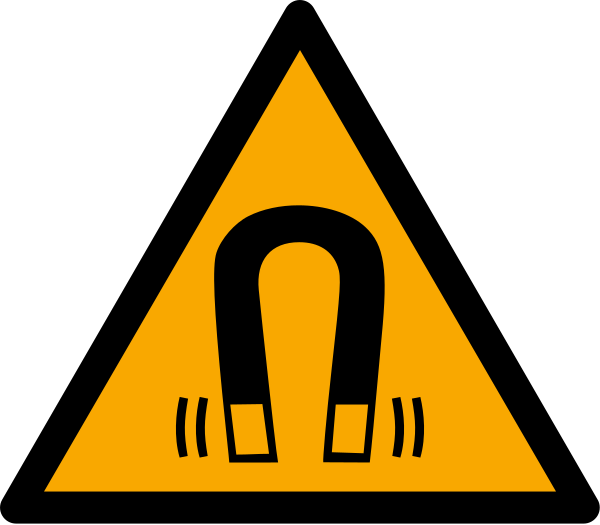
The classic locations are MRI suites, NMR spectrometer rooms, induction furnaces and induction heating lines, resistance welding stations, degaussing and magnetizing equipment, and large electromagnets in research or scrap handling. In hospital MRI practice following the ACR zoning model, P007 belongs at the transition into the controlled zones (Zone III and the magnet room itself, Zone IV), where the static field becomes significant.
In the EU, the electromagnetic fields directive (2013/35/EU) explicitly treats workers with active implanted medical devices as a group at particular risk, and employers must assess EMF exposure for them separately. Posting P007 at the perimeter of assessed field zones — conventionally the area beyond the 0.5 mT line for cardiac implants — is the standard way to make that assessment visible on the floor.
P007, P008 and P014: The Magnetic Access Trio
ISO 7010 splits magnetic-field access control across three prohibition signs. P007 covers active electronic cardiac implants. P014 covers metallic implants generally — passive hardware such as aneurysm clips, stents, and joint prostheses that a field can pull, twist, or heat. P008 covers removable items: metallic articles and watches that must be left outside because they become projectiles or get damaged near a strong magnet.
The three are usually mounted together at the same boundary, alongside the yellow W006 magnetic field warning triangle. W006 explains the hazard; the P-series signs state who and what may not pass. Presenting them as a set is what makes the boundary self-explanatory to a visitor who has never been briefed — a contractor arriving to service air handling above an NMR lab gets the whole rule at a glance.
What the Sign Cannot Decide
Many current pacemakers and ICDs are labeled MR Conditional, meaning MRI scanning is permitted under a defined protocol with the device reprogrammed and monitored. P007 does not overrule that: in an imaging context it stops the person at the door so qualified staff can screen them, check the device labeling, and either turn them away or admit them under the conditional protocol.
In industrial settings there is usually no equivalent supervised pathway, so the prohibition is absolute in practice. Facilities should back the sign with a worker-declaration process at hiring and after any surgery, because an implant is invisible — a sign only works if people know it applies to them and feel safe disclosing a medical device.
Where you will see P007
MRI suites and NMR spectrometer rooms are the classic locations, with the sign posted at the transition into controlled field zones, conventionally the area beyond the 0.5 mT line. Industry applies it around induction furnaces and heating lines, resistance welding stations, degaussing and magnetizing equipment, and large electromagnets in research or scrap handling, usually mounted together with P014, P008, and the W006 magnetic field warning at the same boundary.
Common questions about P007
What is the difference between ISO 7010 P007 and P014?
P007 excludes people with active implanted cardiac devices — pacemakers, ICDs, and similar powered electronics whose function a magnetic or electromagnetic field can disrupt. P014 excludes people with metallic implants of any kind, including passive hardware like aneurysm clips, stents, and orthopedic prostheses, where the risks are field-induced force, torque, and heating rather than electronic malfunction. Strong-field facilities typically post both.
Does P007 apply to people with MR Conditional pacemakers?
Yes, in the sense that they must still stop at the sign. MR Conditional labeling means a scan is possible only under the manufacturer's specified conditions, with the device checked and programmed by qualified staff. The sign exists precisely so that screening happens before entry; it is not a blanket clearance for conditional devices, and outside imaging departments there is usually no conditional pathway at all.
Where should the no-pacemaker sign be placed around an MRI or magnet room?
At the boundary where the field becomes a risk to cardiac implants, before a person can wander into it — not just on the magnet room door. The long-standing convention is to control access to the region beyond the 0.5 mT (5 gauss) contour, and in ACR-style MRI zoning that means signage at the entrance to Zone III as well as Zone IV.
Which implants count as active implanted cardiac devices?
Powered cardiac electronics: pacemakers, implantable cardioverter-defibrillators, cardiac resynchronization therapy devices, and implantable loop recorders are the usual list. Other active implants such as neurostimulators or insulin pumps are also field-sensitive, but they fall under broader EMF risk assessment rather than the P007 pictogram, which specifically depicts a cardiac implant.
Reference details
| Symbol code | P007 |
|---|---|
| Sign family | ISO Prohibition Signs |
| Standard reference | ISO 7010:2019 / ISO 3864-1 ISO Online Browsing Platform: P007 |
| Screen color reference | #FF0000. Screen colors are not a production color specification. |
| Download formats | SVG reference artwork; a 1024 × 1024 pixel PNG conversion on a white canvas. |
| Record date | · How to interpret our dates |
| Page updated |
Choosing a physical sign size
Download dimensions are not installation dimensions. Select sign size, material, placement, and lighting using the applicable standard and the actual viewing conditions. Chemical label sizing follows its own rules. Read the artwork and sizing guide.
Sources and artwork credits
- Artwork source
- Wikimedia Commons file page
- Creator credited by source
- ISO
- License
- Public domain
- Source metadata checked
SVG files are local reference copies. PNG files are raster conversions. Check the linked file history and license terms before reuse; a source-metadata check is not certification of the artwork or a workplace installation.
Report a correction to this reference