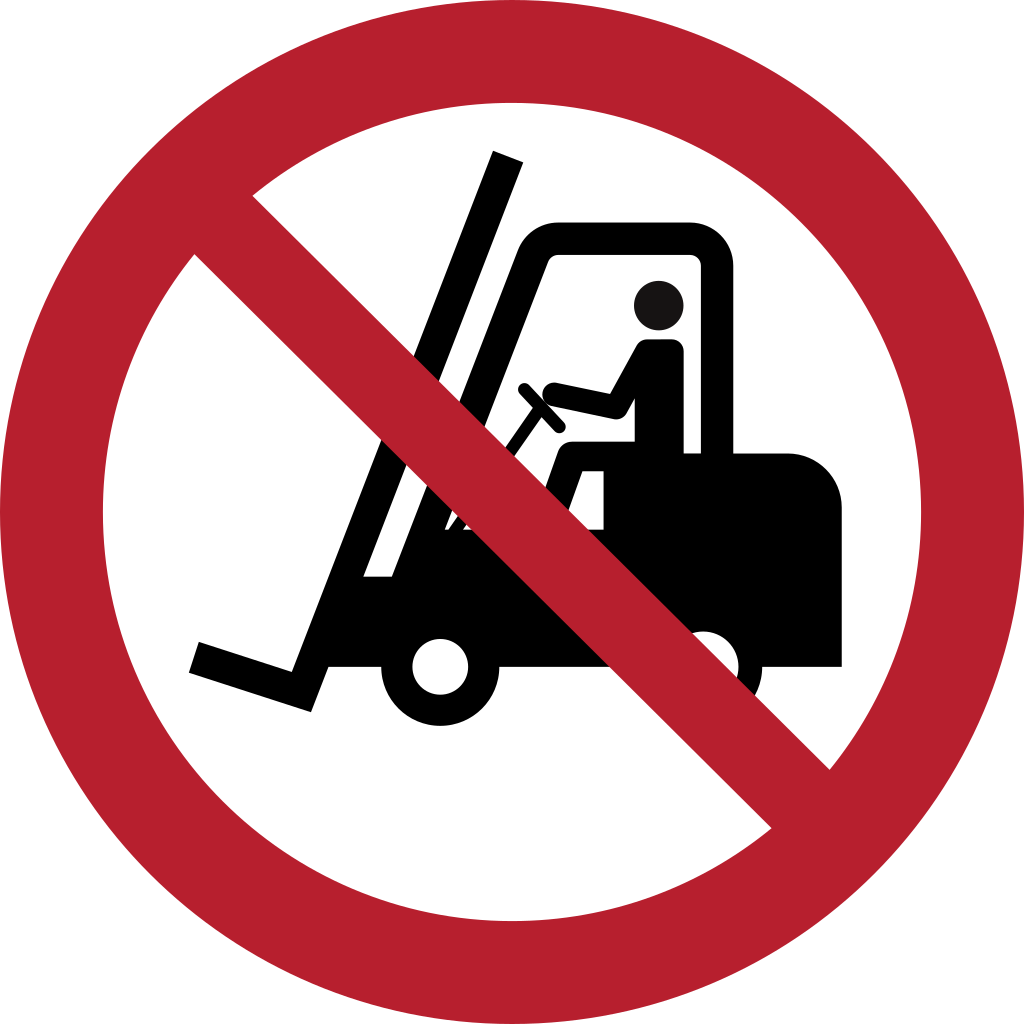
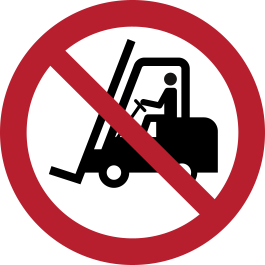
No access for forklift trucks and other industrial vehicles
Access by forklift trucks and other industrial vehicles is prohibited.
Understanding this sign
Red circular signs with a diagonal bar identify an action that must not be taken in the marked area.
Check what object or action the symbol prohibits. A prohibition sign does not identify all the hazards in an area.
A Prohibition Aimed at the Driver's Seat
P006 tells the operator of a forklift or other industrial vehicle that the route or area ahead is closed to their machine. The crossed-out forklift pictogram covers counterbalance and reach trucks, powered pallet trucks, tow tractors, order pickers, and comparable in-plant vehicles. Its audience is the person driving: pedestrians walking past a P006 sign are not addressed by it at all, and road vehicles such as delivery lorries fall under site traffic signage rather than this workplace symbol.
Grey areas should be settled locally in writing. Whether a manual pallet jack, a pedestrian-operated stacker, or a floor-cleaning machine counts as an "other industrial vehicle" is a judgment the pictogram cannot make for you; if the reason for the exclusion is floor loading or clearance, the manual truck may be fine, and if it is congestion in a walkway, it may not. Supplementary text such as ALL POWERED TRUCKS or INCLUDING PALLET TRUCKS removes the argument before it starts.
P006 and W014: Two Halves of One Segregation Scheme
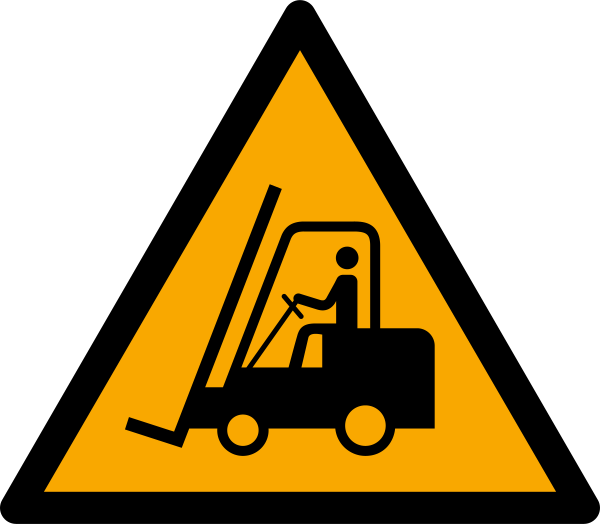
ISO 7010 gives the forklift hazard a matched pair. W014, the yellow triangle with a forklift pictogram, warns pedestrians that industrial vehicles operate in the area they are entering; P006 orders vehicles out of areas reserved for people. They face opposite audiences at opposite boundaries, and a well-planned warehouse uses them as mirror images — W014 where a walkway crosses into truck territory, P006 where an aisle, packing zone, or welfare area is pedestrian ground.
Confusing the two undermines both. Posting W014 at the entrance to a pedestrian-only zone tells walkers to expect trucks in the one place they should never meet one, while a P006 disc in a live truck aisle bans the traffic that the aisle exists to carry. Before ordering signs, sketch the traffic plan and decide, boundary by boundary, whether the message at that line is "trucks keep out" or "people, trucks about."
Zones That Commonly Exclude Trucks
Typical P006 postings guard pedestrian walkways and their entry points, packing and assembly benches, break rooms and locker areas, first-aid stations, mezzanines and suspended floors with load limits the truck would exceed, raised dock plates rated below vehicle weight, freshly laid or damaged flooring, low-clearance passages that would strike masts or overhead guards, and rooms where exhaust or battery gassing is unacceptable, such as food preparation or cleanroom spaces.
Position the sign for a seated driver in motion, not a standing reader: at the driver's eye line, far enough before the boundary to allow a laden truck to stop or turn, and repeated at every practicable entry to the zone. Floor demarcation reinforces it well — a painted or taped line at the threshold gives the operator a precise stop point that a wall-mounted disc alone cannot.
Fitting the Sign Into Traffic Management Duties
US employers answer to 29 CFR 1910.178, which covers operator training and safe truck operation, and carry a broader duty to control struck-by hazards; excluding trucks from pedestrian areas is a core control that P006 makes visible and auditable. UK and EU employers carry an explicit duty to organize workplace traffic routes so vehicles and pedestrians circulate safely, and HSE's workplace transport guidance treats segregation as the first-choice measure with signage marking the boundaries.
Remember the hierarchy: the sign records a decision, it does not enforce it. Where a truck crossing the line could strike someone, back the posting with physical measures — barriers, bollards, gates, or height restrictors for clearance-limited routes — and cover the rule in operator training and site induction. A pattern of trucks appearing in P006 zones is a route-design or workload problem to investigate, not merely a discipline issue to note.
Where you will see P006
Warehouses post it at pedestrian walkway entries, packing and assembly benches, break rooms, and first-aid stations, mirroring W014 warnings on the truck side of the boundary. Other placements guard mezzanines with load limits a truck would exceed, low-clearance passages that would strike masts, and food preparation or cleanroom spaces where exhaust and battery gassing are unacceptable.
Common questions about P006
What is the difference between the P006 and W014 forklift signs?
P006 is a red prohibition disc telling drivers that forklifts and other industrial vehicles must not enter; W014 is a yellow warning triangle telling pedestrians that such vehicles operate nearby. One excludes trucks from people's space, the other alerts people entering trucks' space, and most facilities need both at different boundaries.
Does a no forklift sign apply to pallet jacks and floor scrubbers?
The symbol covers forklifts and other industrial vehicles, but whether that reaches manual pallet trucks or cleaning machines depends on why the zone is closed — floor loading, clearance, or pedestrian congestion. Decide it in your traffic plan and add supplementary text so operators are not left interpreting the pictogram case by case.
Can painted floor lines replace P006 signs at pedestrian zones?
Use them together rather than choosing. Floor demarcation gives drivers an exact boundary but fades, gets obscured by pallets, and carries no standardized meaning by itself; the P006 disc states the rule unambiguously but marks no precise line. A sign at driver eye height plus a marked threshold is the robust combination.
Does P006 keep delivery trucks and cars out of an area?
No. The pictogram addresses in-plant industrial vehicles, and drivers of road vehicles will read it as irrelevant to them. Control cars, vans, and heavy goods vehicles on site roads and yards with road-traffic-style signage and your site traffic rules, reserving P006 for forklift-class equipment inside the workplace.
Reference details
| Symbol code | P006 |
|---|---|
| Sign family | ISO Prohibition Signs |
| Standard reference | ISO 7010:2019 / ISO 3864-1 ISO Online Browsing Platform: P006 |
| Screen color reference | #FF0000. Screen colors are not a production color specification. |
| Download formats | SVG reference artwork; a 1024 × 1024 pixel PNG conversion on a white canvas. |
| Record date | · How to interpret our dates |
| Page updated |
Choosing a physical sign size
Download dimensions are not installation dimensions. Select sign size, material, placement, and lighting using the applicable standard and the actual viewing conditions. Chemical label sizing follows its own rules. Read the artwork and sizing guide.
Sources and artwork credits
- Artwork source
- Wikimedia Commons file page
- Creator credited by source
- ISO
- License
- Public domain
- Source metadata checked
SVG files are local reference copies. PNG files are raster conversions. Check the linked file history and license terms before reuse; a source-metadata check is not certification of the artwork or a workplace installation.
Report a correction to this reference