Not drinking water
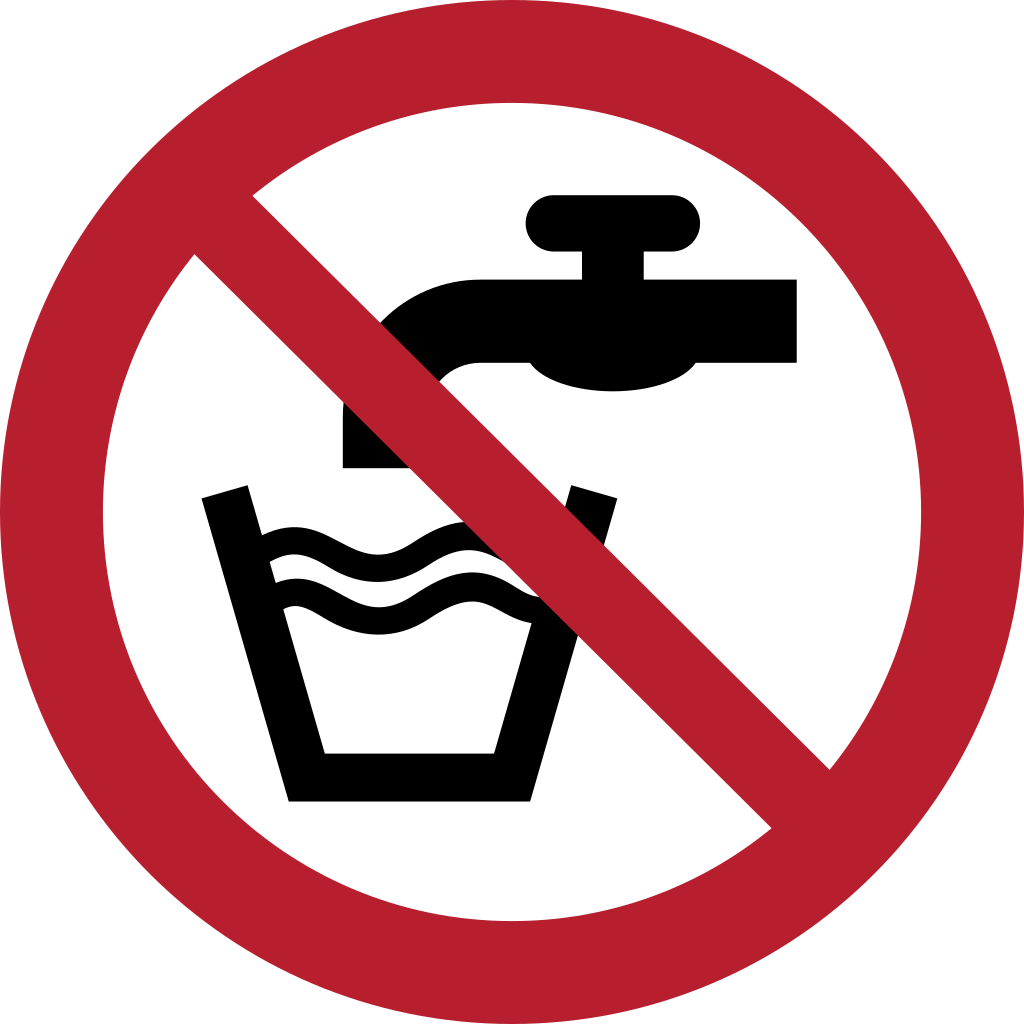
The marked water is not for drinking.
Understanding this sign
Red circular signs with a diagonal bar identify an action that must not be taken in the marked area.
Check what object or action the symbol prohibits. A prohibition sign does not identify all the hazards in an area.
What P005 Tells the Person at the Tap
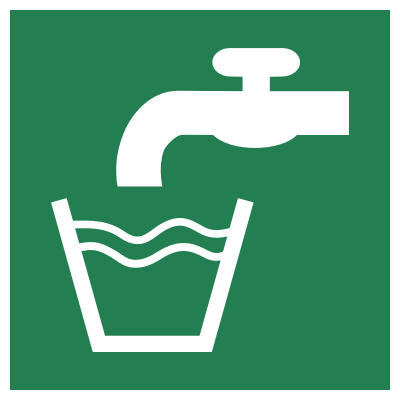
P005 marks water that must not be drunk. The pictogram — a tap filling a glass, struck through in red — is attached to the outlet, tank, or line, and its message is limited to ingestion: the water here is unsuitable for drinking. It covers process and cooling water, firefighting supplies, reclaimed and rainwater systems, untreated well water, and any plumbing whose quality is unknown or unmanaged for human consumption.
The sign deliberately says nothing about what the water may be used for. Non-potable water might be perfectly acceptable for irrigation or wash-down yet unfit for rinsing a coffee cup, and in some systems it is hazardous even on skin contact. Where secondary restrictions apply — no handwashing, no food-contact rinsing — those must be added as supplementary text, because the pictogram alone only rules out drinking.
The Legal Duty to Mark Non-Potable Outlets
In US general-industry workplaces, OSHA requires non-potable outlets to be identified. Under 29 CFR 1910.141(b), outlets for water used for industrial or firefighting purposes must be posted or otherwise marked to make clear the water is unsafe to drink, and non-potable water may not be used for washing the person, food, or cooking and eating utensils. The construction sanitation standard, 29 CFR 1926.51, imposes the equivalent marking duty on job sites.
Plumbing and reuse codes add a second layer: reclaimed-water systems are typically installed in purple-identified pipe and their outlets labeled against drinking, and cross-connection control programs depend on that labeling staying legible. For multilingual workforces and public-facing locations, the symbol-based P005 sign carries the message where an English-only NON-POTABLE placard would fail — one reason ISO-format signs are increasingly specified even in text-first jurisdictions.
Outlets People Actually Drink From
Label the points where drinking is plausible, not just the plant room. Hose bibs in yards and on construction sites, sinks in workshops fed from process lines, rainwater-harvesting taps in washrooms and gardens, eyewash and safety-shower supply where it is not potable-grade, water points on trains, ships, and campsites, and greywater outlets in green buildings all get mistaken for drinking water by thirsty workers and visitors.
Mount the sign directly at the outlet, at hand height where the user reaches for the tap, and repeat it on storage tanks and fill connections so contractors topping up or drawing down the system see it too. A small 50 mm label suffices on a tap body; a tank or standpipe visible across a yard needs a larger diameter. Check the labels on a schedule — outdoor P005 stickers fade and peel faster than most safety signage.
Completing the Picture: Potable Marking and Supplementary Text
Prohibition works best against a clear positive alternative. If a site has both systems, identify the drinking-water points affirmatively as well, so nobody has to infer potability from the absence of a red circle. This two-sided labeling is standard on ships and rail vehicles, where potable and non-potable lines run side by side, and it is good practice in any facility with dual plumbing.
Wording matters when text is added. NOT DRINKING WATER or NON-POTABLE WATER states the rule; CAUTION: WATER UNFIT FOR DRINKING explains it. Avoid vague phrases like UNTREATED WATER, which some readers interpret as merely lower quality rather than prohibited. Where the water also poses contact or aerosol hazards — legionella risk in cooling circuits, chemical dosing in process water — the P005 sign should be accompanied by the relevant warning signage rather than stretched to cover hazards it does not depict.
Where you will see P005
Hose bibs in yards and on construction sites, workshop sinks fed from process lines, and rainwater-harvesting taps in washrooms all carry the label directly at the outlet, at hand height. It is repeated on storage tanks and fill connections for contractors, and appears on trains, ships, and campsites where non-potable water points are easily mistaken for drinking water — OSHA's 29 CFR 1910.141(b) requires such outlets to be marked.
Common questions about P005
Is marking non-potable water legally required?
In US workplaces, yes. OSHA 29 CFR 1910.141(b) requires outlets for non-potable water, such as industrial or firefighting supplies, to be posted or marked as unsafe for drinking, and 29 CFR 1926.51 applies the same duty on construction sites. Reclaimed-water plumbing codes impose additional pipe identification and outlet labeling requirements.
Can non-potable water be used for washing hands?
Not in US workplaces. OSHA's sanitation standard prohibits using non-potable water for washing any portion of the person, food, or cooking and eating utensils. If a marked outlet is the only one near a work area, provide a separate potable supply for hygiene rather than relying on the P005 sign to manage the risk.
Does rainwater or harvested greywater need a not-drinking-water sign?
Yes, wherever a person could plausibly drink from it. Rainwater and greywater are not managed to drinking-water standards, and reuse codes generally require their outlets to be labeled against consumption. Put P005 at every accessible tap and on the storage tank, and add text restricting other uses if your system's water quality warrants it.
What is the difference between the P005 sign and a purple reclaimed-water pipe marking?
Pipe identification tells installers and maintainers what is inside the line; the P005 sign tells the end user at the outlet not to drink it. The two serve different audiences and both are typically required in a reclaimed-water installation — colored pipe alone does not warn the person filling a bottle at the tap.
Reference details
| Symbol code | P005 |
|---|---|
| Sign family | ISO Prohibition Signs |
| Standard reference | ISO 7010:2019 / ISO 3864-1 ISO Online Browsing Platform: P005 |
| Screen color reference | #FF0000. Screen colors are not a production color specification. |
| Download formats | SVG reference artwork; a 1024 × 1024 pixel PNG conversion on a white canvas. |
| Record date | · How to interpret our dates |
| Page updated |
Choosing a physical sign size
Download dimensions are not installation dimensions. Select sign size, material, placement, and lighting using the applicable standard and the actual viewing conditions. Chemical label sizing follows its own rules. Read the artwork and sizing guide.
Sources and artwork credits
- Artwork source
- Wikimedia Commons file page
- Creator credited by source
- ISO
- License
- Public domain
- Source metadata checked
SVG files are local reference copies. PNG files are raster conversions. Check the linked file history and license terms before reuse; a source-metadata check is not certification of the artwork or a workplace installation.
Report a correction to this reference