No thoroughfare
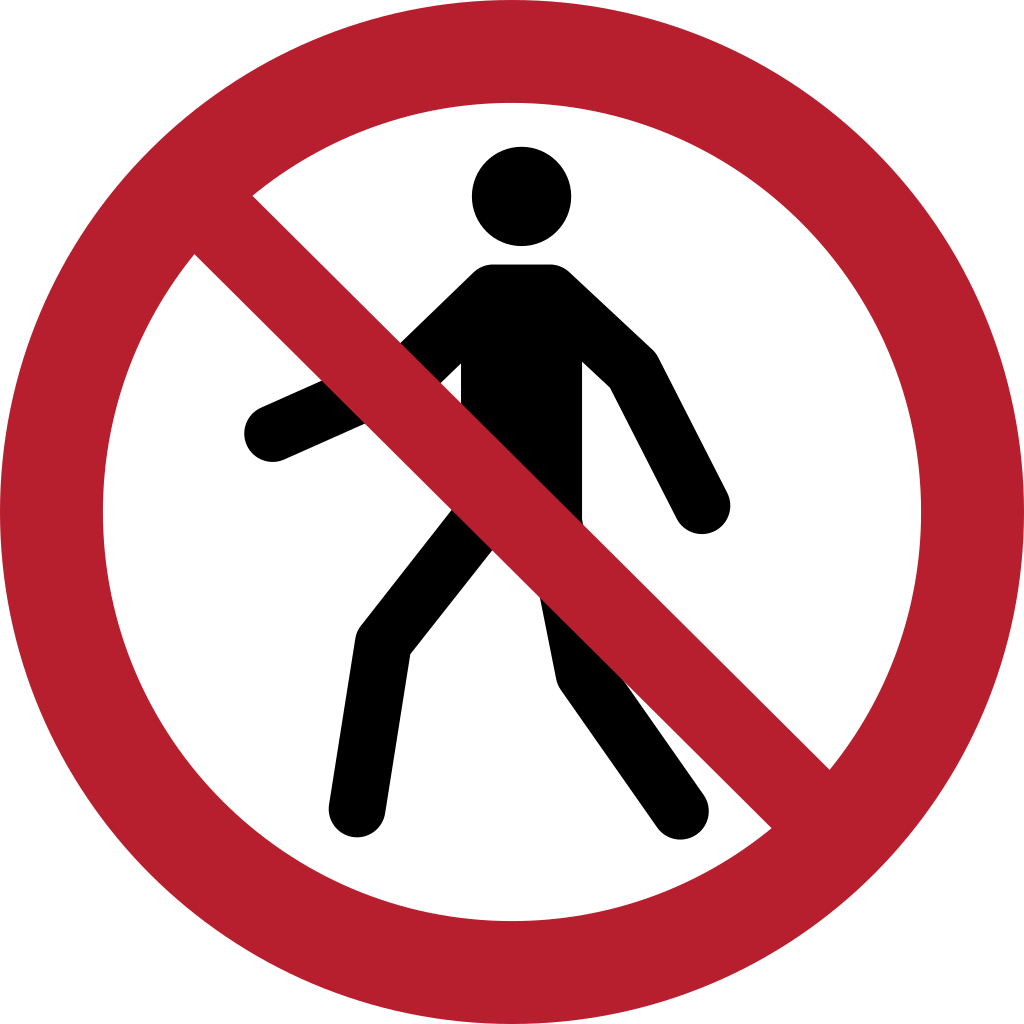
Passing through the marked area is prohibited.
Understanding this sign
Red circular signs with a diagonal bar identify an action that must not be taken in the marked area.
Check what object or action the symbol prohibits. A prohibition sign does not identify all the hazards in an area.
What "No Thoroughfare" Actually Restricts
The ISO 7010 register defines P004's function narrowly: to prohibit the use of a thoroughfare by pedestrians. The pictogram shows a walking figure crossed by the red prohibition bar, and the message is aimed at people on foot who would otherwise treat a route, aisle, gate, or corridor as a way through. It regulates movement along a path, which makes it a traffic-management sign as much as a safety sign.
P004 is not a blanket exclusion from an area. Authorized personnel may still work inside the space, and vehicles may still use the route — the sign says nothing about them. That distinction matters in practice: a warehouse can mark an aisle P004 to keep foot traffic out of a forklift corridor while trucks continue to run through it all shift. Facilities that want to exclude everyone need a different message entirely.
P004 Versus No-Entry and Unauthorized-Access Messages
The familiar red disc with a horizontal white bar is a road-traffic no-entry sign directed at vehicle drivers, not an ISO 7010 workplace symbol, and it should not be recycled indoors to control pedestrians. Conversely, ISO 7010 has no generic "no admittance for unauthorized persons" pictogram; sites that need that rule commonly post P004 with supplementary text such as AUTHORIZED PERSONNEL ONLY, or rely on national sign systems that include an explicit unauthorized-access symbol.
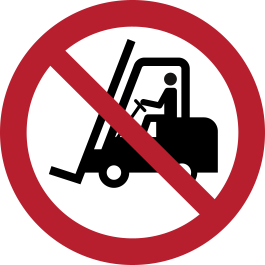
Keep P004 distinct from vehicle-side prohibitions as well. P006 turns industrial trucks away from pedestrian zones, while P004 turns pedestrians away from vehicle routes — a well-designed traffic plan often uses the two as mirror images at opposite ends of the same segregation scheme. Using the correct sign for each audience avoids the ambiguity that makes people ignore signage altogether.
Where Pedestrian Routes Get Closed
Common P004 locations include dedicated forklift and AGV corridors, rail sidings and dock levellers, crane slew and lifting zones during operations, conveyor crossings without a bridge, construction site accesses, roof accesses reserved for maintenance, and walkways closed for repair, spills, or overhead work. Temporary closures are a legitimate use — a P004 sign on a stand at a wet or damaged floor section communicates faster than improvised tape.
The single most important companion to P004 is a signed alternative. People take the shortest available path, and a closed route with no visible detour invites exactly the behavior the sign prohibits. Post the prohibition at both ends of the closed segment, at decision points before it, and add green directional signage or floor arrows to the permitted walkway so compliance costs the pedestrian almost nothing.
Making the Prohibition Hold Up
Under the EU safety signs directive (92/58/EEC), a pedestrian prohibition must use the standard round red-and-white format that P004 implements, and employers must ensure signs are maintained and understood. In the UK, the Workplace (Health, Safety and Welfare) Regulations 1992 separately require traffic routes organized so pedestrians and vehicles can circulate safely, which is the underlying duty a P004 posting usually serves.
A sign is an administrative control, and on routes with real vehicle traffic it should rarely stand alone. Pair P004 with physical measures — barriers, gates, guardrails, or floor-level demarcation — proportionate to the consequence of a breach. If audits show people still cutting through, treat that as evidence the route design is wrong, not just that discipline is lacking: relocating the permitted walkway usually outperforms adding more signs.
Where you will see P004
Facilities close pedestrian access with P004 on dedicated forklift and AGV corridors, rail sidings and dock levellers, crane slew zones during lifting operations, conveyor crossings without a bridge, and roof accesses reserved for maintenance. Temporary postings on stands mark walkways shut for spills, repairs, or overhead work, ideally at both ends of the closed segment with green directional signage guiding people onto the permitted detour.
Common questions about P004
What does a no thoroughfare sign mean compared to a no entry sign?
P004 prohibits pedestrians from using a route as a way through; it does not exclude vehicles and does not necessarily forbid authorized work inside the area. A road-style no-entry disc is aimed at vehicle drivers, and a general keep-out rule for a whole area needs explicit supplementary text, since ISO 7010 has no standalone unauthorized-access pictogram.
Can I use the P004 sign to stop forklifts or cars using a route?
No. The pictogram shows a pedestrian and the ISO-defined function is limited to people on foot. To keep industrial trucks out of a zone, post P006; to control road vehicles on site roads, use road-traffic signage under your local traffic rules.
Do I have to provide an alternative route when I close a walkway?
Workplace regulations in most jurisdictions require safe pedestrian circulation, so closing a walkway without a usable alternative typically breaches that duty and guarantees non-compliance in practice. Post P004 at both ends and at upstream decision points, and mark the detour with directional signs or floor arrows.
Is a P004 sign enough on its own to keep people out of a forklift aisle?
Usually not where the risk is serious. Signs are administrative controls; where a pedestrian entering the route could be struck, combine P004 with barriers, guardrails, or gates and with clearly marked permitted walkways. Persistent shortcutting is a signal to redesign the route rather than add signage.
Reference details
| Symbol code | P004 |
|---|---|
| Sign family | ISO Prohibition Signs |
| Standard reference | ISO 7010:2019 / ISO 3864-1 ISO Online Browsing Platform: P004 |
| Screen color reference | #FF0000. Screen colors are not a production color specification. |
| Download formats | SVG reference artwork; a 1024 × 1024 pixel PNG conversion on a white canvas. |
| Record date | · How to interpret our dates |
| Page updated |
Choosing a physical sign size
Download dimensions are not installation dimensions. Select sign size, material, placement, and lighting using the applicable standard and the actual viewing conditions. Chemical label sizing follows its own rules. Read the artwork and sizing guide.
Sources and artwork credits
- Artwork source
- Wikimedia Commons file page
- Creator credited by source
- ISO
- License
- Public domain
- Source metadata checked
SVG files are local reference copies. PNG files are raster conversions. Check the linked file history and license terms before reuse; a source-metadata check is not certification of the artwork or a workplace installation.
Report a correction to this reference