Use anti-tip restraints
Instructs the reader to use anti-tip restraints.
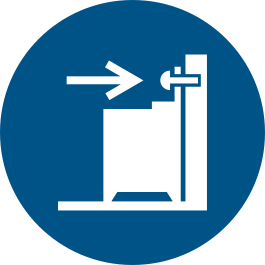
Understanding this sign
Blue circular signs communicate an action, such as wearing eye protection or following a specified procedure.
A pictogram does not select the grade of PPE or explain a complete procedure. Use the task-specific instructions.
What ISO 7010 M071 Requires
M071 mandates the use of anti-tip restraints — devices that keep tall or top-heavy objects from toppling onto people. The category is broad: wall straps and brackets anchoring furniture, factory-supplied anti-tip hardware on appliances, floor fixings and cross-bracing on storage racking, and interlocks or outriggers on mobile equipment. What unites them is the failure they prevent: an object stable enough to seem safe right up until a child climbs it, a drawer load shifts, or a forklift nudges it.
The sign is among the more recent additions to the ISO 7010 mandatory series, reflecting how tip-over grew from a niche concern into a recognized hazard class spanning homes, retail floors, and warehouses. Unlike most workplace signs, M071 often addresses installers and assemblers as much as end users — the restraint only protects if someone actually fits it.
Furniture, Appliances, and Public Spaces
Tip-over of dressers, wardrobes, bookcases, and televisions has injured and killed enough young children that consumer safety agencies run dedicated anchoring campaigns, and the United States now enforces a mandatory stability standard for clothing storage units. Manufacturers ship anchor kits and mark products with instructions to secure them to the wall; M071 is the symbol-based expression of that instruction on packaging, assembly guides, and the furniture itself.
Kitchen ranges illustrate the appliance side: a freestanding range without its anti-tip bracket can rotate forward when weight is applied to an open oven door, spilling hot contents onto whoever leaned on it, which is why installation instructions insist the bracket be fitted. Childcare centers, schools, libraries, and retail showrooms apply the same logic at scale, anchoring display units and shelving in spaces where climbing and pulling are foreseeable.
Warehouses and Industrial Storage
In industrial settings, M071 covers restraints on storage systems and mobile units. Pallet racking is bolted to the floor and, where geometry demands, tied back or braced so that a loading error or minor forklift impact does not become a progressive collapse. Mobile shelving, tool cabinets, and drawer units rely on interlocks that permit only one heavy drawer open at a time, plus counterweights or wall fixings — opening several loaded drawers together shifts the center of gravity dramatically forward.
The sign is posted or affixed where the restraint could plausibly be skipped: on racking uprights near anchor points, on cabinets beside the interlock, on mobile stands and gantries at their outrigger or brake positions, and in goods-in areas where new storage equipment gets assembled. It reminds crews that the anchoring step of an installation is a safety control, not optional finishing work.
Where you will see M071
Furniture makers put it on packaging, assembly guides, and the products themselves following child tip-over deaths, and kitchen ranges carry it for the bracket that stops the appliance rotating forward under an open door's load. In warehouses it sits on racking uprights near anchor points, on cabinets beside drawer interlocks, and in goods-in areas where new storage equipment is assembled.
Common questions about M071
What are anti-tip restraints and where are they required?
They are devices that stop tall or top-heavy items from falling over: wall straps for furniture, anti-tip brackets on kitchen ranges, floor anchors and bracing on pallet racking, and drawer interlocks on heavy cabinets. Requirements come from product standards, installation instructions, and workplace risk assessments; M071 signals that using the restraint is mandatory in the marked context.
Why do dressers and wardrobes come with wall anchor kits?
Because furniture tip-over onto young children has caused numerous deaths and injuries, typically when a child climbs open drawers. Consumer safety agencies run anchoring campaigns, and the US has adopted a mandatory stability rule for clothing storage units. The supplied kit secures the unit to the wall so climbing or pulling cannot bring it down.
Does the anti-tip bracket on a kitchen range actually matter?
Yes. Without the bracket, a freestanding range can pivot forward when weight is placed on the open oven door — a leaning adult or climbing child — tipping hot cookware and the appliance itself onto them. Manufacturers require the bracket in their installation instructions, and it is routinely missed when ranges are moved or replaced.
How does M071 apply to warehouse racking?
Racking must be anchored to the floor and braced per the manufacturer's design so impacts and uneven loading cannot topple it, and mobile or drawer-based storage needs its interlocks and fixings in service. M071 at these installations marks the anchoring hardware as a mandatory safety control rather than an optional part of assembly.
Reference details
| Symbol code | M071 |
|---|---|
| Sign family | ISO Mandatory Signs |
| Standard reference | ISO 7010:2019 / ISO 3864-1 ISO Online Browsing Platform: M071 |
| Screen color reference | #0000FF. Screen colors are not a production color specification. |
| Download formats | SVG reference artwork; a 1024 × 1024 pixel PNG conversion on a white canvas. |
| Record date | · How to interpret our dates |
| Page updated |
Choosing a physical sign size
Download dimensions are not installation dimensions. Select sign size, material, placement, and lighting using the applicable standard and the actual viewing conditions. Chemical label sizing follows its own rules. Read the artwork and sizing guide.
Sources and artwork credits
- Artwork source
- Wikimedia Commons file page
- Creator credited by source
- ISO.org
- License
- CC0
- Source metadata checked

SVG files are local reference copies. PNG files are raster conversions. Check the linked file history and license terms before reuse; a source-metadata check is not certification of the artwork or a workplace installation.
Report a correction to this reference