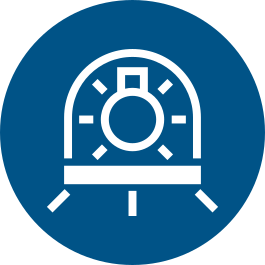
Use lamp in luminaire with shield
Instructs the reader to use the lamp in a luminaire with a shield.
Understanding this sign
Blue circular signs communicate an action, such as wearing eye protection or following a specified procedure.
A pictogram does not select the grade of PPE or explain a complete procedure. Use the task-specific instructions.
What ISO 7010 M070 Means
M070 mandates that a lamp be used only in a luminaire fitted with a protective shield. It is an unusually specialized entry in the mandatory series, aimed at two failure modes of high-output lamps: the bulb shattering and scattering glass into the space below, and certain lamp technologies continuing to operate after breakage in a way that exposes people to hazardous ultraviolet radiation. The shield — a lens, enclosure, or containment sleeve — keeps both problems inside the fitting.
The sign is applied at the fixture or in the area it lights, and increasingly on lamp packaging and replacement stock, because the hazard is created at relamping time. A maintenance electrician who installs a bare lamp into an open fixture, or removes a cracked lens and leaves the fitting unshielded, silently defeats a control that nobody at floor level can see is missing.
Food Facilities and Sports Halls
Food and beverage plants are the most systematic users of shielded lighting. Glass and brittle-plastic control is a standard element of food safety programs and retailer audit schemes, and a lamp bursting over an open production line can force the disposal of everything within throwing distance plus a full line clean-down. Shatter-resistant sleeved lamps or fully enclosed luminaires are the accepted control, and M070 signage in production, filling, and packing areas holds relamping practice to it.
Sports halls present the mechanical version of the same problem: balls and shuttles striking high-bay fittings. Gymnasiums specify impact-rated enclosures or wire guards so a direct hit does not rain glass onto players. The sign also earns a place in pharmaceutical cleanrooms, kitchens, and packaging areas — anywhere falling fragments contaminate product or land on people who cannot see them coming.
The Ultraviolet Hazard Behind the Sign
Some discharge lamps, notably metal halide and mercury vapor types, generate intense ultraviolet radiation that is normally absorbed by the lamp's outer glass envelope. If that envelope breaks while the arc tube keeps burning — which can happen after an impact — the lamp goes on lighting the room while emitting UV strong enough to cause eye and skin burns in people below. Incidents of this kind in gyms and public buildings are a documented reason enclosed fixtures are specified.
Lamp makers address this by producing self-extinguishing types that shut down after envelope breakage and other types that are only permitted in enclosed luminaires; the fixture shield is the mandated barrier for the latter. M070 next to such fittings, and in stores where replacement lamps are picked, tells maintenance staff the enclosure is a safety device, not an optical accessory — the lamp must never run in an open fixture.
Where you will see M070
Food and beverage plants are the most systematic users, posting it in production, filling, and packing areas where a lamp bursting over an open line forces product disposal and a full clean-down. Sports halls specify impact-rated enclosures against ball strikes, pharmaceutical cleanrooms and kitchens use it wherever falling fragments could contaminate product, and the pictogram also appears on lamp packaging and in stores where replacement stock is picked, holding relamping practice to the enclosure requirement.
Common questions about M070
Why do food factories require shielded or shatterproof lighting?
Because a burst lamp over open product scatters glass fragments that are almost impossible to fully recover, forcing product disposal and line clean-downs. Glass control is a core requirement of food safety programs and retail audit standards, so production areas use enclosed luminaires or sleeved shatter-resistant lamps, with M070 signage enforcing the practice at relamping.
Can a broken metal halide lamp really cause UV burns?
Yes. If the outer envelope of a metal halide or mercury vapor lamp breaks while the arc tube keeps operating, the lamp continues to light the space while emitting hazardous ultraviolet radiation, and exposed people can suffer eye injuries and skin burns. Enclosed fixtures contain this failure, and some lamp types are only rated for use in enclosed luminaires.
Where should the M070 sign be placed?
At or near the luminaires it governs, in areas lit by them, and usefully in lamp storage where replacements are picked. The critical audience is whoever changes lamps, since the hazard is created when a bare lamp goes into an open fixture or a damaged shield is left off after maintenance.
Reference details
| Symbol code | M070 |
|---|---|
| Sign family | ISO Mandatory Signs |
| Standard reference | ISO 7010:2019 / ISO 3864-1 ISO Online Browsing Platform: M070 |
| Screen color reference | #0000FF. Screen colors are not a production color specification. |
| Download formats | SVG reference artwork; a 1024 × 1024 pixel PNG conversion on a white canvas. |
| Record date | · How to interpret our dates |
| Page updated |
Choosing a physical sign size
Download dimensions are not installation dimensions. Select sign size, material, placement, and lighting using the applicable standard and the actual viewing conditions. Chemical label sizing follows its own rules. Read the artwork and sizing guide.
Sources and artwork credits
- Artwork source
- Wikimedia Commons file page
- Creator credited by source
- ISO.org
- License
- CC0
- Source metadata checked
SVG files are local reference copies. PNG files are raster conversions. Check the linked file history and license terms before reuse; a source-metadata check is not certification of the artwork or a workplace installation.
Report a correction to this reference