Tools must be tethered
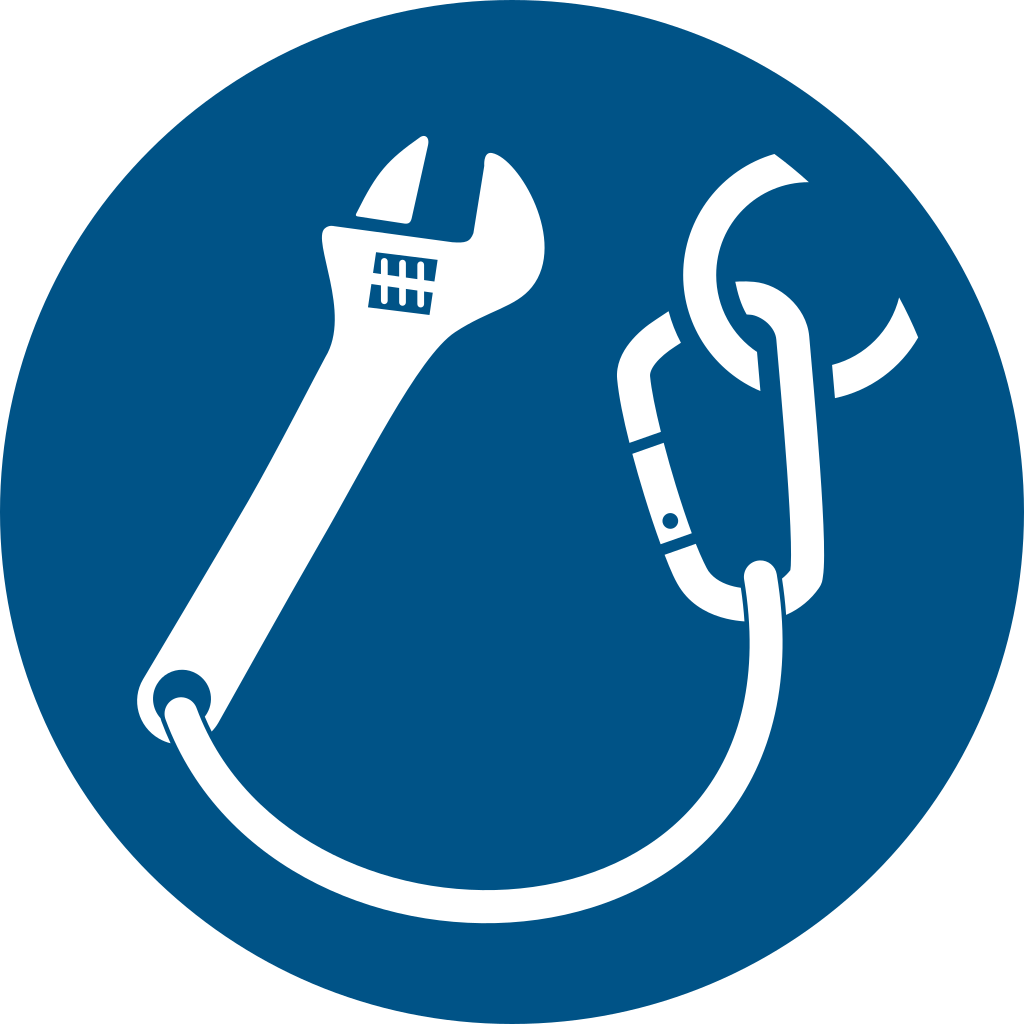
Instructs the reader to tether tools.
Understanding this sign
Blue circular signs communicate an action, such as wearing eye protection or following a specified procedure.
A pictogram does not select the grade of PPE or explain a complete procedure. Use the task-specific instructions.
What ISO 7010 M069 Requires
M069 requires tools to be securely tethered, and it exists for one reason: objects dropped from height keep killing and injuring people below. A wrench slipping from a hand on a scaffold accelerates fast enough over even a modest fall to defeat a hard hat, and drop incidents cluster around exactly the moments tethering prevents — passing a tool between hands, setting it down on a beam, or fumbling it while repositioning. The sign converts tool tethering from good practice into an entry condition for the marked area.
The mandated behavior covers the whole tethering system, not just a lanyard clipped somewhere. Effective programs specify a rated attachment point on the tool (built-in or retrofitted), a lanyard matched to the tool's weight, and an anchorage — the worker's harness or belt for light tools, structure for heavy ones — so that a dropped tool falls centimeters instead of meters.
Where M069 Is Posted
The sign appears at access points to elevated work: scaffold ladders and stair towers, tower crane and wind turbine climbs, telecom masts, offshore platform derricks, rope-access job fronts, and mobile elevating work platform baskets. It is placed where the worker gears up or begins the ascent, because tethering has to be arranged before the climb — clipping lanyards to tools while balanced at height is itself a drop risk.
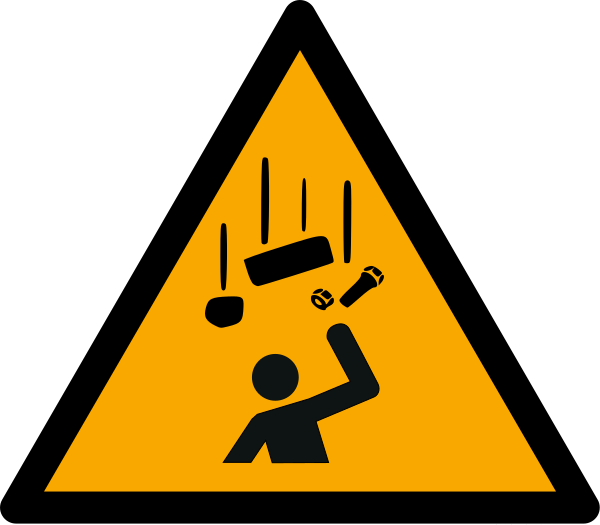
Drop-prevention signage rarely works alone. Below the work front, facilities establish exclusion zones with barriers and pair M069 overhead with W035, the falling-objects warning, at ground level, plus head-protection mandates for anyone who must pass beneath. The combination addresses both directions of the problem: stop objects from falling in the first place, and keep people out from under the ones that fall anyway, since even a tethered site will occasionally drop an untethered fastener or fitting.
Dropped-Object Programs and Standards
Tool tethering grew from industry initiatives before it acquired formal standards. The oil and gas sector's DROPS (Dropped Objects Prevention Scheme) network popularized systematic drop surveys, secondary retention, and tethering requirements across drilling and offshore work, and construction and wind energy followed. In the United States, ANSI/ISEA 121 established design and testing criteria for the hardware itself — tool attachment points, tethers, and containers used at height — giving buyers a way to distinguish rated equipment from improvised cord.
M069 entered ISO 7010 as this practice matured, giving sites a standardized graphic instead of the assorted text placards and homemade decals previously in use. Its arrival matters for multilingual workforces in particular: a turbine crew or offshore rotation drawn from several countries gets one unambiguous symbol at the ladder gate rather than a paragraph of site rules, and contractors moving between operators encounter the same requirement expressed the same way everywhere.
Making the Mandate Workable
A tethering mandate fails if it makes the work clumsy, so sites posting M069 typically back it with practical provisions: tool belts and pouches with integral lanyard points, retractable tethers that keep slack out of the way, buckets and bags with closable tops for hauling tools up rather than carrying them, and a rule that anything too heavy for a person-anchored lanyard gets tethered to structure instead.
Inspection belongs in the routine as well. Lanyards abrade against steel edges, retrofitted attachment points loosen with vibration, and a frayed tether gives false confidence at exactly the moment it is needed. Crews working under an M069 mandate normally check tether condition during the same pre-use inspection as their fall-arrest harness, since both systems protect against the same category of gravity-driven failure and both degrade quietly in service.
Where you will see M069
Access points to elevated work carry the sign: scaffold ladders and stair towers, tower crane and wind turbine climbs, telecom masts, offshore platform derricks, rope-access job fronts, and MEWP baskets. Sites pair it with W035 falling-objects warnings and barrier exclusion zones at ground level, following DROPS practice from oil and gas and using ANSI/ISEA 121-rated tethering hardware.
Common questions about M069
What does the tools-must-be-tethered sign mean on a scaffold or turbine ladder?
It is ISO 7010 M069, a mandatory-action sign requiring every tool taken into the area to be secured with a tether so it cannot fall if dropped. It is posted at access points to work at height because tethering must be set up before climbing, not after.
Is there a standard for tool tethers and lanyards?
In the United States, ANSI/ISEA 121 sets design and test criteria for dropped-object prevention equipment, including tool attachment points, tethers, and containers used at height. Industry schemes such as DROPS in oil and gas also publish widely used guidance. Rated equipment matched to the tool's weight is the expectation wherever M069 is posted.
Which warning sign goes with M069 for people working below?
W035, the ISO 7010 falling-objects warning, posted at ground level around the drop zone, usually together with barriers marking an exclusion area and a head-protection requirement (M014) for anyone entering. M069 controls the source of the hazard while W035 warns those exposed to it.
Do heavy tools have to be tethered to the worker's body?
No, and they should not be. A falling heavy tool arrested by a body-worn lanyard can injure the wearer or pull them off balance. Standard practice tethers light hand tools to the harness or belt within the equipment's rated capacity and anchors anything heavier directly to the structure.
Reference details
| Symbol code | M069 |
|---|---|
| Sign family | ISO Mandatory Signs |
| Standard reference | ISO 7010:2019 / ISO 3864-1 ISO Online Browsing Platform: M069 |
| Screen color reference | #0000FF. Screen colors are not a production color specification. |
| Download formats | SVG reference artwork; a 1024 × 1024 pixel PNG conversion on a white canvas. |
| Record date | · How to interpret our dates |
| Page updated |
Choosing a physical sign size
Download dimensions are not installation dimensions. Select sign size, material, placement, and lighting using the applicable standard and the actual viewing conditions. Chemical label sizing follows its own rules. Read the artwork and sizing guide.
Sources and artwork credits
- Artwork source
- Wikimedia Commons file page
- Creator credited by source
- Clemenspool
- License
- CC0
- Source metadata checked
SVG files are local reference copies. PNG files are raster conversions. Check the linked file history and license terms before reuse; a source-metadata check is not certification of the artwork or a workplace installation.
Report a correction to this reference