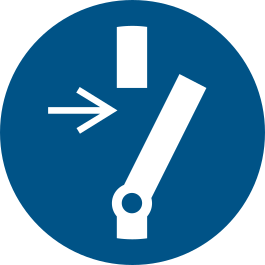
Lock moving mechanical parts
Instructs the reader to lock moving mechanical parts.

Understanding this sign
Blue circular signs communicate an action, such as wearing eye protection or following a specified procedure.
A pictogram does not select the grade of PPE or explain a complete procedure. Use the task-specific instructions.
What ISO 7010 M068 Requires
M068 mandates that moving mechanical parts be locked before anyone enters an area to carry out maintenance or repair. It addresses a hazard that electrical isolation does not touch: parts that can move under gravity, spring tension, or trapped pressure even when every power source is disconnected. A raised press ram, a suspended counterweight, a tensioned blade, or an elevated dump body can all descend or release with lethal force on a machine that is, electrically speaking, completely dead.
The mandated action is physical restraint — inserting locking pins, safety props, blocks, cradles, or chocks so the part cannot move regardless of what fails or who touches what. M068 is one of the newer entries in the ISO 7010 catalogue, added as machine-safety practice increasingly recognized that stored mechanical energy deserved its own explicit sign rather than being folded into the general disconnect message of M021.
Where the Sign Earns Its Place
Typical placements read like a list of crush fatalities that mechanical blocking prevents: under raised tipper and dump bodies, at scissor-lift maintenance positions where the prop must be swung into place, on baler and compactor rams, at press brakes and stamping presses fitted with die-safety blocks, beside vertical-acting guillotines, and on counterweighted gates and lift platforms. Agricultural equipment is another major user — implements raised on hydraulics are notorious for drifting down while someone works beneath them.
The sign belongs at the point of access: the crawl space entry, the guard door, the pit ladder, or the maintenance position where a person would place their body in the path of the movable part. Manufacturers frequently mold or rivet M068 next to the locking device itself, so the pin or prop and the instruction to use it are seen together.
M068 Within Lockout/Tagout
Energy-isolation regulation treats blocking as part of the same discipline as electrical lockout. OSHA's hazardous-energy standard, for instance, requires stored or residual energy to be relieved, disconnected, restrained, or otherwise rendered safe — and for gravity or spring energy, restraint means mechanical blocking. M068 is therefore the natural companion to M021: disconnect all power sources, then lock the parts that could still move without power. A procedure that stops after opening the disconnect has done only half the job.
The blocking hardware itself must be engineered for the load, not improvised. Wooden offcuts and hydraulic pressure are not restraint; rated die blocks, manufacturer-supplied props, and pinned positions are. Where M068 is posted, the corresponding isolation procedure should name the specific device to use, its insertion point, and how to verify the part is actually held before anyone goes underneath.
Where you will see M068
Under raised tipper and dump bodies, at scissor-lift prop positions, on baler and compactor rams, and beside press brakes fitted with die-safety blocks, the sign sits at the point of access where a person would place their body in the path of the movable part. Hydraulically raised agricultural implements are another major user, and manufacturers often rivet M068 next to the locking pin or prop itself as the companion to the M021 disconnect message.
Common questions about M068
Why is locking moving parts required if the machine is already disconnected from power?
Because gravity, springs, and trapped hydraulic or pneumatic pressure keep working after the power is off. A raised ram, bed, or counterweight can fall onto a worker even on a fully de-energized machine. M068 requires those parts to be physically restrained with pins, props, or blocks before anyone enters their path.
How is ISO 7010 M068 different from M021?
M021 requires disconnecting the machine from all power sources before maintenance. M068 covers the step that follows: mechanically locking parts that could still move from stored energy or their own weight. Complete isolation on many machines needs both actions, and the two signs are often posted together.
What counts as an acceptable way to lock moving mechanical parts?
Purpose-designed restraints rated for the load: locking pins engaged in machined holes, manufacturer-supplied safety props on tipper bodies and scissor lifts, die-safety blocks in presses, cradles and chocks for rollers. Relying on the hydraulic system to hold position, or on improvised packing, does not satisfy the requirement because either can fail without warning.
Reference details
| Symbol code | M068 |
|---|---|
| Sign family | ISO Mandatory Signs |
| Standard reference | ISO 7010:2019 / ISO 3864-1 ISO Online Browsing Platform: M068 |
| Screen color reference | #0000FF. Screen colors are not a production color specification. |
| Download formats | SVG reference artwork; a 1024 × 1024 pixel PNG conversion on a white canvas. |
| Record date | · How to interpret our dates |
| Page updated |
Choosing a physical sign size
Download dimensions are not installation dimensions. Select sign size, material, placement, and lighting using the applicable standard and the actual viewing conditions. Chemical label sizing follows its own rules. Read the artwork and sizing guide.
Sources and artwork credits
- Artwork source
- Wikimedia Commons file page
- Creator credited by source
- Clemenspool
- License
- CC0
- Source metadata checked
SVG files are local reference copies. PNG files are raster conversions. Check the linked file history and license terms before reuse; a source-metadata check is not certification of the artwork or a workplace installation.
Report a correction to this reference