Wear snow goggles
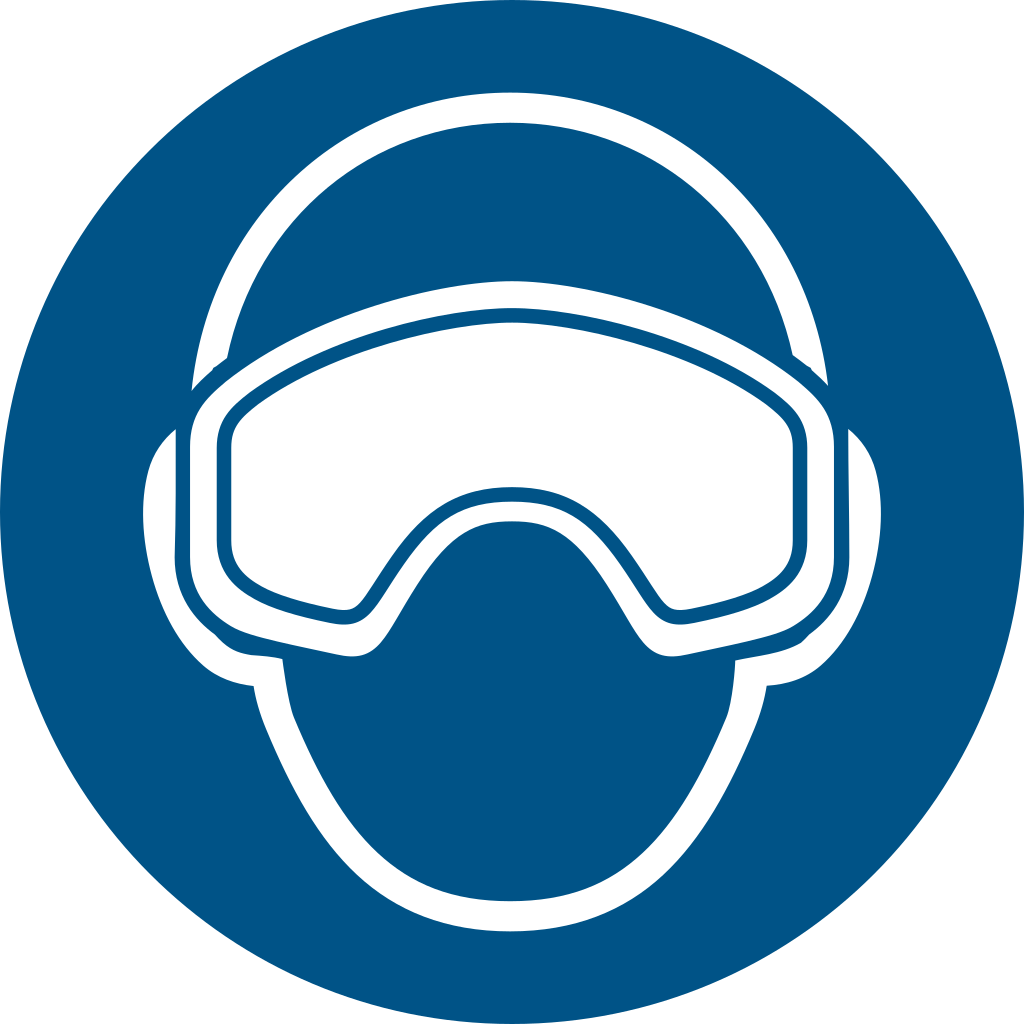
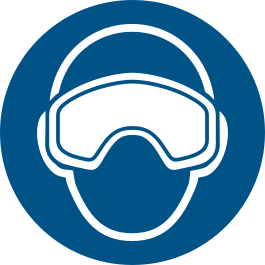
Instructs the reader to wear snow goggles.
Understanding this sign
Blue circular signs communicate an action, such as wearing eye protection or following a specified procedure.
A pictogram does not select the grade of PPE or explain a complete procedure. Use the task-specific instructions.
Eye Protection for Snow Sports
M067 signifies that skiers and snowboarders must wear snow goggles — the ISO register names the audience explicitly, making this one of the standard's recreation-specific additions alongside M066 for sports helmets. Snow goggles differ from everyday sunglasses in ways the mountain environment demands: a sealed foam-lined frame that keeps out wind, spindrift, and peripheral glare; a strap that works over a helmet; anti-fog venting; and lenses selected for the light conditions and ultraviolet load of high terrain.
The sign is aimed at ski areas, glacier resorts, terrain parks, ski schools, and mountain operations that make eye protection a condition of participation or of using certain terrain. Rental shops and lesson meeting points are natural places to post it, since that is where a guest can still fix the problem the sign identifies.
Snow Blindness and Altitude UV
The medical case behind M067 is photokeratitis of the snow-sports kind: snow blindness. Fresh snow reflects a large fraction of incoming ultraviolet back upward, effectively doubling the dose reaching the eyes, and UV intensity itself increases with altitude. The combination can sunburn the cornea in hours — including on overcast days, since UV penetrates cloud — producing the delayed, intensely painful, temporarily blinding symptoms that end trips and, on a glacier, create genuine rescue situations.
Wind and mechanical hazards add the second layer. Cold airflow at skiing speeds causes streaming eyes exactly when vision matters most, and falls, tree branches, and thrown ice from other riders threaten the eye directly. Goggles address all of it at once, which is why guides and patrollers treat them, with a backup pair or glacier sunglasses, as non-negotiable kit above the treeline.
Choosing Lenses and Reading the Sign in Context
Sun-glare eyewear is graded into filter categories from 0 to 4 under the sunglasses standard framework, with category 4 reserved for extreme brightness such as glaciers and high snowfields — and notably too dark for driving. Goggle lens choice tracks conditions: darker mirrored lenses for bluebird glacier days, high-contrast low-light lenses for storms and flat light, with photochromic and interchangeable-lens systems covering both. Whatever the tint, full UV blocking is the property that prevents snow blindness, and it is independent of how dark the lens looks.
Where M067 is posted as a rule — at race training venues, freestyle parks, ski school assembly areas, or glacier access lifts — it typically sits beside M066, since goggles and helmet are designed to work as a pair, the goggle strap seating against the helmet shell. Operators should place the pair of signs where guests gear up and at the entry to the specific terrain the rule covers, and state in text whether the requirement applies to everyone or to particular groups such as lesson participants.
Where you will see M067
Ski areas, glacier resorts, terrain parks, ski schools, and mountain operations post M067 where eye protection is a condition of participation or of entering certain terrain: rental shops, lesson meeting points, race training venues, freestyle parks, and glacier access lifts. It typically sits beside M066, the sports-helmet sign, since goggle strap and helmet shell are designed as a pair, with text clarifying whether the rule covers the whole area or specific runs.
Common questions about M067
What is snow blindness and how do goggles prevent it?
Snow blindness is photokeratitis — a sunburn of the cornea caused by ultraviolet light, intensified in snow sports because snow reflects much of the UV back up at the eyes and altitude raises UV levels further. Symptoms of pain, grittiness, watering, and temporary vision loss appear hours after exposure. Snow goggles with full UV-blocking lenses cut the dose from both above and below, which ordinary unwrapped sunglasses do less completely.
Do I need goggles on a cloudy day on the mountain?
Yes, arguably more. Ultraviolet penetrates cloud, so the corneal hazard persists on overcast days when people are least inclined to protect their eyes, and flat light plus wind makes unprotected vision worse for hazard spotting. Low-light, high-contrast lens tints exist precisely for those conditions; the UV protection is the same regardless of tint darkness.
What lens category do I need for glacier skiing?
The brightest conditions — glaciers and high snowfields in full sun — call for category 4 filters, the darkest grade in the standard sunglasses categories, or dark mirrored goggle lenses of equivalent absorption. Category 3 handles typical sunny resort days. Note that category 4 lenses are unsuitable for driving, so they are a mountain-specific choice rather than an everyday one.
Where would I see the M067 snow goggles sign?
At ski resorts and glacier areas: rental shops, ski school meeting points, race and freestyle training venues, and lifts accessing high or glaciated terrain where the operator makes eye protection compulsory. It frequently appears together with M066, the sports helmet sign, since the two items are worn as an integrated system.
Reference details
| Symbol code | M067 |
|---|---|
| Sign family | ISO Mandatory Signs |
| Standard reference | ISO 7010:2019 / ISO 3864-1 ISO Online Browsing Platform: M067 |
| Screen color reference | #0000FF. Screen colors are not a production color specification. |
| Download formats | SVG reference artwork; a 1024 × 1024 pixel PNG conversion on a white canvas. |
| Record date | · How to interpret our dates |
| Page updated |
Choosing a physical sign size
Download dimensions are not installation dimensions. Select sign size, material, placement, and lighting using the applicable standard and the actual viewing conditions. Chemical label sizing follows its own rules. Read the artwork and sizing guide.
Sources and artwork credits
- Artwork source
- Wikimedia Commons file page
- Creator credited by source
- Clemenspool
- License
- CC0
- Source metadata checked
SVG files are local reference copies. PNG files are raster conversions. Check the linked file history and license terms before reuse; a source-metadata check is not certification of the artwork or a workplace installation.
Report a correction to this reference