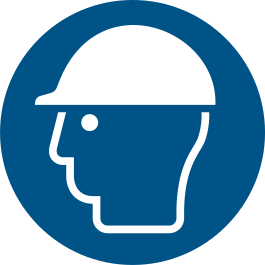
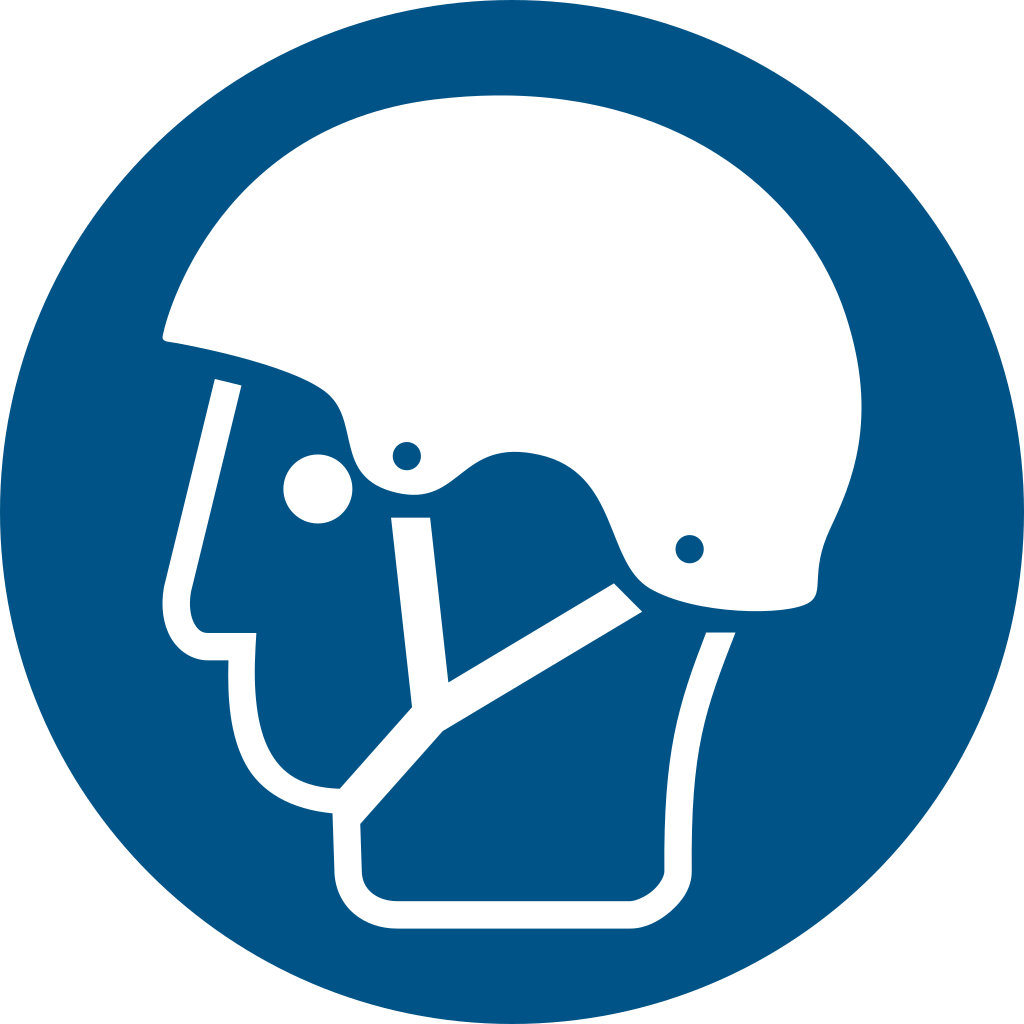
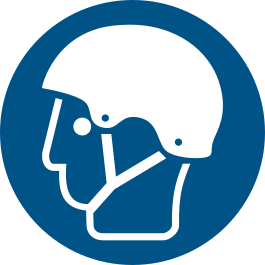
Wear a sports helmet
Instructs the reader to wear a sports helmet.
Understanding this sign
Blue circular signs communicate an action, such as wearing eye protection or following a specified procedure.
A pictogram does not select the grade of PPE or explain a complete procedure. Use the task-specific instructions.
Mandatory Signage Leaves the Factory
M066 requires a sports helmet and marks ISO 7010's expansion beyond industrial premises into recreation. The pictogram shows a head wearing a rounded recreational helmet — visibly different from the brimmed industrial hard hat of M014 — and the distinction is functional, not cosmetic. Industrial helmets are built primarily against falling objects from above; sports helmets are engineered for the impacts their activity actually produces: a skier striking hardpack, a cyclist hitting asphalt, a climber's head swinging into rock.
Operators of ski areas, bike parks, climbing facilities, skate parks, zip lines, toboggan runs, and water parks use M066 to state a helmet rule in a format that works across languages — a real advantage for venues whose guests arrive from everywhere. The sign converts a term-and-conditions clause into something visible at the moment it matters: at the ticket gate, the trailhead, the drop-in ramp.
Where Helmet Rules Come From
Recreational helmet mandates arrive by several routes. Some are law: a number of countries and regions require minors to wear helmets on ski slopes or when cycling, with age thresholds that vary by jurisdiction. Some are venue policy: bike parks, terrain parks, and climbing walls commonly make helmets a condition of entry regardless of local law, and competition sanctioning bodies require them for events. Rental and school programmes add a third layer, bundling a helmet with every hire or lesson.
M066 serves all three cases the same way, but the supplementary text should reflect which rule applies — 'helmets required for all riders' reads differently from 'helmet compulsory under 18'. Venues enforcing a legal mandate benefit from citing it, since guests take a statutory rule more seriously than a house preference, and staff refusing lift access to a bare-headed teenager can point at the posted law rather than argue policy.
Matching the Helmet to the Activity
A helmet certified for one sport is not automatically fit for another, and the certification landscape reflects that. Ski and snowboard helmets in Europe are certified to EN 1077, bicycle helmets to EN 1078 (with CPSC certification the US benchmark), and climbing helmets to EN 12492, which emphasises protection from falling stones and different retention demands. Whitewater, equestrian, and skate disciplines have their own standards. A venue posting M066 should state which certification satisfies the rule when it matters — a climbing gym accepting bike helmets would be diluting real protection.
Condition and fit determine whether the certified shell delivers. Most recreational helmets are single-impact designs whose crushable liner is spent after one significant hit, often without visible damage, and a helmet perched on the back of the head protects a different anatomy than the one at risk. Rental operations backing an M066 sign therefore need inspection and retirement routines, not just a shelf of loaners.
Posting M066 Around a Venue
Effective placement follows the guest's decision path. The first instance belongs where equipment is still within reach — the rental counter, the car park side of the ticket office, the gear-up area — because a helmet rule discovered at the lift gate produces frustration rather than compliance. Repeats then go at control points: lift and tow loading areas, terrain park and bike trail entries, the climbing wall floor, the zip-line launch deck.
Staff-facing uses matter too. Ski patrollers, lift crews working under moving cables, and bike park builders are employees, and their helmet requirements flow from workplace PPE law rather than guest policy; some of those tasks genuinely call for M014 industrial protection instead. Keeping guest signage (M066) and worker signage distinct prevents the quiet error of specifying a leisure product for an occupational hazard.
Where you will see M066
Ski areas, bike parks, climbing facilities, skate parks, zip lines, toboggan runs, and water parks post it along the guest's decision path: first at the rental counter, ticket office, and gear-up area where equipment is still within reach, then at lift loading points, terrain park and bike trail entries, the climbing wall floor, and the zip-line launch deck. Supplementary text states whose rule applies, such as a statutory mandate for minors versus venue policy.
Common questions about M066
What does the sports helmet sign mean?
ISO 7010 M066 means a sports helmet must be worn beyond that point — at ski slopes, bike parks, climbing facilities, skate parks, and similar venues. It signals a binding rule of the venue or local law, not a suggestion, and it refers to activity-appropriate recreational helmets rather than industrial hard hats, which have their own sign, M014.
Are helmets legally required on ski slopes?
It depends on the jurisdiction. Several countries and regions legally require minors to wear helmets when skiing or snowboarding, with differing age limits, while for adults the rule is usually resort policy or competition regulation rather than statute. Check the destination's current rules before travelling; resorts that enforce a legal mandate typically say so on or beside the M066 sign.
Can I use a bike helmet for skiing or climbing?
Not interchangeably. Each sport's helmets are certified against that sport's impact pattern — EN 1077 for ski and snowboard, EN 1078 or CPSC for cycling, EN 12492 for climbing — and differ in coverage, retention, ventilation, and cold performance. Some multi-certified models legitimately cover two disciplines; check the label inside the shell rather than the helmet's appearance.
How is M066 different from the M014 hard hat sign?
M014 mandates industrial head protection against workplace hazards, chiefly falling and swinging objects, and appears on construction sites and factories. M066 mandates recreational sports helmets at leisure venues. The drawn helmets differ on the signs precisely so that a venue can require the right product — an industrial hard hat on a mountain bike trail would satisfy neither the standard nor the physics.
Reference details
| Symbol code | M066 |
|---|---|
| Sign family | ISO Mandatory Signs |
| Standard reference | ISO 7010:2019 / ISO 3864-1 ISO Online Browsing Platform: M066 |
| Screen color reference | #0000FF. Screen colors are not a production color specification. |
| Download formats | SVG reference artwork; a 1024 × 1024 pixel PNG conversion on a white canvas. |
| Record date | · How to interpret our dates |
| Page updated |
Choosing a physical sign size
Download dimensions are not installation dimensions. Select sign size, material, placement, and lighting using the applicable standard and the actual viewing conditions. Chemical label sizing follows its own rules. Read the artwork and sizing guide.
Sources and artwork credits
- Artwork source
- Wikimedia Commons file page
- Creator credited by source
- Clemenspool
- License
- CC0
- Source metadata checked
SVG files are local reference copies. PNG files are raster conversions. Check the linked file history and license terms before reuse; a source-metadata check is not certification of the artwork or a workplace installation.
Report a correction to this reference