Children must be accompanied
Instructs that children be accompanied.
Understanding this sign
Blue circular signs communicate an action, such as wearing eye protection or following a specified procedure.
A pictogram does not select the grade of PPE or explain a complete procedure. Use the task-specific instructions.
Making Adult Supervision a Condition of Entry
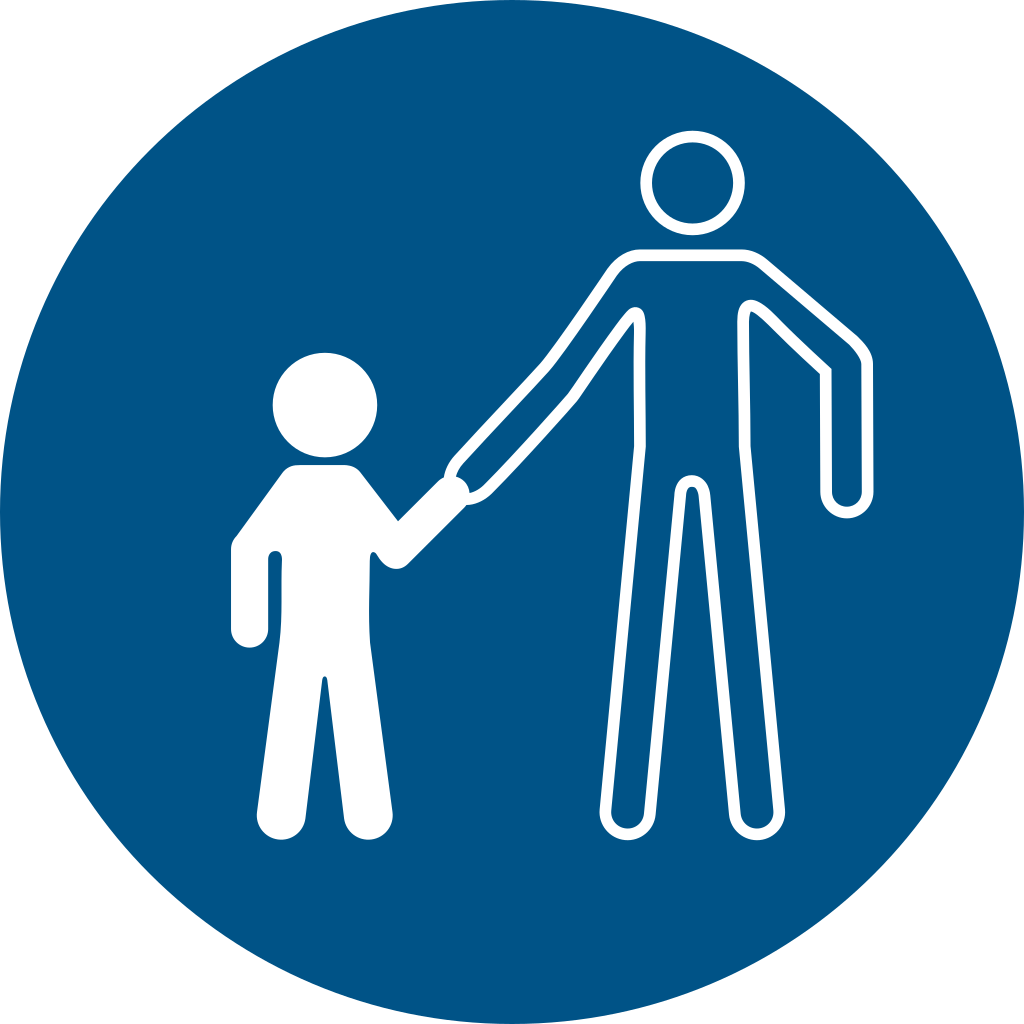
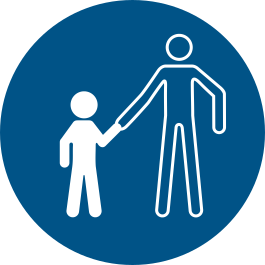
M065 signifies that children may be present in the marked area only when accompanied by an adult. The pictogram — an adult figure holding a child's hand — puts a supervision requirement into the mandatory blue-disc format, which changes its legal and practical character: it is not advice to parents but a condition of access that staff can enforce at the point of entry. An unaccompanied child at an M065-signed pool gate or escalator is, by the sign's logic, a rule breach to act on, not a judgment call.
The sign deliberately leaves the age threshold and the required ratio to the operator, because both vary by venue and jurisdiction. The pictogram carries the principle; a supplementary text panel beneath it typically supplies the specifics — for example the minimum age for unaccompanied entry and how many children one adult may supervise.
Pools, Escalators, and Other Typical Postings
Swimming pools are the archetype. Drowning is fast and silent, lifeguards scan an entire tank rather than watching individual children, and industry safety guidance therefore expects operators to set and post child admission policies — commonly requiring adults in the water within reach of the youngest swimmers, with maximum child-per-adult ratios stated at the entrance. M065 anchors that policy at the reception desk and poolside gates. Spa areas, saunas, and hot tubs extend the same requirement, often with a minimum-age prohibition alongside.
Beyond aquatics, M065 appears at escalators and moving walkways (small children must hold an adult's hand), in station and airport circulation areas, at farm parks and open days where visitors move among animals and machinery, in hotel gyms, at climbing walls and trampoline parks, and in workshops or maker spaces that admit families. Changing villages and locker rooms use it to keep young children within a guardian's sight in areas staff do not continuously monitor.
What Accompaniment Has to Mean in Practice
A recurring failure at signed venues is nominal accompaniment: the adult is on the premises but reading a phone on a lounger while the child is in the water, or waits at the bottom of the escalator while the child rides alone. Effective policies define accompaniment functionally — within arm's reach for non-swimmers, constant direct sight for older children, hand held on escalators — and brief staff to challenge gaps. The sign gives front-line employees the authority for that conversation.
M065 also shapes admission decisions before any hazard is reached. Ticket desks and online booking pages that state the accompaniment rule up front prevent the worst version of the problem: a child turned away, or admitted unsupervised, at the door. Operators pairing M065 with age-based prohibition signs should keep the two distinct — one bans children below an age entirely, the other admits them under supervision.
Where you will see M065
Swimming pools are the archetype, anchoring admission policies at reception desks and poolside gates, with spas, saunas, and hot tubs extending the rule. It also appears at escalators and moving walkways, station and airport concourses, farm parks, hotel gyms, climbing walls, trampoline parks, maker spaces that admit families, and changing villages that staff do not continuously monitor.
Common questions about M065
What does the ISO 7010 M065 sign mean?
It means children are allowed in the marked area only when accompanied by an adult. The pictogram shows an adult holding a child's hand on the blue mandatory background, and it is used at swimming pools, escalators, spas, farm parks, gyms, and other venues where unsupervised children face risks the environment cannot control.
What age counts as a child under the M065 sign?
The ISO pictogram does not fix an age — the operator or local rules do. Venues state the threshold and any ratio on a text panel with the sign; pools, for example, commonly set minimum unaccompanied-swimming ages and limit how many young children each adult may bring in. Always read the supplementary text, because the same symbol carries different admission rules at different sites.
Are child supervision ratios at swimming pools a legal requirement?
Requirements differ by country, but safety regulators and industry bodies widely expect pool operators to assess the risk and enforce a stated admission policy, and ratios such as one adult to one or two young children are common practice published at entrances. Whether the number comes from statute, licensing conditions, or operator policy, the posted ratio is enforceable as a condition of entry — which is what M065 signals.
Where should a children-must-be-accompanied sign be placed?
At the decision points: reception or ticketing, the entrance gate to the pool hall or hazard area, escalator and travelator landings, and inside changing areas. Placing it only deep inside the venue fails the family that has already split up; the sign works best where the accompanying adult is still present and the rule can still shape behavior.
Reference details
| Symbol code | M065 |
|---|---|
| Sign family | ISO Mandatory Signs |
| Standard reference | ISO 7010:2019 / ISO 3864-1 ISO Online Browsing Platform: M065 |
| Screen color reference | #0000FF. Screen colors are not a production color specification. |
| Download formats | SVG reference artwork; a 1024 × 1024 pixel PNG conversion on a white canvas. |
| Record date | · How to interpret our dates |
| Page updated |
Choosing a physical sign size
Download dimensions are not installation dimensions. Select sign size, material, placement, and lighting using the applicable standard and the actual viewing conditions. Chemical label sizing follows its own rules. Read the artwork and sizing guide.
Sources and artwork credits
- Artwork source
- Wikimedia Commons file page
- Creator credited by source
- Clemenspool
- License
- CC0
- Source metadata checked
SVG files are local reference copies. PNG files are raster conversions. Check the linked file history and license terms before reuse; a source-metadata check is not certification of the artwork or a workplace installation.
Report a correction to this reference