Hold two ski poles with a single hand
Instructs the reader to hold two ski poles in one hand.
Understanding this sign
Blue circular signs communicate an action, such as wearing eye protection or following a specified procedure.
A pictogram does not select the grade of PPE or explain a complete procedure. Use the task-specific instructions.
One Hand for the Poles, One for the Lift
M064 requires skiers to gather both poles into a single hand before riding a chairlift, drag lift, or conveyor-belt lift. The point of the instruction is the hand it frees: on a T-bar or button lift the empty hand grabs and controls the tow hanger; on a chairlift it pulls down and holds the safety bar or steadies a child; on a magic carpet it provides balance or a grip on the side. A skier with a pole in each fist has no hand available for any of that.
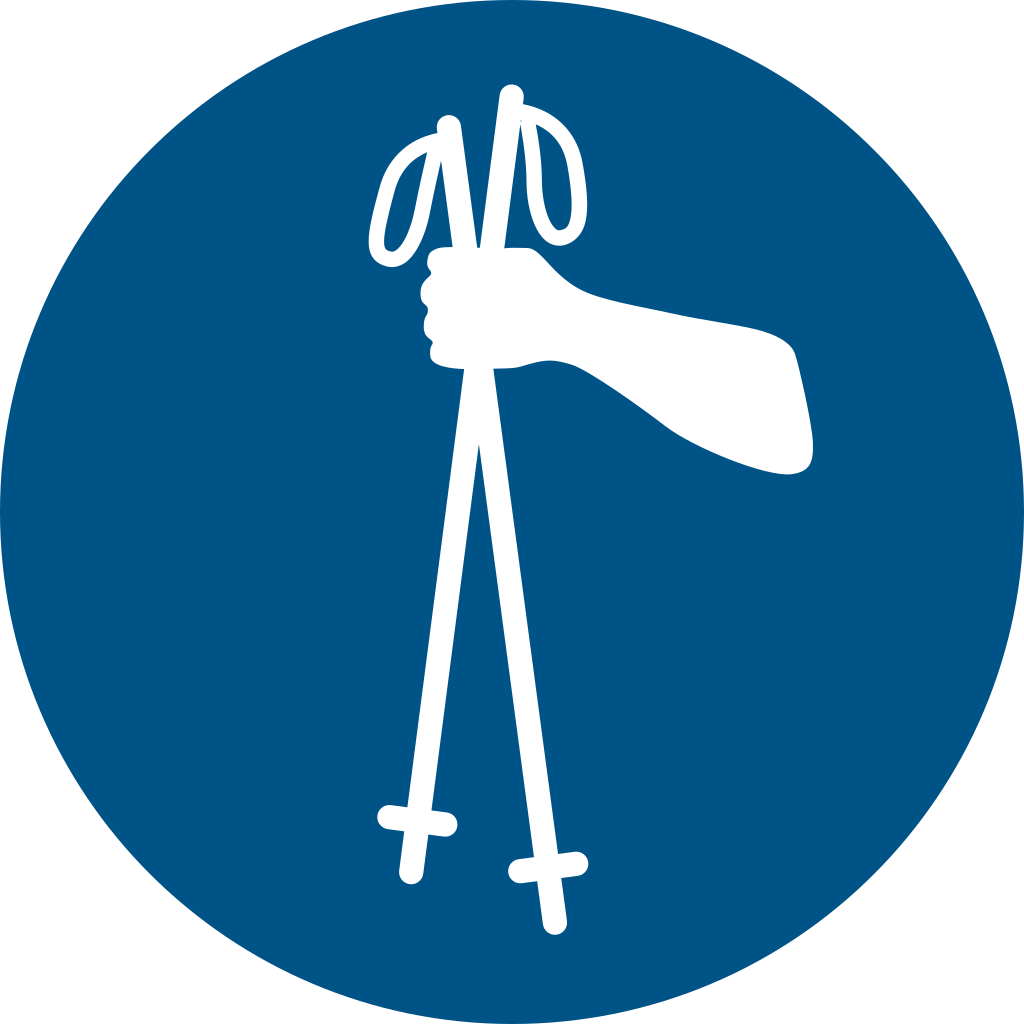
Like its companion M063, the sign encodes what lift attendants have shouted at loading points since drag lifts existed. Turning the phrase into an ISO 7010 pictogram — a hand clasping two crossed poles — lets a resort with visitors from a dozen countries post the rule once, without translation.
The Loading Zone Is the Critical Window
Loading a moving lift is a timed maneuver: the rider positions, watches the approaching chair or hanger, and takes it within a second or two. Fumbling to consolidate poles during that window is how beginners miss the bar, take a chair edge in the back, or fall in the track with the next rider seconds behind. M064 moves the pole handling into the queue, where there is time to do it calmly — poles in one hand, look over the shoulder, take the lift with the other.
The instruction also matters mid-ride and at the top. On a drag lift, poles held loosely across the body are poles that drop onto the track and trip the skiers behind; held together in one grip, they stay controlled through the whole ascent and through the release-and-clear movement at the unloading ramp, where hesitation causes pile-ups.
Posting the Sign and Teaching the Habit
M064 appears on queue barriers and loading-area instruction boards, most consistently at drag lifts and beginner conveyor belts where the audience is least experienced. Resorts often present it within a short pictogram sequence read while shuffling forward in line: remove pole straps (M063), poles in one hand (M064), plus lift-specific panels on lowering the restraint bar and unloading. Sequenced signage works because it matches the order in which the actions must happen.
Ski schools fold the two-sign drill into first lift lessons, and instructors leading a class through a drag lift line will check each pupil's hands before the gate. For adults returning after years away, the queue-side sign is the whole refresher: it says nothing about why, but the crossed-poles-in-one-fist image is self-explanatory to anyone about to reach for a moving T-bar.
Where you will see M064
Ski resorts post it on queue barriers and loading-area instruction boards, most consistently at drag lifts and beginner conveyor belts where the audience is least experienced. It typically appears within a short pictogram sequence read while shuffling forward in line — remove pole straps (M063), poles in one hand (M064), then lift-specific panels on the restraint bar and unloading — and ski schools fold the drill into first lift lessons, checking each pupil's hands before the gate.
Common questions about M064
Why should ski poles be held in one hand on a lift?
To keep your other hand free for the lift itself — grabbing the T-bar or button hanger on a drag lift, pulling down and holding the chairlift safety bar, or balancing on a conveyor belt. It also keeps the poles controlled as one unit so they cannot drop onto the track, tangle with the equipment, or jab neighboring riders during loading and unloading.
What does the ISO 7010 M064 pictogram depict?
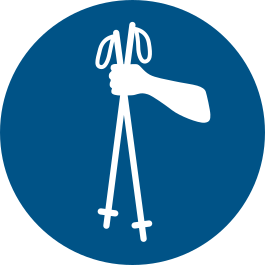
A single hand gripping two ski poles together, on the blue circular background used for mandatory action signs. It signifies that both poles must be gathered into one hand when riding chairlifts, drag lifts, and conveyor belts, and resorts display it at queue barriers and loading points.
Which hand should hold the poles on a drag lift?
The hand away from the approaching hanger, leaving your inside hand free to catch and control the T-bar or button. In practice that depends on the lift layout and which side the hanger arrives from — the sign mandates the one-handed grip itself, and lift attendants or loading boards indicate the side. Get the poles sorted in the queue, not while the hanger is arriving.
Do M063 and M064 have to be posted together?
Nothing requires it, but resorts usually pair them because they describe successive steps of the same preparation: straps off the wrists first, then both poles into one hand. A queue-side board showing the sequence in order gives riders a complete, language-free loading drill in the seconds before they reach the gate.
Reference details
| Symbol code | M064 |
|---|---|
| Sign family | ISO Mandatory Signs |
| Standard reference | ISO 7010:2019 / ISO 3864-1 ISO Online Browsing Platform: M064 |
| Screen color reference | #0000FF. Screen colors are not a production color specification. |
| Download formats | SVG reference artwork; a 1024 × 1024 pixel PNG conversion on a white canvas. |
| Record date | · How to interpret our dates |
| Page updated |
Choosing a physical sign size
Download dimensions are not installation dimensions. Select sign size, material, placement, and lighting using the applicable standard and the actual viewing conditions. Chemical label sizing follows its own rules. Read the artwork and sizing guide.
Sources and artwork credits
- Artwork source
- Wikimedia Commons file page
- Creator credited by source
- Clemenspool
- License
- CC0
- Source metadata checked
SVG files are local reference copies. PNG files are raster conversions. Check the linked file history and license terms before reuse; a source-metadata check is not certification of the artwork or a workplace installation.
Report a correction to this reference