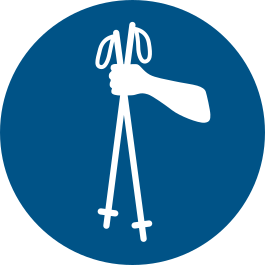
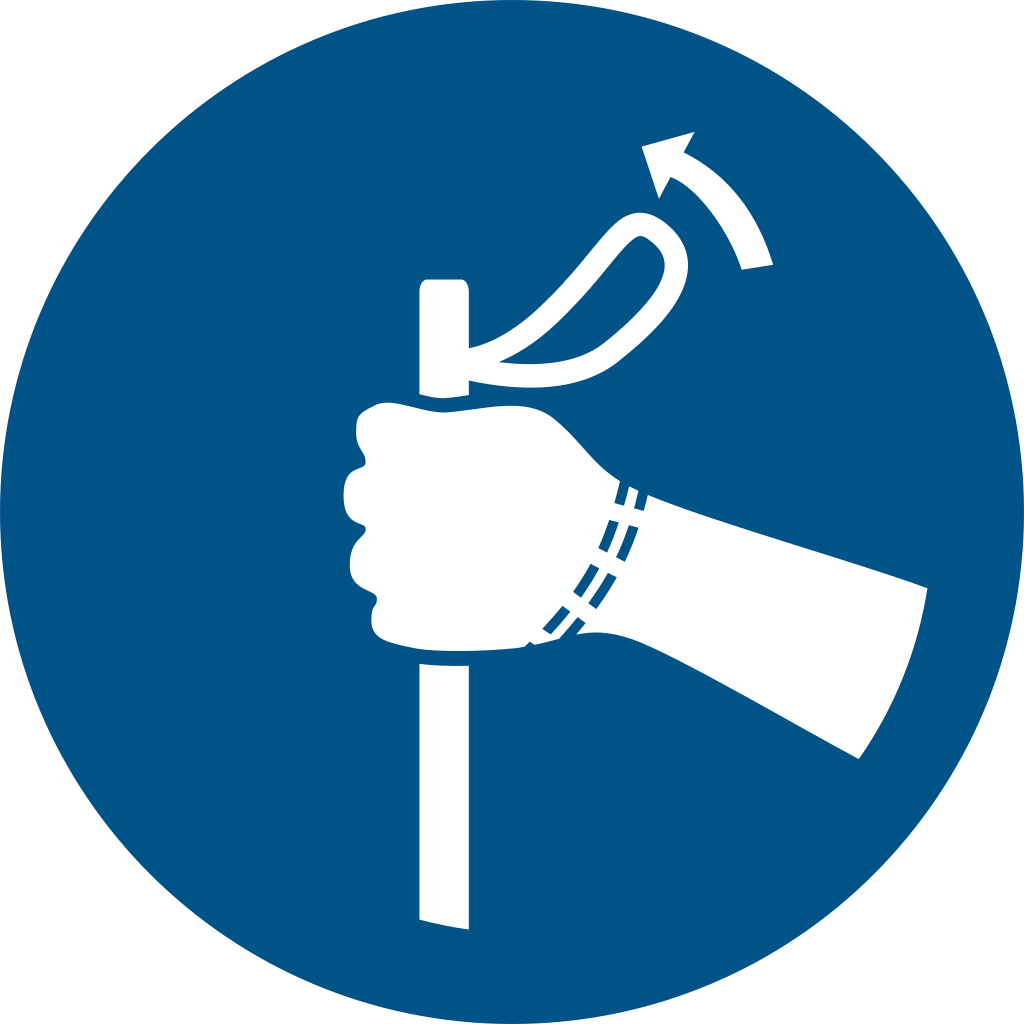
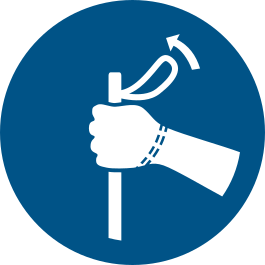
Remove ski pole strap from wrist
Instructs the reader to remove the ski pole strap from their wrist.
Understanding this sign
Blue circular signs communicate an action, such as wearing eye protection or following a specified procedure.
A pictogram does not select the grade of PPE or explain a complete procedure. Use the task-specific instructions.
A Lift-Line Rule Written as a Pictogram
M063 instructs skiers to take their pole straps off their wrists before boarding a chairlift, drag lift (ski tow), or conveyor-belt lift. It is one of a small cluster of ISO 7010 signs written for ski areas rather than workplaces, and it standardizes an instruction lift operators have painted on boards at loading zones for decades. The pictogram shows a hand pulling a strap free of the wrist — the exact motion required in the queue, before the loading point.
The rule exists because a strap turns a dropped pole into an anchor. Around moving lift equipment, a pole that snags on a chair frame, tow hanger, gate, or belt edge will simply be torn from an unstrapped hand; strapped to the wrist, the same snag drags the skier with it.
How Straps Cause Injuries at Lifts
Drag lifts are the sharpest case. On a T-bar or button (Platter) lift, the skier travels holding the hanger with poles carried in the free hand; a strapped pole that catches the towing gear, a lift-line structure, or another rider cannot be released, twisting the arm or pulling the skier off the track. At chairlift unloading, a strap looped over the armrest or slat has hooked skiers as the chair swings around the bullwheel — an entanglement with no time to undo a wrist loop.
Conveyor-belt lifts, common in beginner zones, add a low-speed but persistent variant: a trailing strapped pole caught at the belt's end plate keeps pulling while the child attached to it falls. In every scenario the corrective action is identical and must happen in advance, which is why M063 is posted in the queue rather than at the point of hazard.
Placement and the Companion Sign M064
Resorts post M063 on lift-queue barriers, loading-area boards, and lift-tower panels at the approach, where riders still have both hands free to comply. Because lift users span every language on the mountain, the wordless format does the work that multilingual text boards handled unevenly; many operators run it alongside FIS conduct signage and lift-specific loading instructions for children and beginners.
M063 pairs naturally with M064, which mandates holding both poles in a single hand while riding — the two signs describe successive steps of the same drill. Straps come off first (M063); the poles then move into one hand (M064), freeing the other to grab the T-bar, steady the safety bar, or hold a child. Ski schools teach the pair as one habit, and posting the signs together at drag lifts reinforces that sequence.
Where you will see M063
Ski resorts post it on lift-queue barriers, loading-area boards, and lift-tower panels at the approach, where riders still have both hands free to comply. It commonly pairs with M064, the mandate to hold both poles in one hand while riding, and runs alongside FIS conduct signage and lift-specific loading instructions for children and beginners at drag lifts and T-bars.
Common questions about M063
Why do you have to remove ski pole straps before a lift?
Because a strap binds the pole to your wrist. If the pole snags on the chair, tow hanger, loading gate, or conveyor belt, an unstrapped pole is just lost — a strapped one drags your arm and body with the moving equipment, risking dislocations, falls in the loading zone, or being pulled along the lift line.
What does the ISO 7010 M063 sign show?
A blue mandatory disc with a hand slipping a ski pole strap off the wrist. It signifies that pole straps must be removed before taking a chairlift, ski tow, or conveyor-belt lift, and it is posted in lift queues and at loading areas in ski resorts.
Does the strap rule apply to chairlifts or only drag lifts?
The ISO referent covers chairlifts, ski tows, and conveyor belts alike. Drag lifts pose the most direct entanglement risk because you actively hold the tow while carrying your poles, but chairlift straps have caught on armrests and chair frames at unloading, and belt lifts can trap a trailing pole — so resorts apply the instruction at all three lift types.
What is the difference between M063 and M064?
They are consecutive steps of the same lift-riding drill. M063 requires removing the pole straps from your wrists; M064 requires gathering both poles into one hand for the ride. Together they leave one hand completely free for the tow bar, safety bar, or a child, with nothing tying the poles to your body.
Reference details
| Symbol code | M063 |
|---|---|
| Sign family | ISO Mandatory Signs |
| Standard reference | ISO 7010:2019 / ISO 3864-1 ISO Online Browsing Platform: M063 |
| Screen color reference | #0000FF. Screen colors are not a production color specification. |
| Download formats | SVG reference artwork; a 1024 × 1024 pixel PNG conversion on a white canvas. |
| Record date | · How to interpret our dates |
| Page updated |
Choosing a physical sign size
Download dimensions are not installation dimensions. Select sign size, material, placement, and lighting using the applicable standard and the actual viewing conditions. Chemical label sizing follows its own rules. Read the artwork and sizing guide.
Sources and artwork credits
- Artwork source
- Wikimedia Commons file page
- Creator credited by source
- Clemenspool
- License
- CC0
- Source metadata checked
SVG files are local reference copies. PNG files are raster conversions. Check the linked file history and license terms before reuse; a source-metadata check is not certification of the artwork or a workplace installation.
Report a correction to this reference