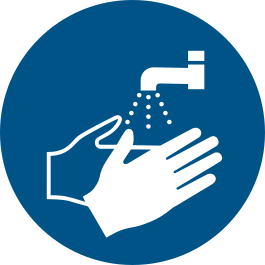
Disinfect your hands
Instructs the reader to disinfect their hands.

Understanding this sign
Blue circular signs communicate an action, such as wearing eye protection or following a specified procedure.
A pictogram does not select the grade of PPE or explain a complete procedure. Use the task-specific instructions.
Disinfection as a Distinct Instruction
M061 mandates hand disinfection — in practice, applying an alcohol-based hand rub or equivalent sanitizer — at the signed location. Its addition to ISO 7010 resolved a long-standing signage gap: for years, sites with sanitizer dispensers borrowed M011, the wash-hands sign, even though it depicts running water at a sink. M061 depicts liquid dropping onto a cupped hand, matching what the user actually finds at the station and what the procedure actually demands.
The distinction is more than pictorial pedantry. Hand rubbing and hand washing are different decontamination operations with different indications. Rubs act fast, need no plumbing, and suit high-frequency use; washing physically removes soil and covers the pathogens alcohol misses. A facility choosing which sign to hang is really documenting which operation its hygiene procedure requires at that point.
Healthcare, Visitors, and Point-of-Care Dispensers
Hospitals and care homes are M061's core territory. Infection-control practice positions rub dispensers at the point of care because sanitizing takes seconds and requires no trip to a sink, and WHO hand-hygiene guidance recommends rubs as the routine method for hands that are not visibly soiled. M061 marks the dispensers that make this possible: ward entrances, corridor stations, bed-end brackets, outpatient reception, and the thresholds of protective-isolation rooms where visitors must sanitize on the way in.
The sign carries particular weight for visitors and contractors, who lack the training clinical staff receive. A dispenser alone is easy to walk past; a mandatory blue disc above it reframes sanitizing from a courtesy into a condition of proceeding. The same logic extended M061 into pandemic-era retail, offices, gyms, and transport hubs, where it remains at entrances and shared-equipment points.
The Boundary With Washing — and With M062
M061 should not be posted where washing is the required control. Alcohol rubs do not reliably inactivate norovirus or Clostridioides difficile spores and do not clean hands that are greasy or visibly dirty; after toilet use, during gastrointestinal outbreaks, and in raw-food handling, soap and water at a sink — signed with M011 — is the correct mandate. Many clinical areas need both signs at different stations, and outbreak protocols may temporarily override rub stations with washing instructions.
M061's other neighbor is M062, which mandates disinfecting a surface rather than skin. The pair often appear together in gyms, clinical treatment rooms, and shared kitchens: sanitize your hands, then wipe the equipment or counter. Keeping the two distinct prevents a common signage muddle in which one generic "disinfect" notice leaves users unsure whether the target is themselves or the workstation.
Where you will see M061
Hospitals and care homes are its core territory, marking rub dispensers at ward entrances, corridor stations, bed-end brackets, and outpatient reception in line with WHO point-of-care hand-hygiene practice, where the blue disc turns a dispenser visitors might walk past into a condition of proceeding. Pandemic-era use carried it into retail, offices, gyms, and transport hubs, and in clinical settings it often works alongside M062, which mandates disinfecting surfaces rather than skin.
Common questions about M061
What is the difference between the M061 and M011 hand hygiene signs?
M061 mandates hand disinfection with a sanitizer such as alcohol-based rub and depicts liquid dispensed onto a hand; M011 mandates washing with soap and running water and depicts hands under a tap. Post M061 at dispenser stations and M011 at sinks — each sign should match the facility actually provided and the operation the procedure requires.
When is hand sanitizer not enough compared with washing?
When hands are visibly dirty or greasy, after using the toilet, and when the target organisms resist alcohol — notably norovirus and Clostridioides difficile spores, which is why gastroenteritis and C. difficile precautions call for soap-and-water washing. Alcohol rub is the fast routine option for unsoiled hands, not a universal substitute for a sink.
Where are M061 signs typically required or posted?
Above sanitizer dispensers wherever disinfection is a required step: hospital ward and room entrances, point-of-care brackets, care home entries, clinic receptions, and visitor thresholds; also gyms, food-adjacent retail, offices, and transport hubs that mandate sanitizing on entry. The sign belongs on or beside the dispenser itself, pairing the instruction with the means of complying.
How should hand sanitizer be applied for the M061 instruction to work?
Dispense enough product to cover all surfaces of both hands — palms, backs, between fingers, fingertips, and thumbs — and rub until completely dry, which typically takes on the order of twenty to thirty seconds. Wiping wet hands or rubbing only the palms leaves areas untreated, and fingertips are the surfaces most involved in touch transmission.
Reference details
| Symbol code | M061 |
|---|---|
| Sign family | ISO Mandatory Signs |
| Standard reference | ISO 7010:2019 / ISO 3864-1 ISO Online Browsing Platform: M061 |
| Screen color reference | #0000FF. Screen colors are not a production color specification. |
| Download formats | SVG reference artwork; a 1024 × 1024 pixel PNG conversion on a white canvas. |
| Record date | · How to interpret our dates |
| Page updated |
Choosing a physical sign size
Download dimensions are not installation dimensions. Select sign size, material, placement, and lighting using the applicable standard and the actual viewing conditions. Chemical label sizing follows its own rules. Read the artwork and sizing guide.
Sources and artwork credits
- Artwork source
- Wikimedia Commons file page
- Creator credited by source
- Clemenspool
- License
- CC0
- Source metadata checked
SVG files are local reference copies. PNG files are raster conversions. Check the linked file history and license terms before reuse; a source-metadata check is not certification of the artwork or a workplace installation.
Report a correction to this reference