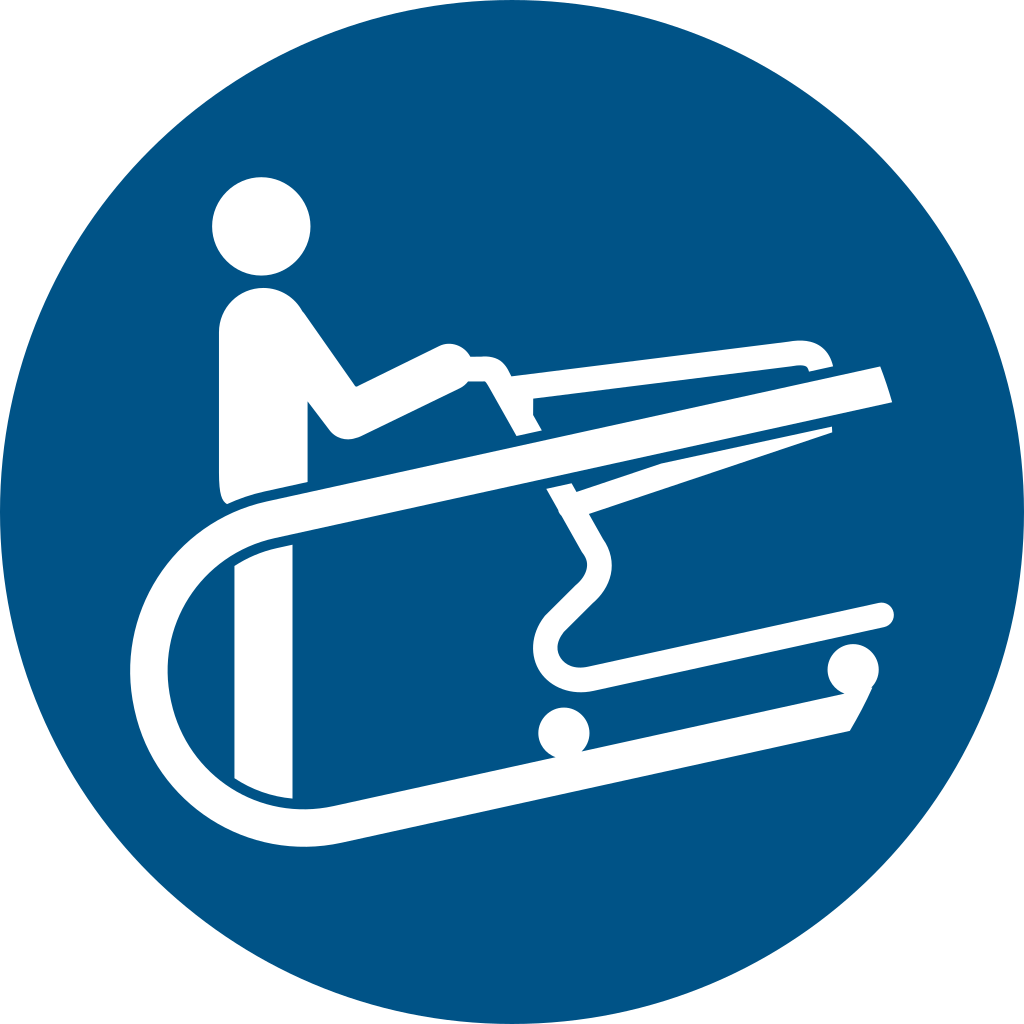
Hold the trolley handle
Instructs the reader to hold the trolley handle.
Understanding this sign
Blue circular signs communicate an action, such as wearing eye protection or following a specified procedure.
A pictogram does not select the grade of PPE or explain a complete procedure. Use the task-specific instructions.
Why a Trolley Needs a Mandatory Sign
M060 requires users to keep a firm grip on the trolley handle while riding a moving walkway or escalator. The instruction targets a specific mechanical fact: airport baggage carts and travelator-rated shopping trolleys are typically fitted with brakes that engage automatically when the handle is released. Let go, and the cart is supposed to stop — but a loaded cart abandoned on a moving incline, or one whose brake is worn, can run away, tip, or jam at the comb plate where the walkway ends.
The sign therefore does double duty. It keeps the human in the control loop of a brake system designed around hand pressure, and it prevents the everyday behavior that defeats it: stepping away from the cart to manage children or luggage, letting the cart drift ahead on the down-slope, or riding two carts at once with neither properly held.
Airports, Retail Parks, and Inclined Travelators
The densest use of M060 is at airport travelators, where passengers push heavily loaded baggage carts between levels, and at multi-level supermarkets and retail parks with inclined moving walkways connecting the sales floor to parking. In both settings the operator permits trolleys on the walkway only on the premise that they are compatible carts under continuous control — and M060, posted at the walkway entry, states that condition to every user in a language-free format.
Placement follows the decision point. The sign belongs on the balustrade or entry portal of each inclined walkway, at cart pick-up points near travelator routes, and frequently as a decal on the trolley handle itself. Operators commonly cluster it with related pictograms: children must be held or accompanied, strollers restricted, dogs carried — the standard moving-walkway instruction panel that lift and escalator codes expect at each landing.
What Goes Wrong Without the Grip
A cart released on a downward travelator concentrates risk at the exit landing: it accelerates or coasts into the fixed floor, stops dead at the transition, and becomes an obstacle that following passengers — carried forward by the moving surface with nowhere to go — pile into. Tipping is the other failure mode: a top-heavy load on an incline pivots easily once no hand is stabilizing it, spilling baggage across the pallets or trapping a child seated in the cart.
Holding the handle also keeps the user correctly positioned behind the load, facing the direction of travel, with body weight available to check the cart at the landing transition. That is why the mandate is phrased as holding the handle rather than merely staying near the trolley; proximity without grip provides neither braking nor stability at the moment either is needed.
Where you will see M060
Its densest use is at airport travelators, where passengers push heavily loaded baggage carts between levels, and at multi-level supermarkets and retail parks with inclined moving walkways connecting the sales floor to parking. Operators post it on the balustrade or entry portal of each inclined walkway, at cart pick-up points near travelator routes, and frequently as a decal on the trolley handle itself, clustered with the standard moving-walkway instruction panel.
Common questions about M060
What does the ISO 7010 M060 sign mean?
It requires that the handle of a trolley or baggage cart be held firmly the whole time the user is on a moving walkway or escalator. It is posted at inclined travelators in airports and multi-level retail sites where carts are permitted.
Why do airport baggage carts have to be held on moving walkways?
Travelator-compatible carts generally use a brake released by pressure on the handle: gripping it frees the wheels, letting go applies the brake. Releasing the handle mid-ride takes the cart out of your control — if the brake is worn or the load shifts on the incline, the cart can roll away, tip over, or block the exit landing where other passengers are being carried toward it.
Are shopping trolleys allowed on escalators?
On conventional step escalators, generally no — carts are restricted to inclined moving walkways (travelators) and only where the operator provides compatible trolleys with automatic brakes. Sites that permit them post M060 at the walkway entrance as a condition of use, and standard carts without travelator brakes remain prohibited.
Where should the M060 symbol be displayed?
At each end of the inclined moving walkway on the entry balustrade or portal, at trolley collection points serving those routes, and as a durable decal on the cart handle itself. It usually appears within the walkway's instruction panel next to signs about supervising children and restrictions on strollers.
Reference details
| Symbol code | M060 |
|---|---|
| Sign family | ISO Mandatory Signs |
| Standard reference | ISO 7010:2019 / ISO 3864-1 ISO Online Browsing Platform: M060 |
| Screen color reference | #0000FF. Screen colors are not a production color specification. |
| Download formats | SVG reference artwork; a 1024 × 1024 pixel PNG conversion on a white canvas. |
| Record date | · How to interpret our dates |
| Page updated |
Choosing a physical sign size
Download dimensions are not installation dimensions. Select sign size, material, placement, and lighting using the applicable standard and the actual viewing conditions. Chemical label sizing follows its own rules. Read the artwork and sizing guide.
Sources and artwork credits
- Artwork source
- Wikimedia Commons file page
- Creator credited by source
- Clemenspool
- License
- CC0
- Source metadata checked
SVG files are local reference copies. PNG files are raster conversions. Check the linked file history and license terms before reuse; a source-metadata check is not certification of the artwork or a workplace installation.
Report a correction to this reference