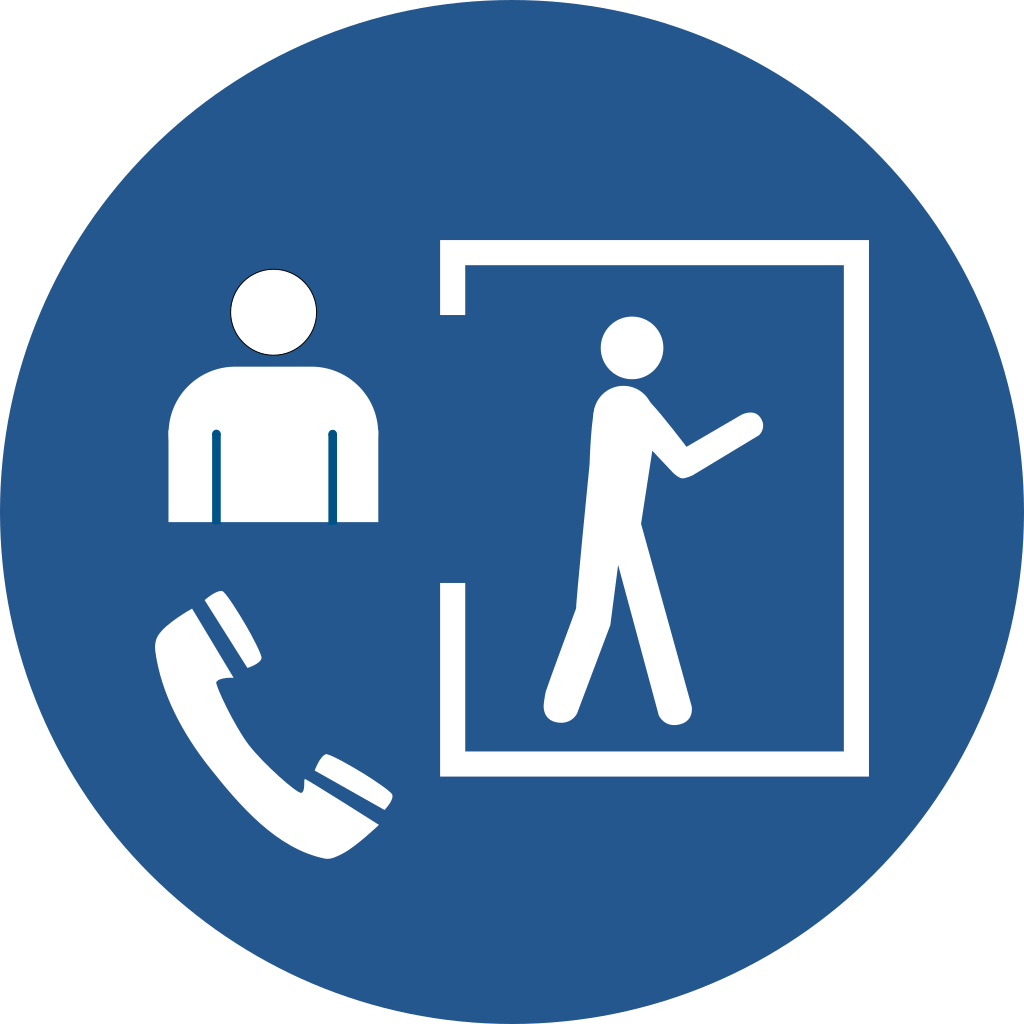
Entry only with supervisor outside
Permits entry only with a supervisor outside.

Understanding this sign
Blue circular signs communicate an action, such as wearing eye protection or following a specified procedure.
A pictogram does not select the grade of PPE or explain a complete procedure. Use the task-specific instructions.
The Human Backup at the Hatch
M058 permits entry into a space only when a supervisor — in most safety programs called an attendant or standby person — is stationed outside, ready to summon help and begin first aid if something goes wrong inside. The ISO register wording captures the core logic of confined-space fatalities: the person in trouble inside a tank or pit usually cannot rescue themselves, and would-be rescuers who rush in unprepared frequently become the additional casualties. The attendant is the circuit breaker in that sequence.
The pictogram shows one figure inside an enclosure and a second standing at the opening, which is exactly the arrangement the sign enforces. Posting M058 at a manway, vault lid, or tank door converts a written procedural rule into a visible condition of entry: if nobody is standing here, nobody goes in.
What the Person Outside Actually Does
Confined-space regulations give the outside role a defined job description. Under OSHA's permit-required confined space standard, 29 CFR 1910.146, the attendant must know the hazards and their symptoms, keep count of who is inside, maintain continuous communication with entrants, monitor conditions, order evacuation when something changes, summon rescue services — and, pointedly, must not enter the space to attempt rescue unless relieved and equipped under the rescue plan. UK and EU confined-space regimes assign an equivalent standby role through their safe-system-of-work requirements.
The role is active, not ceremonial. An attendant distracted by other tasks, out of earshot, or unsure how many people entered fails the function the sign promises. Effective programs pair M058 with non-entry rescue provisions — retrieval lines and a tripod winch at vertical entries — so that the person outside has a means of getting an entrant out without going in.
Completing the Confined-Space Trio
M058 is the third member of ISO 7010's confined-space entry set. M056 handles the atmosphere on entry (ventilate before and while inside), M057 handles spaces needing permanent airflow, and M058 handles the contingency that engineering controls fail anyway. Displaying M058 alongside M056 at a permit space entry tells the crew that clean air readings alone do not authorize entry — the staffing precondition must also be met.
Typical postings include sewer and stormwater access points, ship tanks and cofferdams, digesters and reactors during maintenance, underground utility chambers, and deep excavation shafts. The sign is equally at home on mobile plant: vacuum-truck tanks and tanker barrels entered for cleaning kill workers in exactly the solo-entry scenario M058 prohibits. Wherever a permit board hangs, M058 reinforces the permit line that names the attendant on duty.
Where you will see M058
Sewer and stormwater access points, ship tanks and cofferdams, digesters and reactors opened for maintenance, underground utility chambers, and deep excavation shafts carry the sign at the manway, vault lid, or tank door, converting the written attendant rule into a visible condition of entry. It also belongs on mobile plant such as vacuum-truck tanks and tanker barrels entered for cleaning, and reinforces the permit-board line naming the attendant on duty, typically displayed with the M056 ventilation sign.
Common questions about M058
What does the ISO 7010 M058 sign mean?
It means the marked space may be entered only when a supervisor or attendant remains stationed outside, ready to give first aid and call for help if an accident occurs inside. It is one of the three ISO 7010 confined-space mandatory signs, alongside M056 and M057 on ventilation.
Is an attendant legally required for confined space entry?
For permit-required confined spaces in the United States, yes: OSHA 29 CFR 1910.146 requires at least one attendant stationed outside for the duration of entry operations, with duties including tracking entrants, maintaining communication, ordering evacuation, and summoning rescue. Other jurisdictions impose the same standby-person requirement through confined-space regulations and safe-system-of-work rules, so solo entry into a hazardous confined space is broadly prohibited.
Can the person outside a confined space go in to rescue someone?
Not while serving as attendant. Untrained rescue attempts are a well-documented multiplier of confined-space deaths — responders entering after a collapsed colleague are often overcome by the same atmosphere. The attendant's job is to trigger the rescue plan and use non-entry retrieval where rigged (lifelines, tripod and winch); entering is allowed only if they are properly relieved, trained, and equipped for entry rescue under the plan.
Where should the M058 sign be posted?
Directly at the entry opening — the manway, hatch, lid, or door — where it is unavoidable at the moment entry becomes possible, and ideally on or beside the entry permit board. Common locations include sewer access chambers, tanks and vessels opened for cleaning or inspection, digesters, utility vaults, and tanker interiors.
Reference details
| Symbol code | M058 |
|---|---|
| Sign family | ISO Mandatory Signs |
| Standard reference | ISO 7010:2019 / ISO 3864-1 ISO Online Browsing Platform: M058 |
| Screen color reference | #0000FF. Screen colors are not a production color specification. |
| Download formats | SVG reference artwork; a 1024 × 1024 pixel PNG conversion on a white canvas. |
| Record date | · How to interpret our dates |
| Page updated |
Choosing a physical sign size
Download dimensions are not installation dimensions. Select sign size, material, placement, and lighting using the applicable standard and the actual viewing conditions. Chemical label sizing follows its own rules. Read the artwork and sizing guide.
Sources and artwork credits
- Artwork source
- Wikimedia Commons file page
- Creator credited by source
- Clemenspool
- License
- CC0
- Source metadata checked
SVG files are local reference copies. PNG files are raster conversions. Check the linked file history and license terms before reuse; a source-metadata check is not certification of the artwork or a workplace installation.
Report a correction to this reference