Use this walkway
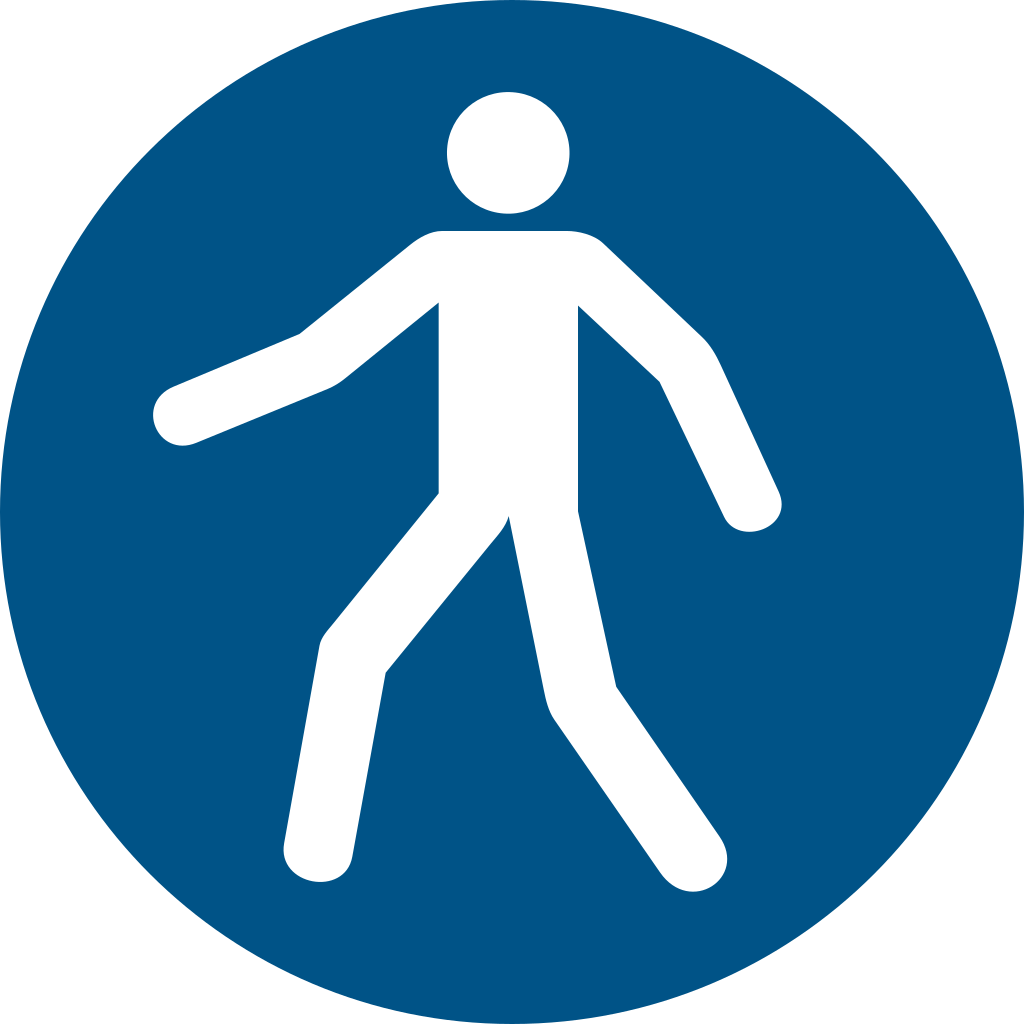
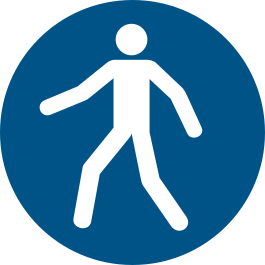
Instructs the reader to use the designated walkway.
Understanding this sign
Blue circular signs communicate an action, such as wearing eye protection or following a specified procedure.
A pictogram does not select the grade of PPE or explain a complete procedure. Use the task-specific instructions.
What ISO 7010 M024 Requires
M024 tells pedestrians they must use the designated walkway — the marked, protected path through an area where walking anywhere else is unsafe or forbidden. Its register meaning is that pedestrians must use a designated walkway, and its natural habitat is any floor or yard shared with powered vehicles: warehouses with forklift traffic, distribution yards, container terminals, manufacturing halls, and construction site access routes.
The sign presumes the walkway actually exists as a distinguishable route. On its own, a blue disc cannot conjure segregation; it points to floor markings, painted lanes, barriers, or raised kerbs that define where feet belong. When the paint has worn away or pallets block the lane, M024 becomes an instruction with no object — which is why walkway maintenance and signage are treated as one control, not two.
Why Pedestrian Segregation Is the Point
Collisions between industrial vehicles and people on foot are a persistent source of severe workplace injuries, and the standard analysis is blunt: a walking person loses every encounter with a forklift. Counterbalance trucks have large blind spots, reverse frequently, and swing their tails on turns, so relying on driver observation in a shared aisle is a weak control. Keeping pedestrians on defined routes with barriers or clearance from vehicle lanes attacks the exposure itself.
Workplace regulations in many jurisdictions reflect this, requiring traffic routes to be laid out and marked so vehicles and pedestrians can circulate without endangering each other; European workplace rules make marking of traffic routes an explicit expectation where workers are at risk. M024 is the standardized way of declaring, at the point of decision, which of those routes is the pedestrian one.
Placement and Layout Practice
Post M024 where a person on foot chooses a path: personnel doors into warehouses and production halls, the pedestrian gate beside a vehicle entrance, the start of each marked lane, and junctions where the walkway crosses or diverges from vehicle routes. Long routes need repetition, since a walkway that disappears visually invites drifting into the aisle. Crossing points deserve extra treatment — dropped kerbs, mirrors, gates that force a pause, and vehicle-facing warnings — because that is where segregation intentionally breaks.
Layout discipline determines whether the sign is obeyed. Effective walkways follow the routes people genuinely want to take; a lane that triples the distance to the canteen will be abandoned within a week. Site designers walk desire lines first, put the protected route on them, keep it clear of staged pallets, and only then hang the blue signs.
Companion Signs on Shared Traffic Routes
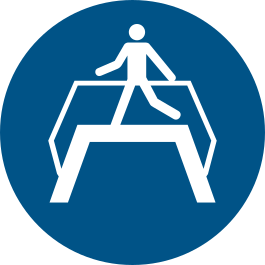
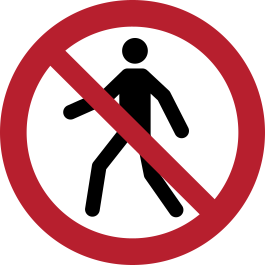
M024 rarely appears alone. W014, the industrial-truck warning, faces pedestrians where forklifts operate; P006 bars forklifts from areas reserved for people; P004 blocks pedestrians from vehicle-only zones; and M023 takes over where the safe route crosses a hazard on a bridge rather than at grade. Each sign handles one side of the same separation, and a coherent site traffic plan assigns them together rather than sprinkling them individually.
The distinction from M023 is worth keeping sharp for specifiers: M024 governs a route at floor level, defined by marking and barriers, while M023 mandates an elevated crossing structure. Where a walkway leads to a bridge over a conveyor or roadway, both signs appear in sequence — the walkway sign along the route, the footbridge sign at the crossing.
Where you will see M024
Warehouses with forklift traffic, distribution yards, container terminals, manufacturing halls, and construction site access routes are its natural habitat. The sign goes where a person on foot chooses a path: personnel doors into production halls, the pedestrian gate beside a vehicle entrance, the start of each painted lane, and junctions where the walkway crosses vehicle routes, working alongside W014 truck warnings, P006, and P004 in a coherent site traffic plan.
Common questions about M024
What does the blue sign of a person walking mean in a warehouse?
It is ISO 7010 M024, requiring people on foot to stay on the designated pedestrian walkway rather than walking through vehicle aisles or yard space. It is posted at entrances, at the start of marked lanes, and at junctions where the walkway meets forklift or truck routes.
Are marked pedestrian walkways a legal requirement in workplaces?
Many jurisdictions require workplaces to organize traffic routes so pedestrians and vehicles can move safely, and European workplace rules expect traffic routes to be clearly marked where workers are at risk. Whether a walkway with M024 signage is the specific answer depends on the site's risk assessment, but where vehicles and people share space it is the standard control.
What is the difference between M024 and M023?
M024 mandates a designated walkway at ground level, defined by floor markings or barriers. M023 mandates crossing via a footbridge, an elevated structure over the hazard. Sites often use both: M024 along the marked route and M023 at the point where it climbs over a conveyor, rail line, or roadway.
How do you get workers to actually stay on the walkway?
Design it along the routes people already want to walk, keep it physically clear of pallets and equipment, protect crossing points with gates or mirrors, and repaint markings before they fade. Enforcement helps, but a walkway that is direct, unobstructed, and obviously safer than the aisle largely enforces itself; M024 then confirms the rule rather than fighting the layout.
Reference details
| Symbol code | M024 |
|---|---|
| Sign family | ISO Mandatory Signs |
| Standard reference | ISO 7010:2019 / ISO 3864-1 ISO Online Browsing Platform: M024 |
| Screen color reference | #0000FF. Screen colors are not a production color specification. |
| Download formats | SVG reference artwork; a 1024 × 1024 pixel PNG conversion on a white canvas. |
| Record date | · How to interpret our dates |
| Page updated |
Choosing a physical sign size
Download dimensions are not installation dimensions. Select sign size, material, placement, and lighting using the applicable standard and the actual viewing conditions. Chemical label sizing follows its own rules. Read the artwork and sizing guide.
Sources and artwork credits
- Artwork source
- Wikimedia Commons file page
- Creator credited by source
- ISO
- License
- Public domain
- Source metadata checked
SVG files are local reference copies. PNG files are raster conversions. Check the linked file history and license terms before reuse; a source-metadata check is not certification of the artwork or a workplace installation.
Report a correction to this reference