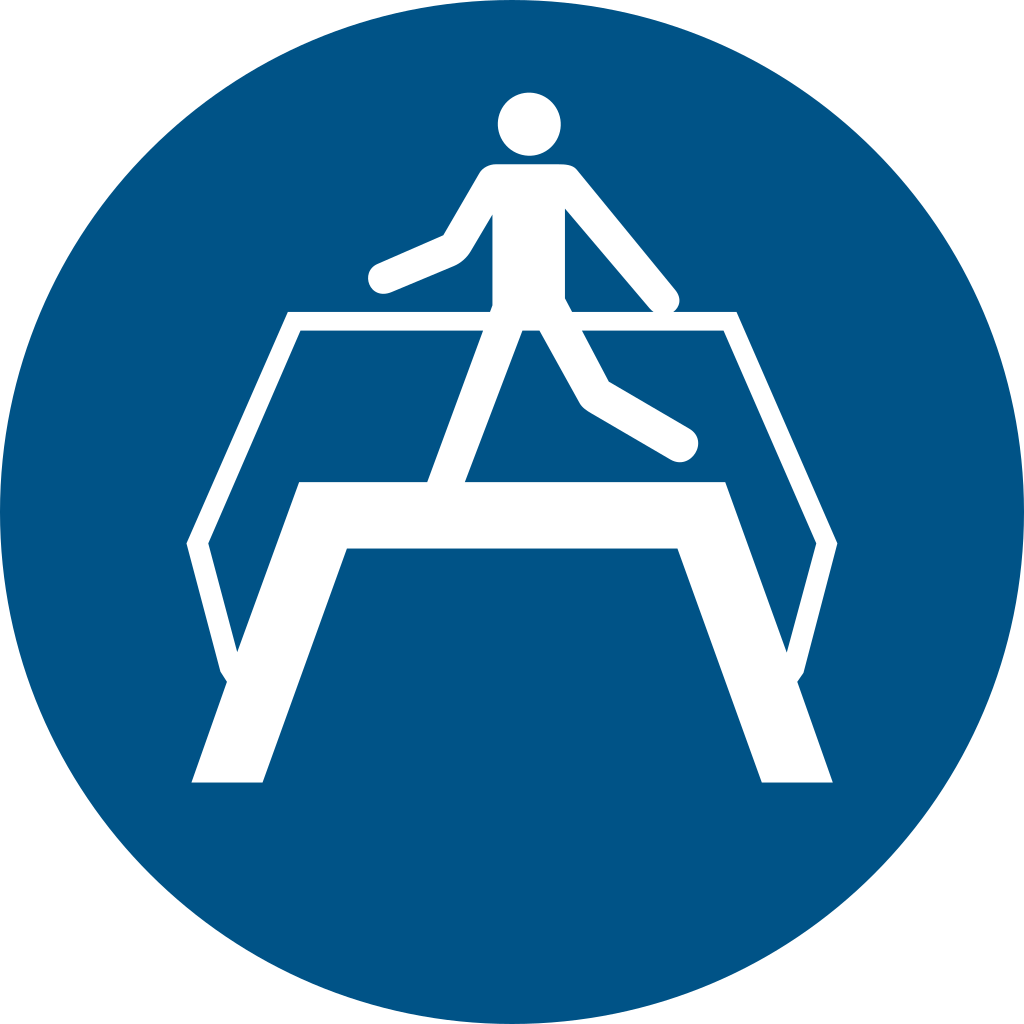
Use footbridge
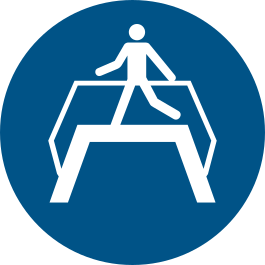
Instructs the reader to use the footbridge.
Understanding this sign
Blue circular signs communicate an action, such as wearing eye protection or following a specified procedure.
A pictogram does not select the grade of PPE or explain a complete procedure. Use the task-specific instructions.
What ISO 7010 M023 Means
M023 requires pedestrians to cross using the footbridge rather than at grade. The pictogram — a figure walking over an arched bridge — encodes a simple trade: a longer, higher route in exchange for never sharing a surface with the hazard below. That hazard varies by site. It may be a live conveyor, rail tracks in a freight yard, a busy internal roadway, open water or effluent channels, or runs of hot or pressurized pipework at ground level.
The sign matters because footbridges compete with shortcuts. Climbing over a stopped conveyor or stepping across tracks saves seconds and usually goes unpunished, which is exactly how habits form that eventually meet a conveyor restarting or a shunting movement. M023 removes ambiguity: the bridge is not a suggestion for cautious moments, it is the only permitted crossing.
Typical Installations
Bulk-handling sites are the sign's heartland. Quarries, ports, power stations, and mines run conveyors for hundreds of meters, and every point where people need to reach the other side gets either a bridge or a culture of climbing over belts — the industry learned long ago which one ends badly, since belts can start remotely and without warning. Rail yards and tram depots use M023 at authorized crossing structures over tracks; large factories and logistics parks use it where pedestrian desire lines cross heavy vehicle routes.
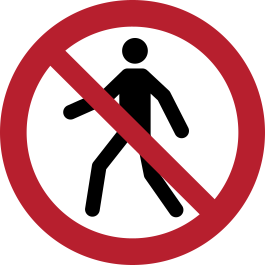
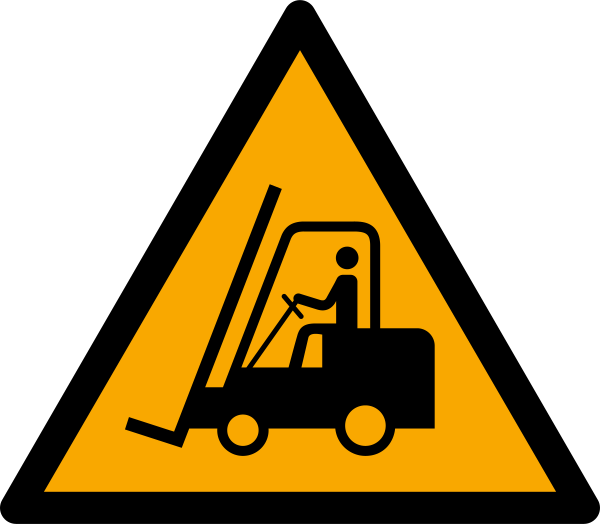
The sign belongs at both ends of the bridge and, just as importantly, at the tempting informal crossing points it is meant to close off. Pairing is standard practice: P004 (no thoroughfare) or fencing at the prohibited crossing, W014 or a site-specific vehicle warning where traffic is the hazard, and M023 directing people to the engineered alternative.
M023 in a Segregation Strategy
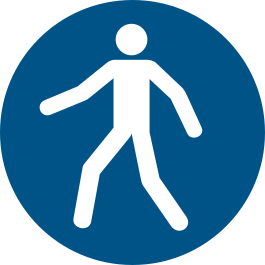
Within the ISO 7010 route family, M023 is the vertical member: M024 keeps pedestrians on a designated walkway at grade, while M023 takes them over the hazard entirely. A footbridge is the stronger control in hierarchy-of-controls terms because it removes the interaction rather than managing it — no driver vigilance, belt guard, or floor marking is involved once the person is on the bridge. Workplace rules in many jurisdictions require traffic routes to be organized so pedestrians and vehicles can circulate safely, and a bridge is often how that requirement gets engineered at severe crossing points.
For the control to hold, the bridge itself has to stay usable: treads maintained, lighting working, snow and spillage cleared, and the route not blocked by stored material. Sites auditing M023 compliance watch worn paths in gravel or grass beside the structure — the clearest possible evidence that people are crossing at grade regardless of the sign.
Where you will see M023
Quarries, ports, power stations, and mines post it at bridges spanning conveyor runs that can start remotely and without warning, while rail yards and tram depots use it at authorized crossing structures over tracks. It belongs at both ends of the bridge and at the tempting informal crossing points it closes off, paired with P004 or fencing at the prohibited crossing.
Common questions about M023
What does the sign showing a person walking over a bridge mean?
It is ISO 7010 M023, a mandatory sign requiring pedestrians to cross via the footbridge instead of at ground level. It is used where the ground-level crossing would put people onto conveyors, rail tracks, vehicle roadways, open channels, or pipework.
Why are footbridges mandatory over conveyors instead of just stepping over the belt?
Because conveyors on industrial sites commonly start remotely and automatically, without anyone nearby pressing a button. A person straddling or standing on a belt when it starts can be carried into transfer points and crush zones within seconds. Purpose-built crossing bridges exist precisely so no one ever needs to touch the belt, and M023 makes using them compulsory.
What signs are used together with M023?
Typically P004 (no thoroughfare) or physical barriers at the informal crossing points the bridge replaces, vehicle warnings such as W014 where industrial trucks are the underlying hazard, and M024 where the approach routes to the bridge are themselves designated walkways. The combination closes the shortcut and signposts the safe route.
Reference details
| Symbol code | M023 |
|---|---|
| Sign family | ISO Mandatory Signs |
| Standard reference | ISO 7010:2019 / ISO 3864-1 ISO Online Browsing Platform: M023 |
| Screen color reference | #0000FF. Screen colors are not a production color specification. |
| Download formats | SVG reference artwork; a 1024 × 1024 pixel PNG conversion on a white canvas. |
| Record date | · How to interpret our dates |
| Page updated |
Choosing a physical sign size
Download dimensions are not installation dimensions. Select sign size, material, placement, and lighting using the applicable standard and the actual viewing conditions. Chemical label sizing follows its own rules. Read the artwork and sizing guide.
Sources and artwork credits
- Artwork source
- Wikimedia Commons file page
- Creator credited by source
- ISO
- License
- Public domain
- Source metadata checked
SVG files are local reference copies. PNG files are raster conversions. Check the linked file history and license terms before reuse; a source-metadata check is not certification of the artwork or a workplace installation.
Report a correction to this reference