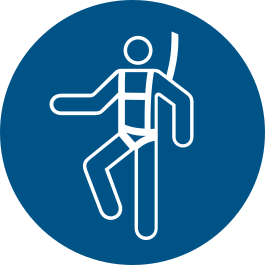
Wear safety belts
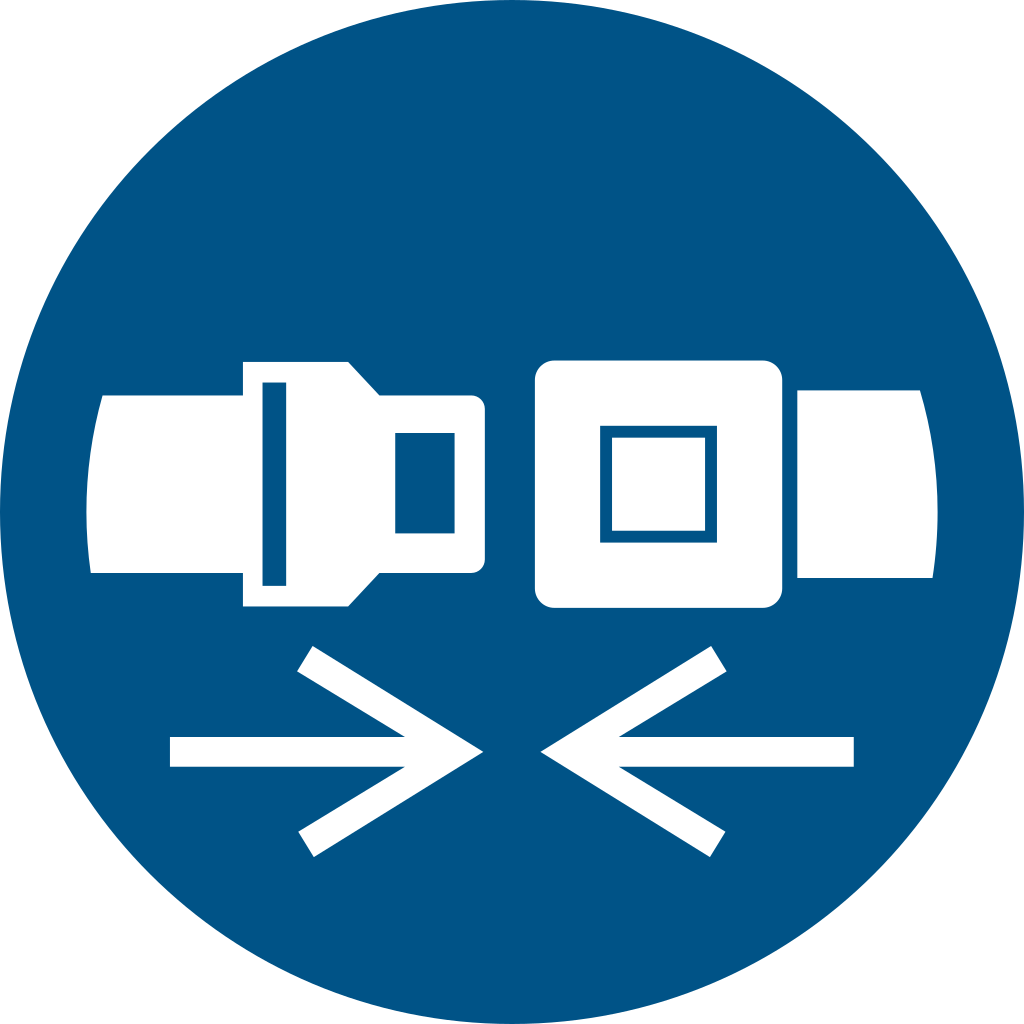
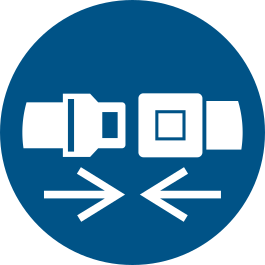
Instructs the reader to wear safety belts.
Understanding this sign
Blue circular signs communicate an action, such as wearing eye protection or following a specified procedure.
A pictogram does not select the grade of PPE or explain a complete procedure. Use the task-specific instructions.
A Restraint Instruction for Seated Occupants
M020 orders occupants of a vehicle, machine, or ride to fasten the installed safety belt before movement begins. The pictogram shows a seated figure with a belt across the body, and the instruction targets restraint in a seat — which separates it cleanly from M018, the harness sign used for work at height. If the risk is being thrown from or crushed by a moving machine, M020 applies; if the risk is falling from a structure or platform, M018 does.
The sign turns up in more places than road vehicles. Forklift and telehandler cabs, dumpers and other mobile plant, airport ground support equipment, amusement ride seats, off-road tour vehicles, and crew transport on industrial sites all use M020 at the point of boarding or inside the cab. In each case the belt is part of the machine's designed protection, and the sign exists because unbelted operation defeats that design.
The Forklift Case: Why Staying in the Seat Matters
Counter-balanced forklifts are the sharpest illustration of what M020 protects against. In a tip-over, the instinct to jump clear is usually fatal or maiming: the overhead guard and mast come down faster than a person can escape, and crushing between the truck and the ground is the characteristic fatality. Manufacturers therefore train operators to stay in the seat, brace, and lean away from impact — a survival strategy that only works if the operator is belted in.
In the United States, the governing rule is 29 CFR 1910.178, OSHA's standard for forklifts and similar trucks, which requires operators to use trucks safely per their training, and the agency enforces seat belt use on trucks equipped with operator restraints, drawing on the standard and the manufacturer's operating instructions. Posting M020 inside the cab or at the dashboard puts that expectation in front of the operator every shift, and gives supervisors an unambiguous reference when enforcing it.
Placement in Vehicles, Plant, and Rides
Inside machinery, the effective location is within the operator's pre-start field of view: on the dash, the inside of the cab door, or beside the ignition. A decal-sized M020 there outperforms a large sign on the warehouse wall, because the decision moment is the second before the key turns. Fleet operators commonly combine it with the pre-use checklist so belt condition — webbing, buckle, retractor — is inspected along with brakes and horn.
For passenger applications, the sign moves to the boarding point. Amusement rides, funicular and off-road tourist vehicles, and site crew buses display M020 where guests take their seats, often accompanied by an attendant check. Multilingual sites benefit particularly here: the wordless blue disc communicates the buckle-up rule to visitors who share no language with the operator, which is precisely the problem ISO 7010 pictograms were standardised to solve.
Where you will see M020
Forklift and telehandler cabs, dumpers, airport ground support equipment, amusement ride seats, off-road tour vehicles, and site crew transport all display it, ideally on the dash, cab door, or beside the ignition where the pre-start decision happens. Fleet operators tie it to the pre-use checklist, and passenger operations move it to the boarding point where attendants check buckles.
Common questions about M020
Does OSHA require seat belts on forklifts?
OSHA enforces the use of operator restraints on forklifts that are equipped with them, based on 29 CFR 1910.178 together with manufacturers' operating instructions, and has cited employers for unbelted operation. Trucks built to modern industry standards come with restraint systems fitted, so in practice belted operation is the enforceable norm in US workplaces.
Why shouldn't a forklift driver jump if the truck tips over?
Because the truck falls faster than a person can jump clear, and the typical fatal injury is being crushed by the overhead guard or mast while half out of the cab. The trained response is the opposite: stay belted in the seat, grip the wheel, brace your feet, and lean away from the direction of the fall. The seat belt is what makes that survivable strategy possible.
What is the difference between M020 and the safety harness sign M018?
M020 is about being restrained in a seat against vehicle movement, tip-over, or ejection — forklifts, mobile plant, rides, and vehicles. M018 requires a full-body harness for fall protection when working at height, such as on platforms, towers, or in lifted work baskets. The hazard type decides the sign: machine movement points to M020, gravity points to M018.
Where should the wear-seat-belt sign be placed on machinery?
At the decision point: a decal on the dashboard, cab door interior, or next to the ignition, visible as the operator sits down and before start-up. For passenger vehicles and rides, place it where people board and take their seats. Wall-mounted versions in traffic areas are useful reinforcement but should never be the only instance.
Reference details
| Symbol code | M020 |
|---|---|
| Sign family | ISO Mandatory Signs |
| Standard reference | ISO 7010:2019 / ISO 3864-1 ISO Online Browsing Platform: M020 |
| Screen color reference | #0000FF. Screen colors are not a production color specification. |
| Download formats | SVG reference artwork; a 1024 × 1024 pixel PNG conversion on a white canvas. |
| Record date | · How to interpret our dates |
| Page updated |
Choosing a physical sign size
Download dimensions are not installation dimensions. Select sign size, material, placement, and lighting using the applicable standard and the actual viewing conditions. Chemical label sizing follows its own rules. Read the artwork and sizing guide.
Sources and artwork credits
- Artwork source
- Wikimedia Commons file page
- Creator credited by source
- ISO
- License
- Public domain
- Source metadata checked
SVG files are local reference copies. PNG files are raster conversions. Check the linked file history and license terms before reuse; a source-metadata check is not certification of the artwork or a workplace installation.
Report a correction to this reference