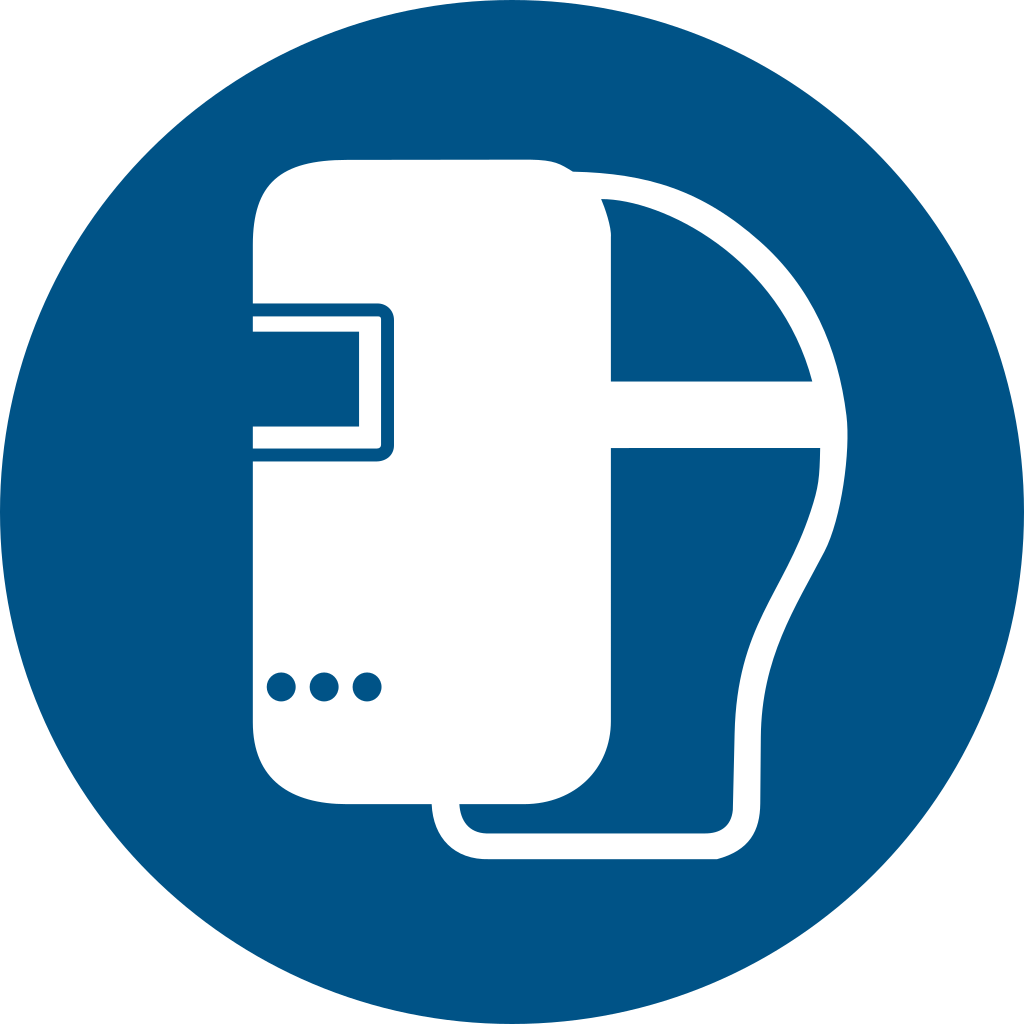
Wear a welding mask
Instructs the reader to wear a welding mask.
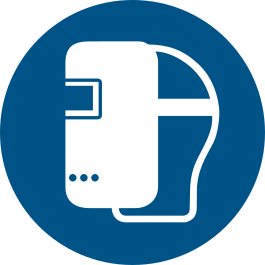
Understanding this sign
Blue circular signs communicate an action, such as wearing eye protection or following a specified procedure.
A pictogram does not select the grade of PPE or explain a complete procedure. Use the task-specific instructions.
The Hazard Behind the Mask
M019 mandates a welding mask — a helmet or handshield fitted with a dark filter lens — before arc or gas welding begins in the marked area. The controlling hazard is optical radiation. An electric arc emits intense ultraviolet, visible, and infrared radiation; unprotected exposure of even a few seconds can produce photokeratitis, the painful corneal burn welders call arc eye or flash burn, and chronic exposure contributes to cataract risk. The mask's filter absorbs this radiation while the shell protects the face from spatter, sparks, and heat.
Because the injury mechanism is radiant rather than mechanical, substitutes fail in non-obvious ways. Sunglasses, clear visors, and standard tinted safety spectacles transmit far too much UV and IR. Even a correct filter in a handshield leaves gaps if the welder lifts it early to inspect the weld — one reason auto-darkening helmets, which switch from a light state to the working shade within milliseconds of arc strike, have become the default in production shops.
Filter Shades and Standards
Welding filters are graded by shade number, and the right shade depends on the process and current: gas welding sits at the light end of the scale, while high-amperage arc processes such as air carbon arc gouging demand the darkest filters. OSHA publishes minimum protective shade numbers by process and amperage in its eye and face protection rule, and the usual field guidance is to start darker than the minimum and lighten until the weld pool is comfortably visible. In Europe, welding filters and welding face equipment are covered by dedicated EN standards, and CE-marked helmets state their shade range on the shell.
An M019 posting should be read together with the rest of the welder's PPE stack. The mask does not remove the need for safety spectacles underneath (grinding between passes, slag chipping), flame-resistant clothing and gloves, or fume controls — welding fume has its own exposure limits and is addressed by ventilation and, where needed, respiratory protection under a separate sign.
Posting M019 in Fabrication and Hot Work Areas
Fixed welding bays are the straightforward case: mount M019 at the bay entrance and on welding screens, so the instruction is visible before anyone steps inside the arc's line of sight. Maintenance welding is harder, because the hazard moves with the job. There the sign travels with the hot work permit system — many sites include a portable M019/hot-work sign stand in the permit kit, set up at the boundary of the temporary screened area along with the fire watch.
Bystander protection deserves explicit attention, since arc radiation injures spectators at surprising distances and reflections off bright surfaces extend the reach. Welding curtains and screens absorb the radiation; the M019 sign on the outside of the screen tells anyone who must enter that a mask, not curiosity, gets them past it. Training riggers, fitters, and apprentices that the sign applies to them — not only to the person holding the torch — closes the most common gap.
Where you will see M019
Fixed welding bays carry the sign at the entrance and on welding screens so it is read before anyone steps into the arc's line of sight, and it appears on the outside of curtains to protect bystanders, riggers, and apprentices at surprising distances. For maintenance welding the sign travels with the hot work permit system, with portable M019 stands set up at the boundary of the temporary screened area alongside the fire watch.
Common questions about M019
What shade of welding lens do I need?
It depends on the process and amperage. Gas welding and cutting use relatively light shades, while arc processes need progressively darker filters as current rises; OSHA's eye and face protection standard tables list minimum shade numbers for each process. A practical approach is to begin one or two shades darker than the table minimum and adjust lighter until you can see the weld pool clearly without discomfort.
Can you get arc eye from just watching someone weld?
Yes. Photokeratitis is caused by ultraviolet radiation, not by looking at brightness as such, and a bystander within range of an unscreened arc can receive a corneal burn in seconds without noticing until hours later, when the gritty, intensely painful symptoms appear. This is why welding areas are screened and why M019 applies to everyone inside the screen, not only the welder.
Do I need safety glasses under a welding helmet?
Yes, in standard practice. Welders routinely lift the hood to chip slag, grind, and inspect, and at those moments impact-rated spectacles are the only eye protection in place. Many auto-darkening helmets also rely on the spectacles for protection against particles that get under the shell. Site PPE rules typically state 'safety glasses at all times, helmet down when arc is struck'.
What is the difference between M019 and the face shield sign M013?
M013 calls for a clear visor against splash and flying particles; it provides no meaningful filtering of arc radiation. M019 calls for a welding mask whose shaded filter is the whole point. In a fabrication shop the two often coexist — M019 at the welding bays, M013 at the grinding and finishing stations.
Reference details
| Symbol code | M019 |
|---|---|
| Sign family | ISO Mandatory Signs |
| Standard reference | ISO 7010:2019 / ISO 3864-1 ISO Online Browsing Platform: M019 |
| Screen color reference | #0000FF. Screen colors are not a production color specification. |
| Download formats | SVG reference artwork; a 1024 × 1024 pixel PNG conversion on a white canvas. |
| Record date | · How to interpret our dates |
| Page updated |
Choosing a physical sign size
Download dimensions are not installation dimensions. Select sign size, material, placement, and lighting using the applicable standard and the actual viewing conditions. Chemical label sizing follows its own rules. Read the artwork and sizing guide.
Sources and artwork credits
- Artwork source
- Wikimedia Commons file page
- Creator credited by source
- ISO
- License
- Public domain
- Source metadata checked
SVG files are local reference copies. PNG files are raster conversions. Check the linked file history and license terms before reuse; a source-metadata check is not certification of the artwork or a workplace installation.
Report a correction to this reference