Wear a safety harness
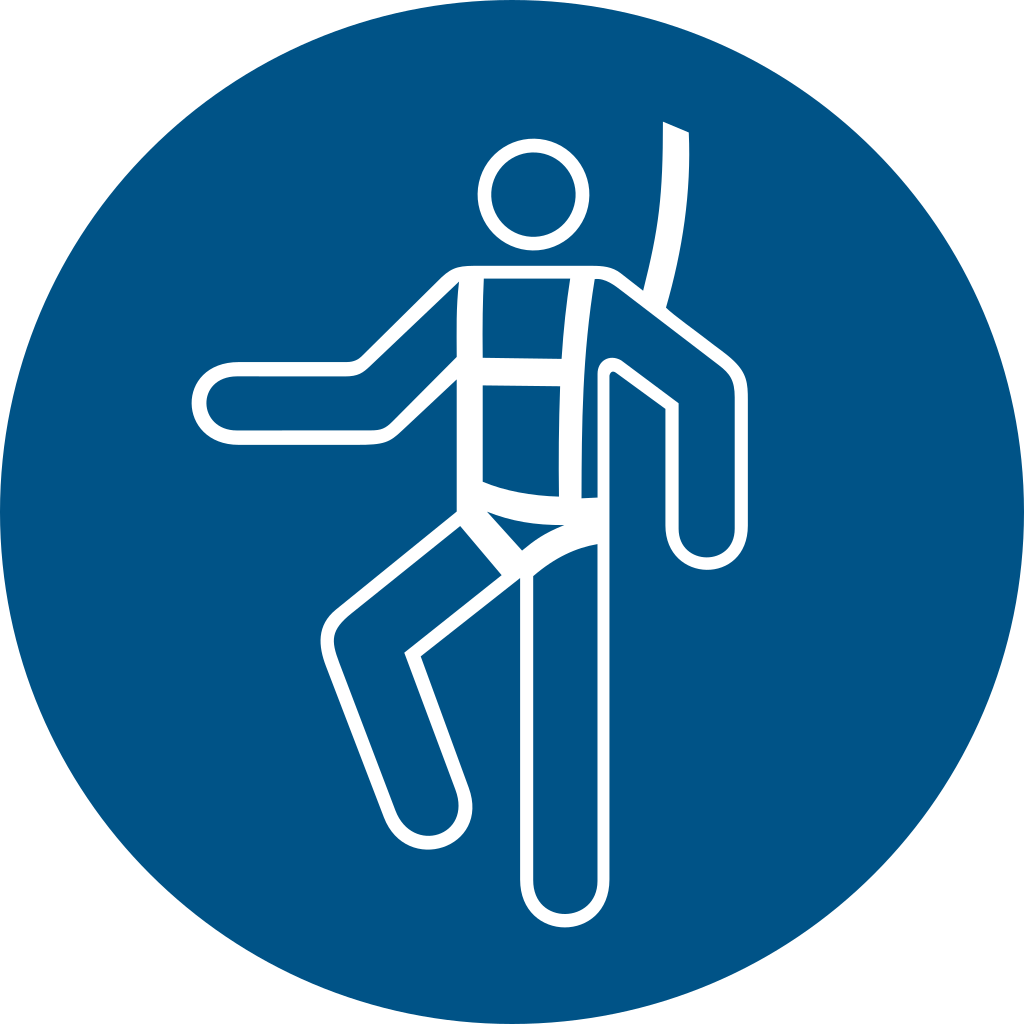
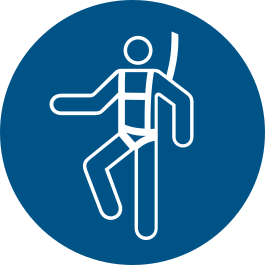
Instructs the reader to wear a safety harness.
Understanding this sign
Blue circular signs communicate an action, such as wearing eye protection or following a specified procedure.
A pictogram does not select the grade of PPE or explain a complete procedure. Use the task-specific instructions.
What M018 Actually Commits You To
M018 requires a safety harness to be worn from the point marked onward. The pictogram — a white figure wearing a full-body harness with a lanyard line, inside the blue mandatory circle — appears where work at height cannot be protected by guardrails, nets, or other collective measures, leaving personal fall protection as the control. Unlike a hard hat or safety glasses, a harness protects nobody by itself: the M018 obligation implicitly includes connecting the harness to a suitable anchorage with the specified lanyard or fall arrester, and site rules should say so in plain words beneath the symbol.
The sign covers two distinct systems that look identical to a bystander. Work restraint uses the harness and a fixed-length lanyard to stop the wearer physically reaching an edge, so a fall never starts. Fall arrest lets a fall begin and stops it with an energy-absorbing connection, which demands clearance below, an anchor rated for arrest loads, and a rescue plan. An M018 posted at a flat roof hatch may mean restraint only; on a mast climber it means arrest — the difference must come from the task documentation, not guesswork.
Fall Protection Thresholds and Standards
In US construction, 29 CFR 1926.501 requires fall protection at 6 feet (1.8 m) above a lower level for most work, with personal fall arrest as one permitted method; system component and use criteria sit in 1926.502. General industry's walking-working surfaces rules set the threshold at 4 feet (1.2 m), with personal fall protection systems governed by 1910.140. A harness-mandatory sign at a roof access, tower base, or elevated platform is the visible edge of those duties. European employers arrive via national work-at-height regulations under the EU framework, and mark the requirement using Directive 92/58/EEC's blue mandatory format.
Equipment certification is layered because the system has parts. In Europe, full-body harnesses are certified to EN 361, energy absorbers to EN 355, and anchor devices to EN 795, all as Category III PPE under Regulation (EU) 2016/425 with mandatory periodic examination. In the US, ANSI/ASSP Z359 covers harnesses and connectors, and OSHA's system criteria — including limits on arrest forces and free-fall distance — apply regardless of brand. Only a full-body harness is acceptable for fall arrest; body belts are prohibited for that purpose in US construction.
Where the Sign Goes and Where It Fails
Post M018 at the last safe point before the protected task begins: the roof access hatch or ladder gate, the base of a fixed ladder run requiring a fall arrester, the entry to a mobile elevating work platform (many MEWP baskets carry a small M018 on the gate), the boarding point for suspended access cradles, and the entrance to shafts or tank tops where restraint lines are mandatory. Because harness donning takes minutes and needs a buddy check, the sign should sit where donning happens, with the anchor plan and clearance information available at the same spot.
Placement failures with M018 are more dangerous than with any other mandatory sign because partial compliance looks like compliance. A worker wearing an unclipped harness satisfies the pictogram literally while having zero protection, so effective signage pairs the symbol with a "clip on before opening gate" or "100 percent tie-off beyond this point" instruction. Another failure is signing the requirement without engineering it: an M018 at a roof hatch that leads to a roof with no rated anchor points documents a rule that cannot be followed, which inspectors treat as evidence of a paper-only system.
The System Around the Harness
An M018 zone implies commitments beyond the garment. Anchorages must be rated and identified — OSHA requires personal fall arrest anchorages capable of supporting 5,000 pounds per attached worker or engineered with a safety factor of two under qualified-person supervision. Clearance below the work position must exceed the total fall distance including lanyard extension, or the arrest happens on the ground. And because a person hanging in a harness after an arrest can deteriorate within minutes from suspension intolerance, a rescue arrangement faster than calling the fire service is part of the plan, not an optional extra.
Harnesses also carry inspection duties the sign silently assumes: a pre-use check by the wearer for cut webbing, deployed energy-absorber indicators, and damaged hardware, plus documented periodic examination by a competent person, and immediate withdrawal of any equipment that has arrested a fall. M018 differs from its neighbors on scaffolding and roofing sites — M014 and M008 protect against contact injuries, while M018 marks the transition to a task where the control is an engineered system the wearer must actively complete by clipping on.
Where you will see M018
Construction and maintenance sites post it at roof access hatches, ladder gates on fixed climbs requiring a fall arrester, boarding points for suspended access cradles, and entries to shafts and tank tops where restraint lines are mandatory. Many MEWP baskets carry a small M018 on the gate, and effective installations add wording such as clip on before opening gate so an unclipped harness is not mistaken for compliance.
Common questions about M018
At what height is a safety harness required?
In US construction, fall protection is required at 6 feet (1.8 m) above a lower level under 29 CFR 1926.501, and in general industry at 4 feet (1.2 m) under the walking-working surfaces rules — with a harness-based personal system being one permitted method where guardrails or other collective protection are not used. Many European regimes avoid a single trigger height and require protection wherever a fall is liable to cause injury. The M018 sign marks the specific access points where the site has decided a harness is the control.
What is the difference between fall restraint and fall arrest?
Restraint uses the harness and a short lanyard to prevent the wearer from reaching a position where they could fall — the fall never starts, so clearance and rescue are simpler. Arrest allows a fall to begin and stops it with an energy-absorbing system, which requires a high-rated anchor, calculated clearance below, and a prompt rescue plan. Both are worn the same way, so the M018 sign alone cannot tell you which applies; the task method statement must.
Do I have to wear a harness in a scissor lift or boom lift?
In boom-type platforms, yes as standard practice and per US rules requiring occupants to be tied off to the manufacturer's anchor, because boom movement can catapult occupants over the rails. For scissor lifts, the guardrails are generally the primary protection and harness policies vary by manufacturer instruction and site rules — many sites mandate at least restraint anyway. Where the basket gate carries an M018 sign, clip on before the platform moves.
How often does a safety harness need to be inspected?
Twice over, on different clocks: a visual and tactile pre-use check by the wearer every time it is donned — webbing cuts, chemical damage, stitching, deployed fall-indicator, hardware function — and a documented detailed examination by a competent person at intervals set by the manufacturer and local law, commonly at least every 12 months and often more frequently in harsh use. Any harness that has arrested a fall must be removed from service immediately.
Reference details
| Symbol code | M018 |
|---|---|
| Sign family | ISO Mandatory Signs |
| Standard reference | ISO 7010:2019 / ISO 3864-1 ISO Online Browsing Platform: M018 |
| Screen color reference | #0000FF. Screen colors are not a production color specification. |
| Download formats | SVG reference artwork; a 1024 × 1024 pixel PNG conversion on a white canvas. |
| Record date | · How to interpret our dates |
| Page updated |
Choosing a physical sign size
Download dimensions are not installation dimensions. Select sign size, material, placement, and lighting using the applicable standard and the actual viewing conditions. Chemical label sizing follows its own rules. Read the artwork and sizing guide.
Sources and artwork credits
- Artwork source
- Wikimedia Commons file page
- Creator credited by source
- ISO
- License
- Public domain
- Source metadata checked
SVG files are local reference copies. PNG files are raster conversions. Check the linked file history and license terms before reuse; a source-metadata check is not certification of the artwork or a workplace installation.
Report a correction to this reference