Wear respiratory protection
Instructs the reader to wear respiratory protection.
Understanding this sign
Blue circular signs communicate an action, such as wearing eye protection or following a specified procedure.
A pictogram does not select the grade of PPE or explain a complete procedure. Use the task-specific instructions.
The Obligation Behind M017
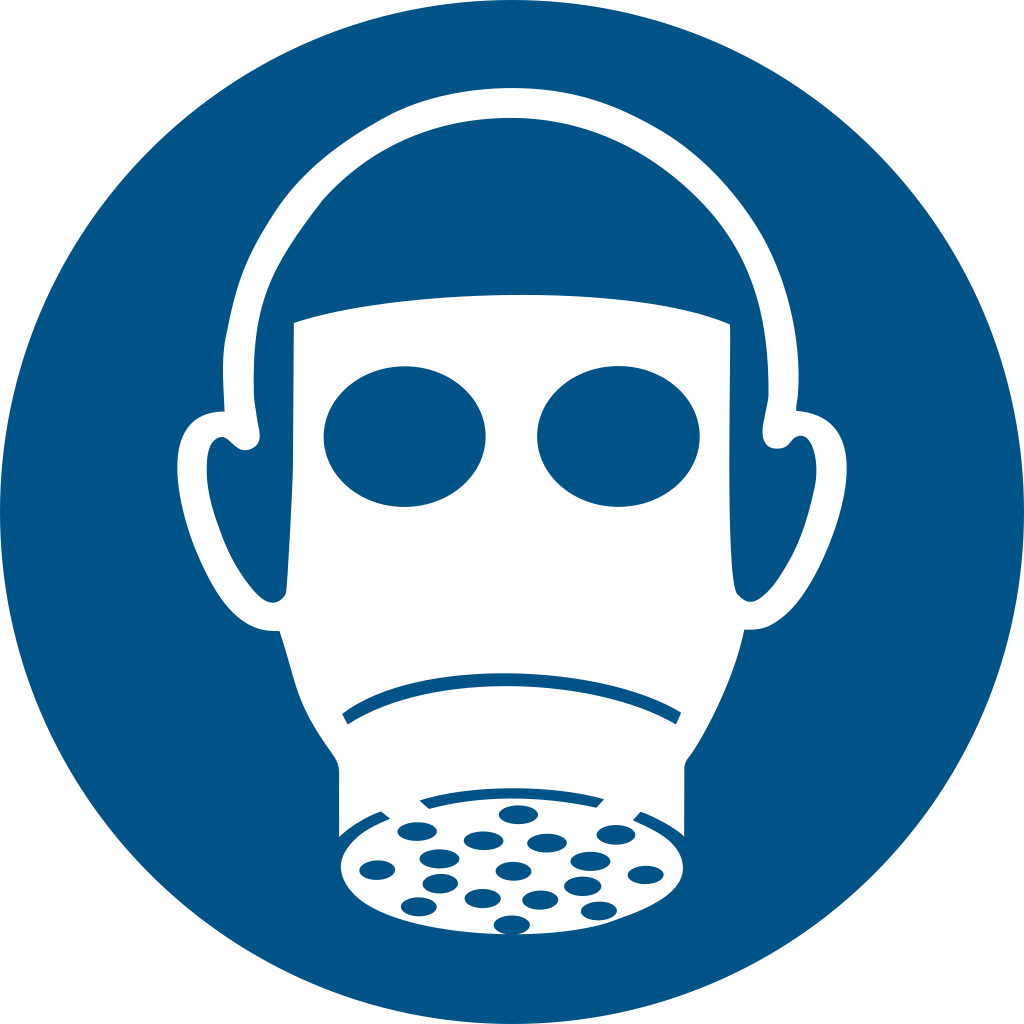
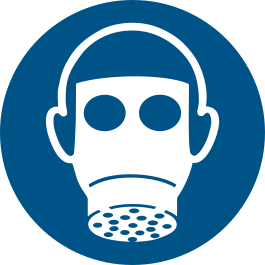
M017 requires respiratory protective equipment (RPE) to be worn before entering the marked area or beginning the marked task. The pictogram — a white head wearing a half-mask respirator with visible cartridges, on the blue mandatory circle — signals that the atmosphere past this point contains, or may contain, contaminants at levels the unprotected worker must not breathe. Of all the ISO 7010 mandatory signs, M017 carries the heaviest supporting infrastructure: a sign is meaningless unless the site has already measured exposures, selected suitable devices, and prepared workers to wear them correctly.
"Respiratory protection" spans a wide equipment range: disposable filtering facepieces (FFP2/FFP3 in Europe, N95/P100 classes under NIOSH approval in the US), reusable half and full-face masks with particle or gas cartridges, powered air-purifying respirators, and supplied-air or self-contained breathing apparatus for atmospheres that filters cannot make safe. The M017 pictogram cannot distinguish among these, so the device class for each zone must come from the exposure assessment and be stated in supplementary text or the site RPE register.
1910.134 and the European Framework
In the United States, any required respirator use falls under OSHA's respiratory protection standard, 29 CFR 1910.134, which demands a written program with a trained administrator, medical evaluation before first use, annual fit testing for tight-fitting facepieces, procedures for cartridge change-out, and NIOSH-approved equipment. Posting M017 where respirators are mandatory effectively declares that all of those program elements apply to everyone entering. Substance-specific standards — silica, asbestos, lead — add their own trigger levels at which respirator zones must be established and marked.
European law approaches it through the hierarchy in the Chemical Agents Directive and national rules: RPE is the control of last resort after substitution, enclosure, and ventilation, and where it remains necessary, employers must mark the areas under Directive 92/58/EEC using the blue mandatory format. The equipment is Category III PPE under Regulation (EU) 2016/425 — the class reserved for protection against death or irreversible harm — with filtering facepieces certified to EN 149 and gas filters and masks to their own EN series. Face-fit testing for tight-fitting RPE is an established legal expectation in several member states and the UK.
Marking Respirator Zones Correctly
Typical M017 locations include abrasive blasting rooms, spray booths using isocyanate paints, silica-generating cutting and grinding operations, asbestos removal enclosures, pharmaceutical powder dispensing suites, welding bays with poor extraction, and sewage or biological treatment areas. Place the sign at the boundary where the required protection must already be worn and sealed — for tight-fitting masks that means before entry, since donning and user seal checks cannot be done safely inside the contaminated zone. Pair the boundary sign with a donning station immediately outside it.
Two mistakes dominate audits. The first is posting M017 as a comfort measure for nuisance odors without any exposure assessment; under 1910.134 even seemingly casual required use pulls the full program obligations in, and unjustified signs blur the line workers rely on. The second is failing to distinguish escape-only equipment: some plants issue escape hoods for ammonia or CO releases, but M017 marks areas where RPE must be worn during work, not areas where an escape set must merely be carried — that different rule needs different, explicit signage.
Fit, Filters, and the Line Between M016 and M017
Tight-fitting respirators only protect through the face seal, which is why fit testing is central to every serious RPE program and why facial hair along the seal line is disqualifying — a bearded worker in a perfectly good FFP3 is unprotected, and OSHA prohibits required tight-fitting respirator use over beards. Filter selection is equally unforgiving: a particulate filter does nothing against solvent vapor, gas cartridges are contaminant-specific and have finite service lives, and no filtering device of any kind is permitted in oxygen-deficient or IDLH atmospheres, which require supplied air.
Keep M017 sharply separated from its neighbor M016. M016 mandates a hygiene mask that mainly protects other people and products from the wearer; M017 mandates certified equipment that protects the wearer from the air. Confusing them in either direction fails: a surgical mask in a silica zone provides essentially no protection, while demanding fit-tested respirators at a food-hygiene barrier wastes the program's credibility. On combined boards, M017 often appears with M004 and M009 at chemical handling points, and with W-series warnings identifying what the atmosphere actually contains.
Where you will see M017
Abrasive blasting rooms, spray booths using isocyanate paints, silica-generating cutting and grinding operations, asbestos removal enclosures, and pharmaceutical powder dispensing suites are typical locations, with the sign at the boundary and a donning station immediately outside it. Welding bays with poor extraction and sewage treatment areas also carry it, and in the US any zone it marks falls under the full written-program duties of OSHA 29 CFR 1910.134.
Common questions about M017
What does the M017 sign require me to wear?
Respiratory protective equipment selected for that specific zone — which may be a disposable FFP3 or N95-class facepiece, a reusable half or full-face mask with the correct filters, a powered air-purifying respirator, or supplied-air equipment. The pictogram itself does not specify the class; check the supplementary text, the area's RPE specification, or your supervisor before entry, because wearing the wrong class of device is a real and common failure.
Do I need a fit test before working in a respirator-required area?
If the device is tight-fitting, yes. OSHA 1910.134 requires fit testing before first use and annually thereafter for all required tight-fitting respirators, plus a medical evaluation beforehand; UK and several EU regimes have equivalent face-fit expectations. Loose-fitting powered hoods are the usual route for workers who cannot achieve a face seal, including those with facial hair.
Can I wear a dust mask instead of a respirator where the M017 sign is posted?
Only if the "dust mask" is actually a certified filtering facepiece of the class specified for that zone — an EN 149 FFP2/FFP3 or NIOSH-approved N95/P100 is legitimate RPE for particulate hazards. Uncertified comfort masks and surgical masks are not, and no particulate facepiece of any grade protects against gases, vapors, or oxygen deficiency. Match the device to the contaminant named in the zone's exposure assessment.
Why is there a respirator sign but no visible dust or smell in the area?
Many of the most serious respiratory hazards are invisible and odorless at dangerous concentrations: respirable crystalline silica, asbestos fibers, carbon monoxide, and isocyanate vapors among them. Odor and visible dust are unreliable indicators, which is why M017 zones are defined by air monitoring and exposure assessment rather than by the senses. If the sign is posted, the assessment found a reason — comply first and query the assessment through your safety representative if it seems outdated.
Reference details
| Symbol code | M017 |
|---|---|
| Sign family | ISO Mandatory Signs |
| Standard reference | ISO 7010:2019 / ISO 3864-1 ISO Online Browsing Platform: M017 |
| Screen color reference | #0000FF. Screen colors are not a production color specification. |
| Download formats | SVG reference artwork; a 1024 × 1024 pixel PNG conversion on a white canvas. |
| Record date | · How to interpret our dates |
| Page updated |
Choosing a physical sign size
Download dimensions are not installation dimensions. Select sign size, material, placement, and lighting using the applicable standard and the actual viewing conditions. Chemical label sizing follows its own rules. Read the artwork and sizing guide.
Sources and artwork credits
- Artwork source
- Wikimedia Commons file page
- Creator credited by source
- ISO
- License
- Public domain
- Source metadata checked
SVG files are local reference copies. PNG files are raster conversions. Check the linked file history and license terms before reuse; a source-metadata check is not certification of the artwork or a workplace installation.
Report a correction to this reference