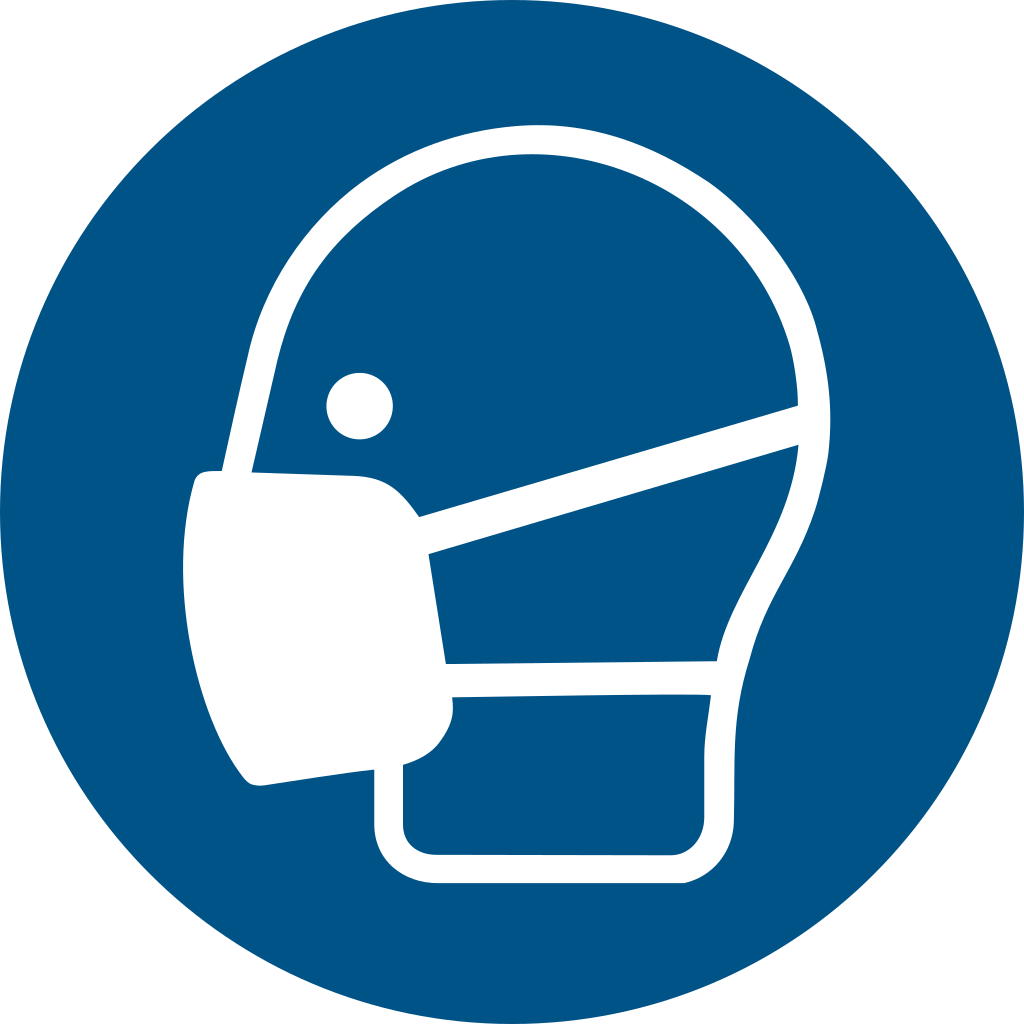
Wear a mask
Instructs the reader to wear a mask.

Understanding this sign
Blue circular signs communicate an action, such as wearing eye protection or following a specified procedure.
A pictogram does not select the grade of PPE or explain a complete procedure. Use the task-specific instructions.
What Kind of Mask M016 Means
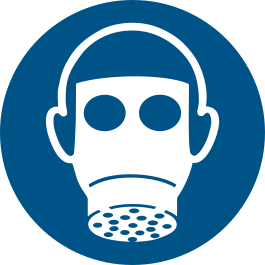
M016 requires a face mask to be worn beyond the point where it is posted. The ISO 7010 referent is deliberately "wear a mask," not "wear respiratory protection": the pictogram — a white face covered by a flat mask on the blue mandatory disc — refers to hygiene-type face coverings such as surgical or procedure masks, the kind that primarily control what the wearer emits rather than filtering what the wearer breathes in. That makes M016 the correct sign for source control and product protection, and the wrong sign for atmospheres containing hazardous dust, fumes, or vapors.
This is the single most consequential distinction in the mandatory-sign catalog. A surgical mask fits loosely, is not leak-tested against the face, and carries no assigned protection factor; treating an M016 zone as if it protected workers from airborne contaminants gives false assurance. Where the air itself is the hazard, ISO 7010 provides M017 (wear respiratory protection), and the two signs must never be swapped to save ordering a second sign face.
Where Mask Zones Come From
The typical drivers for M016 are hygiene and contamination control rather than occupational-exposure law. Food manufacturers post it on high-care and ready-to-eat production entrances to keep droplets and beard stubble out of open product, supported by food-hygiene obligations and retailer audit standards such as BRCGS rather than by PPE regulation. Cleanrooms in pharmaceutical and semiconductor plants mandate masks as part of gowning to protect the product from the person. Healthcare settings use mask rules for infection control in theatres, sterile services, and immunocompromised-patient areas.
Infectious-disease response added a public dimension: during outbreak periods, health authorities and employers used M016-style signage at building entrances to communicate universal masking rules. In the EU, note the regulatory split that follows from the mask's purpose — surgical masks are medical devices (tested under EN 14683), not PPE under Regulation (EU) 2016/425, whereas filtering respirators are PPE. Workplace signage law is unaffected by that split: Directive 92/58/EEC's blue mandatory format applies to whatever behavior the employer makes compulsory, masks included.
Posting M016 Without Creating Confusion
Place M016 at the gowning or hygiene barrier where masks are actually donned: the entrance to the high-care changing area in a food plant, the cleanroom airlock, the door to a sterile suite. The sign should sit beside the mask dispenser so the instruction and the means of compliance are in one line of sight, and it should mark the last point at which an unmasked face is acceptable. In multi-step gowning sequences, put the symbol at its correct position in the sequence signage rather than only on the final door.
The main placement error is scope creep between hygiene and safety. If a coating line generates solvent vapor, posting M016 there because "masks are worn anyway" is actively dangerous — workers will comply with a surgical mask and remain fully exposed. Audit every M016 on site against the question: is this mask protecting the product and other people, or the wearer's lungs? Any location where the honest answer is the wearer's lungs needs an exposure assessment, an M017 sign, and equipment selected under respiratory-protection rules instead.
M016 Versus M017 and Neighboring Requirements
The practical test for choosing between the two signs is direction of protection. M016: the mask stops droplets and particles leaving the wearer, or acts as a splash barrier — food lines, cleanrooms, infection source control. M017: the device protects the wearer from the atmosphere, which brings fit testing, filter selection, and in the US the full respiratory protection program of 29 CFR 1910.134. An FFP2 or N95 filtering facepiece worn for wearer protection belongs to the M017 world even though it looks superficially like a mask, because it is certified respiratory protective equipment.
M016 rarely stands alone. In food and pharma gowning corridors it appears with M022-style hygiene requirements, hairnet instructions, and handwashing signage; in healthcare it pairs with hand-hygiene prompts and local infection-control notices. Supplementary text earns its space here more than under most symbols: stating the mask type ("Type IIR surgical mask") and the replacement rule ("new mask each entry; replace when damp") converts a vague obligation into an auditable one, since a reused, soggy mask satisfies the pictogram while defeating its purpose.
Where you will see M016
Food manufacturers post it at high-care and ready-to-eat production entrances to keep droplets out of open product, pharmaceutical and semiconductor plants place it at cleanroom airlocks and gowning barriers, and hospitals use it at sterile suites and infection-control points. Best practice mounts the sign beside the mask dispenser at the last point where an unmasked face is acceptable, with text stating the mask type and replacement rule.
Common questions about M016
What is the difference between the M016 mask sign and the M017 respirator sign?
M016 requires a hygiene-type face mask, which mainly controls what the wearer breathes out — used for product protection and infection source control. M017 requires respiratory protective equipment that protects the wearer from hazardous dust, fumes, gases, or vapors, and brings formal requirements such as exposure assessment, equipment selection, and fit testing. If the air is dangerous to the person breathing it, M017 is the only correct sign.
Does a surgical mask count as PPE?
Generally no, in the regulatory sense. In the EU, surgical masks are medical devices tested to EN 14683 and are not certified under PPE Regulation (EU) 2016/425; in the US, they are not NIOSH-approved respirators and cannot be used to satisfy OSHA's respiratory protection standard. They are legitimate hygiene and source-control equipment — which is exactly the role the M016 sign covers — but they are not protection against hazardous atmospheres.
Why do food factories require masks on production lines?
To protect open product from droplet, saliva, and particle contamination originating from workers — a food-safety control, not a worker-safety one. Mask rules in high-care and ready-to-eat areas flow from food hygiene law and customer audit standards such as BRCGS, and the M016 sign at the hygiene barrier makes the rule visible at the exact point where gowning happens. The same logic applies in pharmaceutical and electronics cleanrooms.
Can an N95 or FFP2 be worn in an area marked with the M016 sign?
Yes — a filtering facepiece exceeds what a hygiene mask does, though valved respirators are an important exception: an exhalation valve releases the wearer's unfiltered breath, so valved FFP2/N95s defeat source control and are typically banned in sterile, food, and infection-control settings. The reverse substitution is what must never happen: a surgical mask can never stand in where respiratory protection is required.
Reference details
| Symbol code | M016 |
|---|---|
| Sign family | ISO Mandatory Signs |
| Standard reference | ISO 7010:2019 / ISO 3864-1 ISO Online Browsing Platform: M016 |
| Screen color reference | #0000FF. Screen colors are not a production color specification. |
| Download formats | SVG reference artwork; a 1024 × 1024 pixel PNG conversion on a white canvas. |
| Record date | · How to interpret our dates |
| Page updated |
Choosing a physical sign size
Download dimensions are not installation dimensions. Select sign size, material, placement, and lighting using the applicable standard and the actual viewing conditions. Chemical label sizing follows its own rules. Read the artwork and sizing guide.
Sources and artwork credits
- Artwork source
- Wikimedia Commons file page
- Creator credited by source
- ISO
- License
- Public domain
- Source metadata checked
SVG files are local reference copies. PNG files are raster conversions. Check the linked file history and license terms before reuse; a source-metadata check is not certification of the artwork or a workplace installation.
Report a correction to this reference