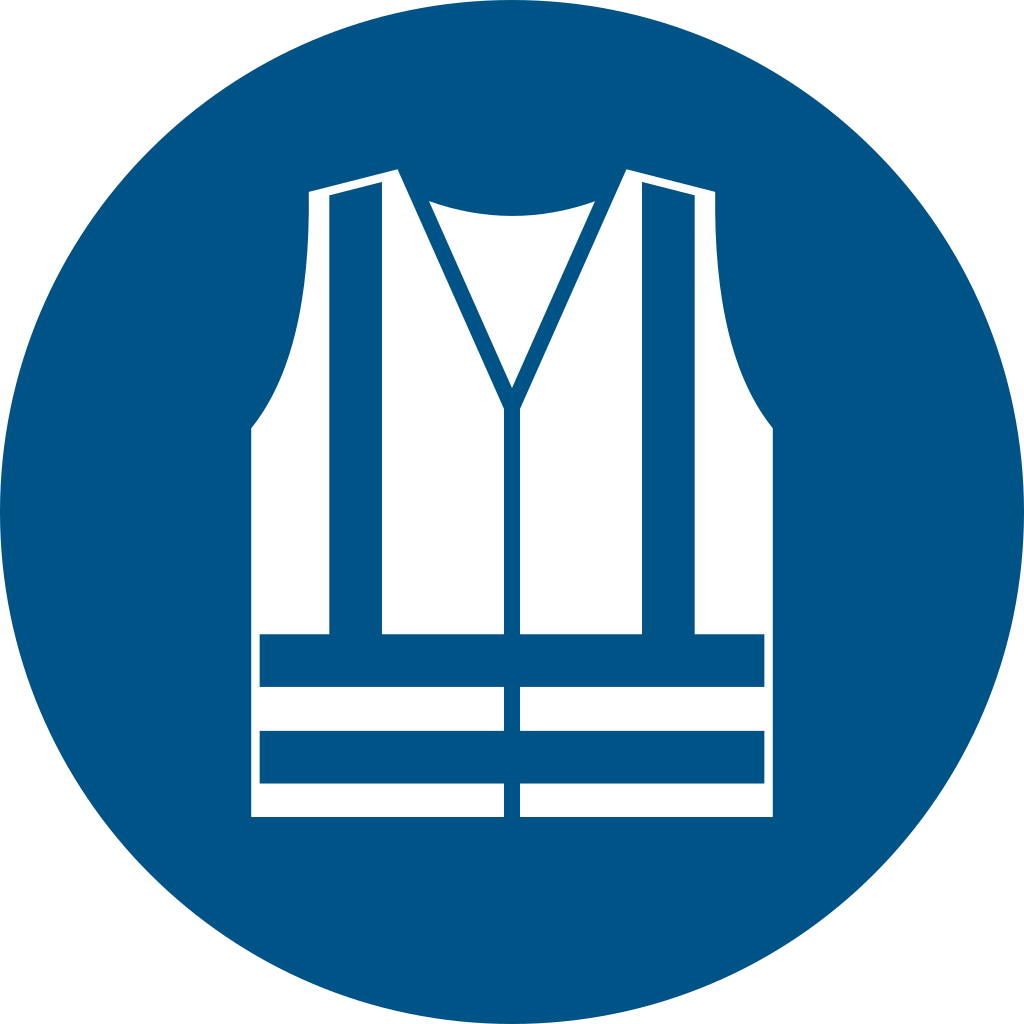
Wear high-visibility clothing
Instructs the reader to wear high-visibility clothing.
Understanding this sign
Blue circular signs communicate an action, such as wearing eye protection or following a specified procedure.
A pictogram does not select the grade of PPE or explain a complete procedure. Use the task-specific instructions.
What M015 Demands of Everyone Past the Sign
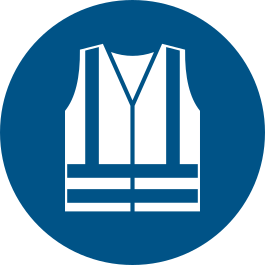
M015 requires high-visibility clothing — a vest, jacket, or full garment in fluorescent material with retroreflective bands — to be worn from the sign onward. Its pictogram shows a white figure in a banded vest inside the ISO 3864-1 blue mandatory circle. The logic differs from most PPE signs: hi-vis does not shield the wearer from anything, it makes the wearer conspicuous to the people who could hurt them, primarily drivers of forklifts, trucks, cranes, and road vehicles. The sign therefore protects a relationship between pedestrian and machine operator, and it only works if compliance is near-universal.
That interdependence is why hi-vis zones are usually enforced with less tolerance than any other PPE rule. A driver who has learned that everyone on the yard wears fluorescent yellow will unconsciously scan for that color; a single unmarked pedestrian defeats the expectation the whole system builds. M015 accordingly appears at the boundary of every vehicle-pedestrian interface area, and most operators apply it to drivers who leave their cabs as strictly as to their own staff.
Standards and Legal Context
Garment performance is defined by two main standards. EN ISO 20471 governs high-visibility clothing in Europe, grading garments into classes 1 to 3 by the minimum areas of fluorescent background material and retroreflective tape — class 3, typically a jacket with sleeves, being required where risk is highest such as high-speed road work. In North America, ANSI/ISEA 107 performs the equivalent role with performance classes and garment types for roadway and off-road use. Under PPE Regulation (EU) 2016/425, hi-vis clothing is CE-marked, and Directive 92/58/EEC gives the blue mandatory sign its legal form in EU workplaces.
US regulation is more fragmented than for other PPE: there is no dedicated OSHA general-industry hi-vis standard, but the general PPE duty in 29 CFR 1910.132 applies where struck-by hazards are assessed, OSHA requires high-visibility apparel for flaggers and workers exposed to traffic in construction work zones, and federal rules for workers on federal-aid highway rights-of-way require garments meeting ANSI/ISEA 107 performance class 2 or 3. Rail, airport, and port authorities layer their own mandatory hi-vis rules on top, which the M015 sign at the perimeter consolidates into one visible instruction.
Zoning Traffic Areas Effectively
Post M015 wherever pedestrians and powered vehicles legitimately share space: yard and dock gates, warehouse doors opening onto forklift routes, container terminals, aircraft aprons, rail sidings, and the pedestrian entrances to road work zones. Position the sign at the last point where a person can still put a vest on safely — beside the vest dispenser or rack, not past it — because a rule that can only be satisfied by walking unprotected through the traffic area to fetch a vest is designed to be broken.
The recurring placement errors are transitional spaces. Car parks that feed into service yards often leave the walk from car door to building entrance unsigned and unprotected, even though it crosses live truck routes at the darkest times of the shift. Doorways from production into dispatch frequently carry the sign in one direction only. And where a site's rule is conditional — hi-vis required outside painted walkways but not on them — the signage must say exactly that, because a bare M015 pictogram reads as unconditional and inspectors will treat it as such.
Garment Class, Condition, and Companion Signs
The pictogram cannot convey garment class, yet class matters: a class 1 vest acceptable in a slow-moving warehouse is inadequate beside a live carriageway, where EN ISO 20471 class 3 or ANSI 107 class 3 garments with sleeves are the norm. Color choice is also operational — yellow-green versus orange-red is often dictated by the backdrop (orange machinery makes orange vests invisible) or by sector convention, such as orange in rail environments. State the required class and color in text under the sign where it is not obvious.
Hi-vis degrades in service faster than most PPE: fluorescence fades with UV exposure and washing, retroreflective tape cracks and delaminates, and a filthy vest can perform below its class. A garment inspection cue belongs in toolbox talks wherever M015 zones exist. On entry boards, M015 typically stands alongside M014 (head protection) and M008 (safety footwear) at construction and logistics gates; the difference to remember is that those two protect against contact, while M015 works upstream by preventing the contact from happening.
Where you will see M015
Post it wherever pedestrians and powered vehicles legitimately share space: yard and dock gates, warehouse doors opening onto forklift routes, container terminals, aircraft aprons, rail sidings, and the pedestrian entrances to road work zones. The sign should sit beside the vest rack at the last point where a garment can be put on safely, and at construction and logistics gates it typically stands with M014 and M008 on the entry board.
Common questions about M015
Is high-visibility clothing an OSHA requirement?
There is no single general-industry OSHA standard named for hi-vis, but the requirement arises several ways: the general PPE duty in 29 CFR 1910.132 where a struck-by hazard assessment demands it, construction work-zone rules requiring high-visibility apparel for flaggers and workers exposed to vehicle traffic, and federal highway worker-visibility rules requiring ANSI/ISEA 107 class 2 or 3 garments on federal-aid highway rights-of-way. A posted M015 sign makes the site-level rule enforceable regardless of which route created it.
What do hi-vis class 1, 2, and 3 mean?
Both EN ISO 20471 and ANSI/ISEA 107 grade garments by the minimum area of fluorescent background material and retroreflective tape. Class 1 is the smallest coverage, acceptable only for low-risk, low-speed environments; class 2 is the common vest for warehouses, yards, and most work zones; class 3 requires the largest coverage, typically including sleeves, and is specified for high-speed traffic, poor weather, and night work. The class required in a given M015 zone should come from the site's traffic risk assessment.
Do truck drivers need to wear a vest when delivering to a site with this sign?
Yes, from the moment they leave the cab inside the marked zone. Visiting drivers are the group most often struck in yards precisely because they are outside their own employer's supervision. Well-run sites state the hi-vis rule in delivery booking instructions, keep spare vests at the gatehouse, and treat cab-exit without a vest as a turn-back offense rather than relying on the sign alone.
When should a hi-vis vest be replaced?
When the fluorescent material has visibly faded or is heavily soiled, when retroreflective tape is cracked, torn, or peeling, or after the number of wash cycles the manufacturer states on the care label — often around 25 washes for economy garments. A vest that no longer stands out in daylight or headlights has lost the only property the M015 sign exists to guarantee, whatever its label says.
Reference details
| Symbol code | M015 |
|---|---|
| Sign family | ISO Mandatory Signs |
| Standard reference | ISO 7010:2019 / ISO 3864-1 ISO Online Browsing Platform: M015 |
| Screen color reference | #0000FF. Screen colors are not a production color specification. |
| Download formats | SVG reference artwork; a 1024 × 1024 pixel PNG conversion on a white canvas. |
| Record date | · How to interpret our dates |
| Page updated |
Choosing a physical sign size
Download dimensions are not installation dimensions. Select sign size, material, placement, and lighting using the applicable standard and the actual viewing conditions. Chemical label sizing follows its own rules. Read the artwork and sizing guide.
Sources and artwork credits
- Artwork source
- Wikimedia Commons file page
- Creator credited by source
- ISO
- License
- Public domain
- Source metadata checked
SVG files are local reference copies. PNG files are raster conversions. Check the linked file history and license terms before reuse; a source-metadata check is not certification of the artwork or a workplace installation.
Report a correction to this reference