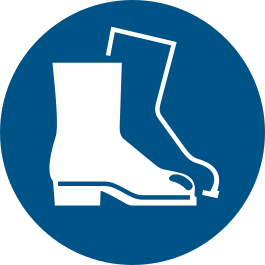
Wear a face shield
Instructs the reader to wear a face shield.

Understanding this sign
Blue circular signs communicate an action, such as wearing eye protection or following a specified procedure.
A pictogram does not select the grade of PPE or explain a complete procedure. Use the task-specific instructions.
Full-Face Coverage, Not Just Eyes
M013 requires a face shield: a visor covering the whole face from forehead to below the chin, mounted on a headgear or helmet bracket. The sign answers a specific gap left by ordinary eyewear. Spectacles and goggles guard the eyes, but a splash of caustic, a burst of coolant, or a shattered abrasive wheel strikes cheeks, mouth, and throat just as readily. Wherever the hazard threatens the face as a whole rather than the eye alone, M013 is the correct instruction — often displayed alongside, not instead of, an eye protection sign.
The classic triggers are energetic and liquid hazards at close range: bench and angle grinding, wire brushing, chipping and scaling, machining with flying swarf, pouring or decanting corrosives, pressure washing, and working on energised battery banks where electrolyte spray is possible. Food and medical settings add biological splash — bone saws, necropsy, and dishwashing chemical dosing stations all appear on real M013 placements.
Secondary Protection Over Primary Eyewear
A point that surprises many wearers: in North American practice under ANSI/ISEA Z87.1, a face shield is treated as secondary protection, worn over safety spectacles or goggles rather than replacing them. The visor intercepts the bulk of a splash or fragment stream, but debris can ricochet up under the window or the visor can be lifted at the wrong moment, so primary eyewear stays on underneath. OSHA interpretation letters have repeatedly reinforced this layering for grinding and chemical handling.
For signage this means an M013 zone is usually also an eyewear zone, and the posting should reflect it — either M013 and M004 side by side or a combined PPE panel stating 'face shield over safety goggles'. European selection logic under EN 166 reaches a similar outcome by marking face shields for specific fields of use, with goggles specified underneath whenever the shield alone does not seal against the relevant hazard.
M013 Compared With M019 and M004
Do not use M013 to mark welding bays. A clear polycarbonate visor transmits the ultraviolet and infrared radiation of an arc essentially unimpeded; arc work needs a filtered welding mask, which has its own sign, M019. The reverse substitution also fails — a welding helmet's dark filter makes it useless for tasks that need normal vision, so grinding stations inside a fabrication shop should carry M013 even when M019 governs the bay next door.
Against M004, the decision rests on splash geometry and fragment energy. If the credible event is a droplet or particle travelling toward the eyes, rated spectacles or goggles suffice and M004 is honest signage. If the event can wet or strike the whole face — an open pour above waist height, a disintegrating wheel, a hose failure — escalate the posted requirement to M013. Sites that default everything to face shields invite non-compliance in summer heat; matching the sign to the actual exposure keeps the rule credible.
Where you will see M013
Bench and angle grinding stations, wire brushing and chipping work, machining with flying swarf, corrosive pouring and decanting points, pressure washing, and battery bank maintenance are classic placements. Food and medical settings post it at bone saws, necropsy tables, and chemical dosing stations for dishwashers, frequently alongside M004 so the goggles-underneath layering is explicit.
Common questions about M013
Can I wear a face shield instead of safety glasses?
Generally no. Under ANSI Z87.1-based practice, face shields are secondary protection: they supplement spectacles or goggles worn underneath, because particles and splash can reach the eyes around or under the visor. An M013 sign therefore usually implies rated eyewear as well, and many sites post the two requirements together.
When is a face shield required at work?
Whenever the hazard assessment finds the whole face exposed — typical examples are grinding and wire brushing, chipping, decanting acids or caustics, pressure washing, molten material handling at low energy, and biological splash tasks. In the US the legal hook is 29 CFR 1910.133, which covers face as well as eye protection; the M013 sign marks the areas or machines where that finding applies.
Is a face shield enough for welding?
No. Clear visors do not filter the intense ultraviolet and infrared radiation of an arc, so welding requires a mask with an appropriate shade filter — the requirement carried by the separate sign M019. A clear M013-style shield is appropriate for the adjacent grinding and finishing work, not for striking an arc.
Do face shields protect against chemical splash?
They protect the face, but not reliably the eyes on their own, since liquid can run or splash behind the window. For corrosive liquids the accepted combination is sealed chemical goggles under the shield. Check the visor's own rating too: shields are marked for the hazards they cover, and a basic impact visor is not automatically suitable for chemicals.
Reference details
| Symbol code | M013 |
|---|---|
| Sign family | ISO Mandatory Signs |
| Standard reference | ISO 7010:2019 / ISO 3864-1 ISO Online Browsing Platform: M013 |
| Screen color reference | #0000FF. Screen colors are not a production color specification. |
| Download formats | SVG reference artwork; a 1024 × 1024 pixel PNG conversion on a white canvas. |
| Record date | · How to interpret our dates |
| Page updated |
Choosing a physical sign size
Download dimensions are not installation dimensions. Select sign size, material, placement, and lighting using the applicable standard and the actual viewing conditions. Chemical label sizing follows its own rules. Read the artwork and sizing guide.
Sources and artwork credits
- Artwork source
- Wikimedia Commons file page
- Creator credited by source
- ISO
- License
- Public domain
- Source metadata checked
SVG files are local reference copies. PNG files are raster conversions. Check the linked file history and license terms before reuse; a source-metadata check is not certification of the artwork or a workplace installation.
Report a correction to this reference