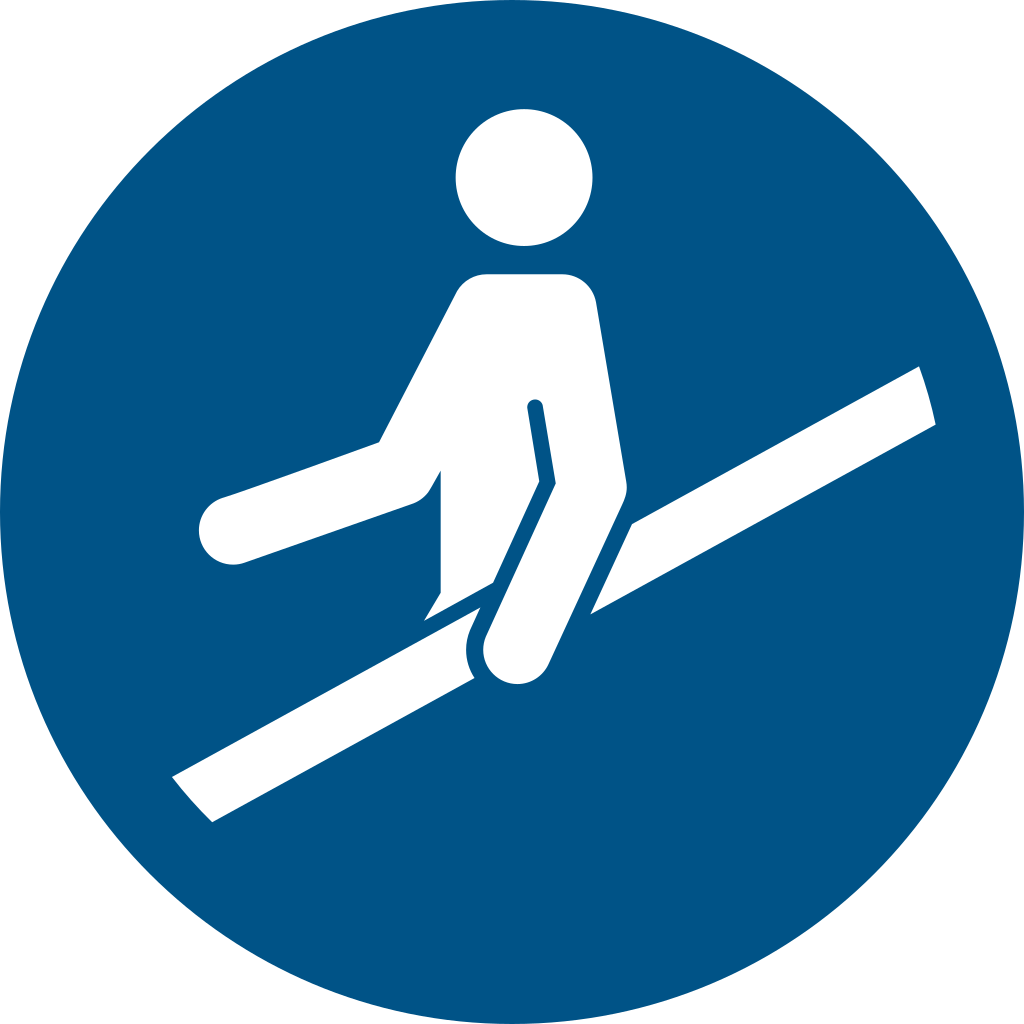
Use handrail
Instructs the reader to use the handrail.
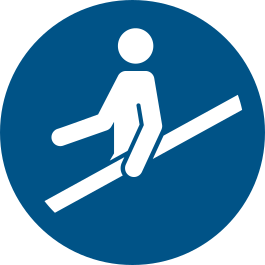
Understanding this sign
Blue circular signs communicate an action, such as wearing eye protection or following a specified procedure.
A pictogram does not select the grade of PPE or explain a complete procedure. Use the task-specific instructions.
What ISO 7010 M012 Means
M012 shows a figure gripping a rail on the blue mandatory disc and requires exactly that: the handrail must be used. It converts a piece of passive infrastructure into an active behavior. Stairs, gangways, and ramps are usually built with compliant rails, yet people descend them with both hands full, eyes on a phone, or moving at a pace that leaves no chance of recovery from a missed step. The sign exists because providing the rail and getting hands onto it are two different problems.
Falls on stairs are among the most common causes of serious workplace and public-space injuries, and the mechanics are unforgiving: a slip on a descent turns into an uncontrolled fall within a step or two unless something arrests it. A gripped handrail is that arrest. M012 makes the grip a site rule rather than a personal preference.
Where the Sign Is Used
M012 is a fixture of environments where stairs meet adverse conditions: ships and offshore installations, where the entire staircase moves and one hand for the vessel is long-standing culture; food plants and breweries with wet, washed-down stair towers; plant rooms and mezzanine access stairs used while carrying items; and external steel stairs exposed to rain and ice. Transit systems and large offices post it on busy escalators and staircases where crowd pace magnifies any stumble.
Placement follows the behavior: at the top and bottom of each flight, at eye height where a person commits to the stairs, not midway where the choice has already been made. Sites often reinforce it with rules the sign implies but cannot state — keep one hand free, use bags or hoists rather than carrying loads two-handed on stairs — because a person with full hands physically cannot comply.
Regulation and Practical Effect
The legal duty behind M012 usually attaches to the structure rather than the user: workplace rules such as OSHA's walking-working surfaces provisions in the United States, and building codes generally, require stairways to be equipped with stair rails and handrails of specified height and graspability. Mandating use is then an employer or site-operator policy, expressed through the ISO 7010 sign, that turns the engineered provision into protection that actually functions.
Behavioral safety programs treat handrail use as a leading indicator precisely because it is visible and habitual — a workforce that grips rails without prompting tends to follow other routine controls too. That is also M012's limitation: it works through habit formation, so a single sign has less effect than consistent posting across every staircase paired with visible reinforcement from supervision.
Where you will see M012
Ships and offshore installations post it throughout, where the whole staircase moves and one hand for the vessel is established culture, as do food plants and breweries with wet washed-down stair towers, plant rooms and mezzanine access stairs, and external steel stairs exposed to rain and ice. Transit systems and large offices add it on busy escalators and staircases, mounting the sign at eye height at the top and bottom of each flight where a person commits to the stairs.
Common questions about M012
Is holding the handrail a legal requirement or just a site rule?
Regulations typically require handrails to be provided on stairways — for example under OSHA's walking-working surfaces rules and building codes — but the obligation to actually hold the rail is usually imposed by the employer or site operator as a policy. M012 is how that policy is communicated in the standardized ISO 7010 format, and on many industrial and offshore sites it is enforced like any other safety rule.
Why do ships and offshore platforms insist on handrail use?
Because the stairs themselves move. Vessel motion, wet steel, and steep ladder-like stairways combine so that a hand on the rail is often the only thing preventing a fall during a roll or lurch. The maritime habit of keeping one hand for the vessel predates the sign; M012 standardizes it visually.
Where should use-handrail signs be positioned on a staircase?
At the decision points: the top and bottom landings of each flight, at eye height, so the instruction registers before the first step is taken. On long stair towers, repeating the sign at intermediate landings maintains the prompt. A sign visible only mid-flight arrives after the person has already committed hands and attention elsewhere.
What if someone cannot hold the rail because they are carrying something?
That is the situation the sign is meant to expose. Sites posting M012 typically pair it with a rule against two-handed carrying on stairs, providing lifts, hoists, bags, or a second person instead. If a task routinely forces people onto stairs with full hands, the fix is the task, not an exception to the rail rule.
Reference details
| Symbol code | M012 |
|---|---|
| Sign family | ISO Mandatory Signs |
| Standard reference | ISO 7010:2019 / ISO 3864-1 ISO Online Browsing Platform: M012 |
| Screen color reference | #0000FF. Screen colors are not a production color specification. |
| Download formats | SVG reference artwork; a 1024 × 1024 pixel PNG conversion on a white canvas. |
| Record date | · How to interpret our dates |
| Page updated |
Choosing a physical sign size
Download dimensions are not installation dimensions. Select sign size, material, placement, and lighting using the applicable standard and the actual viewing conditions. Chemical label sizing follows its own rules. Read the artwork and sizing guide.
Sources and artwork credits
- Artwork source
- Wikimedia Commons file page
- Creator credited by source
- ISO
- License
- Public domain
- Source metadata checked
SVG files are local reference copies. PNG files are raster conversions. Check the linked file history and license terms before reuse; a source-metadata check is not certification of the artwork or a workplace installation.
Report a correction to this reference