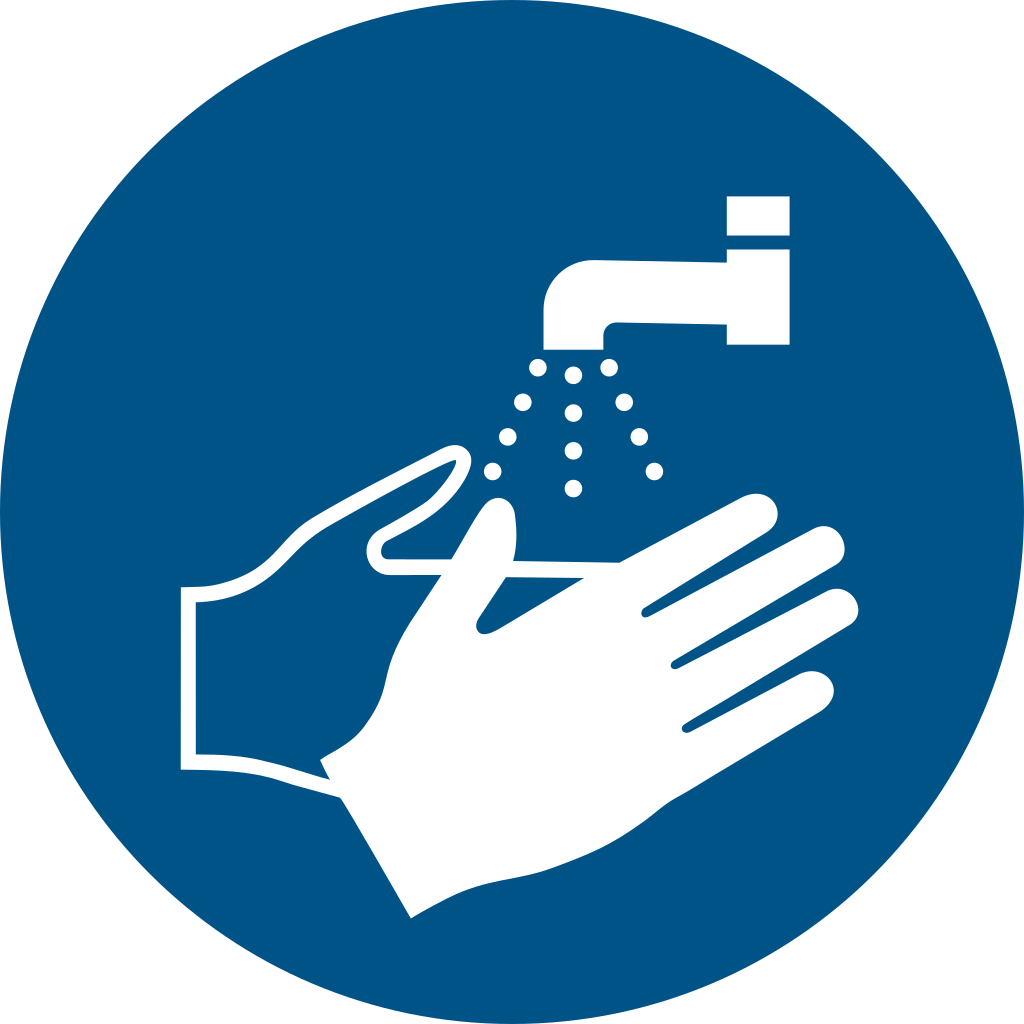
Wash your hands
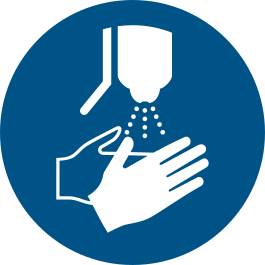
Instructs the reader to wash their hands.
Understanding this sign
Blue circular signs communicate an action, such as wearing eye protection or following a specified procedure.
A pictogram does not select the grade of PPE or explain a complete procedure. Use the task-specific instructions.
The Instruction Behind the Sign
M011 is the ISO 7010 mandatory sign for hand washing: a blue disc showing white hands under running water. As a mandatory sign it does not suggest hygiene — it requires it, making hand washing a condition of being in or passing through the signed location. The pictogram specifically depicts washing with water, which is the full decontamination step, as distinct from alcohol-based hand rubbing.
That specificity matters in practice. Washing with soap and water removes soil, grease, and organisms mechanically and is the required response after using the toilet, after handling raw food or chemicals, and whenever hands are visibly dirty. Alcohol rubs are faster and often preferred in clinical routine but do not clean soiled hands and are ineffective against some pathogens, notably Clostridioides difficile spores and norovirus. Sites that mandate sanitizing rather than washing should sign that requirement distinctly instead of stretching M011 to cover it.
Food Businesses: Where the Sign Is Effectively Compulsory
Food production and food service are the strongest legal context for M011. The U.S. FDA Food Code requires a sign or poster notifying food employees to wash their hands at every handwashing sink they use, which is why the sign is universal in commercial kitchens; state retail food regulations adopt this through their Food Code versions. In the EU, Regulation 852/2004 on the hygiene of foodstuffs requires adequate washbasins and hygienic practice, and hand-wash signage at entry points to production areas is the standard audited control.
Effective placement in a food plant follows the hygiene barrier concept: post M011 at the entrance to high-care and production zones so washing happens before entry, at the sinks themselves, at exits from toilets and changing rooms, and at transitions from raw to ready-to-eat areas. Third-party certification schemes such as BRCGS and SQF audit hand-washing behavior directly, and signage at each mandated wash point is part of demonstrating the procedure exists.
Healthcare Use and the WHO Five Moments
Hospitals frame hand hygiene through the WHO's Five Moments: before touching a patient, before a clean or aseptic procedure, after body fluid exposure risk, after touching a patient, and after touching the patient's surroundings. Most of those moments happen at the bedside, where alcohol rub at the point of care is the recommended default — so healthcare hand-hygiene programs lean on Five Moments posters and dispenser placement more than on M011 alone.
M011 still earns fixed positions in clinical buildings: at ward and unit entrances, outside isolation rooms where contact precautions apply, in sluice and dirty utility rooms, in kitchens and staff toilets, and at scrub sinks. Since healthcare-associated infections are transmitted substantially via staff hands, the sign functions as a visible institutional commitment as well as an instruction — but the evidence on compliance says signage works only as one layer over accessible sinks, available product, and active monitoring.
Neighboring Signs and Common Substitution Errors
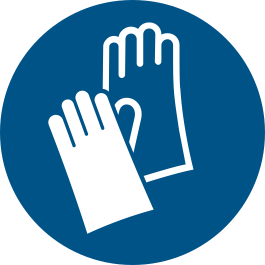
M011 belongs to a cluster of hygiene and hand-related signs that are frequently swapped in error. M009 mandates protective gloves — an instruction that complements rather than replaces washing, since hands must typically be washed after glove removal. Facilities that require alcohol disinfection rather than washing should use a rub-specific sign or explicit text, because showing running water where there is no sink invites the sign to be ignored.
The sign also has a warning-side counterpart in chemical settings: where the concern is contamination carried off-site — lead work, pesticide handling, laboratories — M011 at the exit route enforces decontamination before eating, drinking, or leaving, often paired with prohibition signs banning food and drink in the work area. In washrooms themselves, the sign is most effective directly above the basin at eye level, at the moment and place the decision is made.
Where you will see M011
Commercial kitchens and food plants post it at every handwashing sink under the FDA Food Code and EU hygiene rules, at entrances to high-care production zones, and at transitions from raw to ready-to-eat areas. Hospitals fix it at ward entrances, outside isolation rooms, in sluice rooms, and at scrub sinks, while lead, pesticide, and laboratory workplaces use it on exit routes to enforce decontamination before eating or leaving.
Common questions about M011
Is a wash-your-hands sign legally required in restaurants?
In the United States, effectively yes: the FDA Food Code, adopted in some version by states and localities, requires signage at handwashing sinks reminding food employees to wash their hands, and health inspectors routinely check for it. Elsewhere, food hygiene laws such as EU Regulation 852/2004 require hygienic practice and adequate facilities, and hand-wash signage is the accepted way of evidencing the procedure even where the sign itself is not named.
Does the M011 sign cover hand sanitizer use?
Strictly, no. The pictogram depicts washing with water, and washing and sanitizing are different operations: alcohol rubs do not clean visibly soiled hands and do not kill certain pathogens such as C. difficile spores or norovirus. If your control is sanitizing at a dispenser rather than washing at a sink, sign it with rub-specific signage or clear text rather than M011.
What are the WHO Five Moments for hand hygiene?
The five points in patient care when hand hygiene is required: before touching a patient, before a clean or aseptic procedure, after exposure risk to body fluids, after touching a patient, and after touching the patient's surroundings. They define when clinical staff decontaminate hands; M011 signage supports the program at fixed locations such as ward entrances and sluice rooms, while point-of-care moments usually rely on alcohol rub.
Where should hand washing signs be posted in a food factory?
At every point where washing is a condition of proceeding: entrances to production and high-care zones, all designated hand-wash stations, exits from toilets and changing areas, and crossings from raw to ready-to-eat sides. Mount the sign at the sink at eye level and at the zone entry before the barrier, so the instruction is seen where the behavior must happen — audit schemes like BRCGS check both the stations and their use.
Reference details
| Symbol code | M011 |
|---|---|
| Sign family | ISO Mandatory Signs |
| Standard reference | ISO 7010:2019 / ISO 3864-1 ISO Online Browsing Platform: M011 |
| Screen color reference | #0000FF. Screen colors are not a production color specification. |
| Download formats | SVG reference artwork; a 1024 × 1024 pixel PNG conversion on a white canvas. |
| Record date | · How to interpret our dates |
| Page updated |
Choosing a physical sign size
Download dimensions are not installation dimensions. Select sign size, material, placement, and lighting using the applicable standard and the actual viewing conditions. Chemical label sizing follows its own rules. Read the artwork and sizing guide.
Sources and artwork credits
- Artwork source
- Wikimedia Commons file page
- Creator credited by source
- ISO
- License
- Public domain
- Source metadata checked
SVG files are local reference copies. PNG files are raster conversions. Check the linked file history and license terms before reuse; a source-metadata check is not certification of the artwork or a workplace installation.
Report a correction to this reference